
Sienna Parulis-Cook: Director of Marketing & Communications, Dragon Trail International
For some destinations, the Chinese tourism market still seems very niche to them, even though it’s one of the largest international tourism markets in the world. They may have a lot of preconceptions about Chinese travellers that are either outdated or unrealistic – but really this is a market that’s already quite mature and also very diverse.
◦ 12 min readEarly Influences
Growing up, were you always curious about the wider world, or did that passion develop later?
My father is American and my mother is British, and they met in Algeria and lived in Kuwait and Mexico before I was born, in addition to traveling extensively in Asia, so I was always exposed to different cultures. My parents were ESL teachers, and we would regularly have students from all over the world come to our home, so this was another influence. Growing up, I felt it was expected that I would also travel and live in other countries, and learn to speak other languages.
Was there a particular journey, book or person that inspired your lifelong interest in China?
Yes! I saw the Zhang Yimou film To Live when I was 12, and this changed everything. It’s the story of one Chinese family from the 1940s through the 1970s, and it made a profound impression on me. Afterwards I couldn’t stop reading about modern Chinese history, and I decided to start studying Mandarin. That was 30 years ago, and I have never tired of learning about China since then.
A Career Across Cultures
You began your career in publishing before moving into destination marketing. How did those experiences shape the communicator you’ve become?
The publishing to marketing career trajectory is a pretty common one since there is so much overlap, including writing, editorial planning, and interviewing. I also enjoy working with the media now from the other side, and understand how being reliable and responding as fast as possible is really the key to a good media relationship.
Living and working in Beijing gave you a unique perspective. What lessons from that time still influence your work today?
My work for City Weekend, a lifestyle magazine in Beijing, meant that I got to know the world of international hotels and hospitality brands well, especially as many hotel brands were rapidly opening properties in Beijing and nearby Tianjin during my years in China. I have a very deep appreciation for the immense behind-the-scenes work that goes on at these hotels, and for all the considerations that go into maintaining a global brand while also adapting it to the local market.
I’m really lucky to still use Mandarin regularly for work these days although I live outside of China, and at least to some extent keep up those skills from my time in Beijing. This is kind of trivial, but I really enjoy when I have the opportunity to work with our designers on things like ads and company brochures, and I get use vocabulary like “font”, “bold”, and “vertical” in Chinese.
What attracted you to Dragon Trail International, and what continues to inspire you there?
After I left Beijing in 2014, I worked for a cardmaking magazine for a few years, which had almost nothing to do with China. A contact I had worked with previously on China consulting asked me to start writing weekly blog content for Dragon Trail in 2017, and it felt so exciting and so right to be doing something China-related again. So I was very lucky when the company decided to take me on full-time to do marketing and communications work for them later that year. I feel extraordinarily fortunate to have a job where I continue to learn about China, use Mandarin, and write professionally every day – it’s the perfect combination.
Looking back, what has been the biggest challenge in helping destinations understand Chinese travellers?
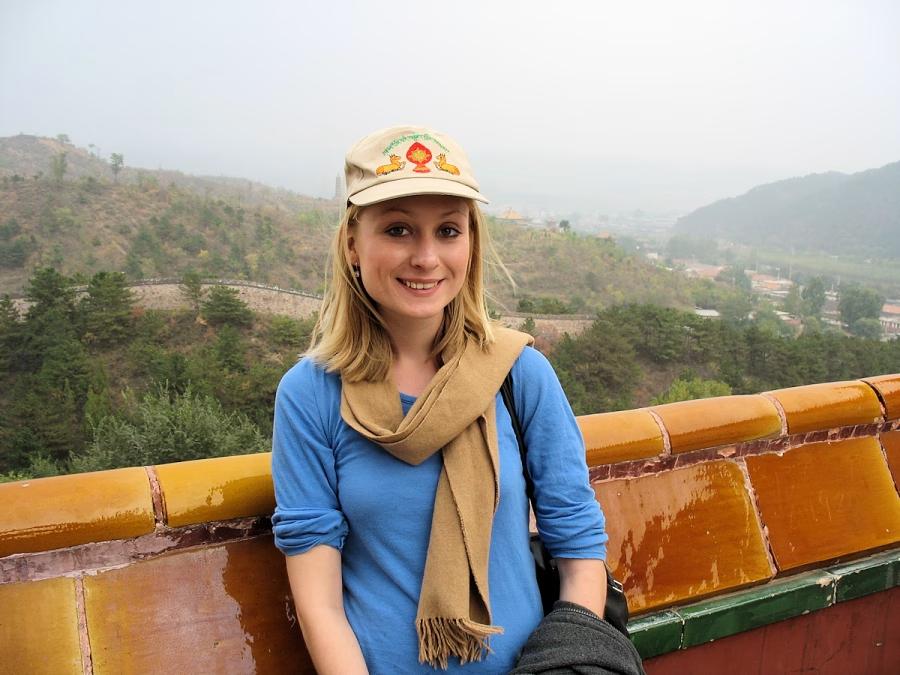
For some destinations, the Chinese tourism market still seems very niche to them, even though it’s one of the largest international tourism markets in the world. They may have a lot of preconceptions about Chinese travellers that are either outdated or unrealistic – but really this is a market that’s already quite mature and also very diverse.
Understanding Today’s Traveller
Chinese outbound tourism continues to evolve. What are the biggest changes you’ve witnessed over the past decade?
One major change that perhaps we still don’t talk about enough is that many Chinese travellers – especially younger generations – are now seeking much more relaxing trips than they used to. Beach holidays are growing in popularity, and families are looking for destinations where they can enjoy spending time together. In the past, Chinese travellers were known for jam-packed, dawn-to-dusk itineraries trying to see as much as they could and cover as much ground as possible during their limited travel time. Some older travellers still have the feeling that they’re not getting their money’s worth from a trip if the pace is slower and less organized, but I think in general Chinese travellers are preferring now to slow down and opt for trips that don’t leave them so exhausted.
This also relates to the shift away from traditional group tours, which were notorious for unrelenting sightseeing. Tour sizes are nearly all much smaller now, capped at around 11-20, and may have more free time and experiences rather than just sightseeing.
The rise of RedNote (Xiaohongshu) as a social media platform for travel sharing and research has also been a very pronounced change in the past six years or so. I think this gives Chinese travellers more independence, confidence, and flexibility, to have reliable, crowd-sourced information and travel advice so readily available.
What do you think many destinations still misunderstand about welcoming Chinese visitors?
This isn’t specific to destinations – maybe more for anyone working in the tourism and hospitality industry – but I think sometimes people can feel intimidated or awkward about Chinese travellers being very culturally different, or having a language barrier, and then this can lead to what gets perceived as cold or unfriendly service. Even if there is a language barrier, non-verbal communication and a generally welcoming attitude can leave a very good impression on travellers about a destination – and word-of-mouth is sometimes the best marketing!
Luxury travel today is about far more than five-star hotels. How are traveller expectations changing?
China’s HNWIs are a very mature, experienced international travel market with high expectations around privacy, exclusivity, and unique, bespoke experiences. They’re seeking new destinations and experiences, as well as ultra-personalized itineraries.
How important is authenticity when designing experiences for international visitors?
Authenticity is a growing priority for Chinese travellers, and I think there’s a real hunger to experience different cultures and lifestyles, sample local cuisines, and interact with local people.
The Future of Tourism
Artificial intelligence is transforming marketing. How do you see technology enhancing – not replacing, human storytelling?
I think we need to be very careful about using AI for things like marketing and storytelling. Travelers – and this is definitely true of Chinese travellers – are really seeking authenticity right now, and marketing that feels overly photoshopped or posed is already being rejected. Marketing that feels like AI risks putting people off even further. I do think that AI can be an exceptional tool at helping people to access the travel information they need in a smooth and natural way – for example, a travel agent putting together a personalized itinerary or a traveller looking to book a hotel that meets their specific needs. By ensuring that AI is given lots of accurate, detailed information – and setting up booking systems to be easily used by AI – then travellers can more easily have the experiences that allow them to connect to other humans and inspire their own travel storytelling.
Sustainability has become a global priority. How are Chinese travellers engaging with responsible tourism?
Interestingly, Chinese travellers tend to have a different take on what responsible tourism means, placing more emphasis on the impact of tourism on local communities and how to be culturally respectful, rather than on local or global eco-systems. There’s still a lot of work that can be done to show Chinese travellers how eco-friendly measures can add value to the travel experience, and that they are not just a way to cut costs.
What role should tourism play in building greater understanding between cultures?
I think its potential for building cultural understanding and respect is one of the most important things about tourism, and why I believe what we do is important and beneficial to the world. Experiencing a place in real life and interacting with people there will always reshape your image and challenge your assumptions about that place. Even if the impression the tourist comes away with isn’t exactly “real life” in the destination, the experience will still give a human face to the destination and hopefully leave the traveller a greater and more nuanced understanding of the place.
Looking Forward
If you could change one thing about how destinations market themselves internationally, what would it be?
I think some destinations already do this well, but tourism boards need to ensure they are supporting local businesses and partners – not just putting content out there for would-be visitors or travel agents. Many businesses like attractions, hotels, retailers etc. – or smaller destinations within a country – can find it difficult to find information or know what they should do to improve their own marketing or services. A tourism board is really well placed to be commissioning research, conducting training, and setting up initiatives to help businesses adapt themselves better to receiving tourists – Chinese or otherwise – and I’d like to see more of this. Two years ago, Turespaña commissioned really extensive research and reporting on the Chinese inbound market to Spain, and ran a two-day workshop in Madrid for local suppliers, which was geared towards what a SME could and should realistically be doing. I think this was a great initiative – one of many from the Spanish tourism board – and other destinations should follow their example.
What advice would you give tourism businesses hoping to build stronger connections with Chinese travellers?
There’s a lot that tourism businesses can do to make things easier, more welcoming, and more accessible for Chinese travellers. For example, booking systems that accept or are integrated into Chinese payment and communication systems – Alipay and WeChat Pay are preferred over MasterCard; WeChat is preferred over email. Some booking systems and loyalty programs don’t accept names written in Chinese characters, or even reject common Chinese names written in their Romanised form for being too short, if they are only two letters. Beyond this, providing information in Chinese communicates a welcoming message, even if the traveller might be proficient in English or another foreign language.
Chinese travellers are also drawn to finding connections between foreign places and cultures and China. A great example of this is the popularity of King’s College at Cambridge University with Chinese visitors – the college is famous in China for its connection to the 20th century Chinese poet Xu Zhimo, and the college even opened a Xu Zhimo Memorial Garden in 2018. Destinations can do more to uncover their own histories and how this relates to China – it could be a famous Chinese person, or just the story of regular Chinese people, like the Titanic Belfast’s 2025 exhibition on the eight Chinese passengers on board the Titanic. Finding cultural connections and points of cultural overlap – tea culture, for instance – is also something that can make a destination resonate more with a Chinese audience.
What legacy would you like your work to leave within the global travel industry?
The primary goal of my work is to publicize the work and expertise of Dragon Trail International, to communicate the work we do and why it’s important for tourism brands in helping them connect to the Chinese market. So I’m very happy to have played a role in boosting the company’s reputation and name recognition. Beyond that, the most exciting work I’ve done at Dragon Trail is developing our research publications, starting with Chinese traveller sentiment reports from 2020, then travel trade surveys from 2023, and additional white papers on key destinations and market segments. I think these provide really interesting insights onto the Chinese tourism market that were not available before, and are hopefully guiding people’s understanding of this market, its demands, and where it’s going.
Finally, when people think of Sienna Parulis-Cook many years from now, what do you hope they’ll remember?
A reliable colleague and source of information.
Quickfire
Beijing hutong or Shanghai skyline?
Beijing hutong.
High-speed rail or overnight sleeper train?
I’m very glad to have had the experience of overnight sleeper trains in China as well as Russia, but these days I would prefer to take advantage of a high-speed rail connection.
One destination that’s ready to surprise the world?
There are still a lot of underrated destinations in the world. One of them is Bristol, England, where I live! It’s a beautiful and colourful city, with lots of history, places to walk, a great food scene, and a nice local culture.
Favourite regional Chinese dish?
Most Yunnan food – black bean jelly, regional mushrooms, many kinds of tofu. Jellyfish salad is also a fantastic Chinese dish that should be more popular.
Sunrise over the Great Wall or sunset on the Bund?
Sunset on the Bund.
Which country has challenged your assumptions the most?
Recently, the UAE. I first went to Dubai to attend Arabian Travel Market in 2023, and I liked the city much more than I thought I would because it’s the most international place I’ve ever been, and I loved the feeling of being at the world’s crossroads.
One travel item you never leave home without?
British Airways business class sleep masks. I buy big packs of them on eBay because I can’t sleep without them.
If you could share a meal with any historical explorer or travel writer, who would it be?
Somerset Maugham.
What’s the greatest lesson travel has taught you?
Challenges and risks are usually very rewarding and good for personal growth. But don’t feel embarrassed about insisting on getting to the airport really early – this isn’t where you want to take any risks!
Complete this sentence:
“The future of travel depends on…”
Government policy.