Charles ‘Dr. Charlie’ Powell, MD: From Combat Medicine to a New Vision of Family Hospitality
With Saint Charlie, I started with the experience of a family like mine trying to take a vacation. Once you understand what keeps that family from participating, you begin making different decisions about staffing, meals, communication, and activities. That's where thinking outside the box has to become practical.
◦ 22 min readEarly Life, Service & Medicine
Before medicine, military service or entrepreneurship, what kind of person were you growing up, and what values shaped you most?
I’ve always enjoyed solving problems and thinking outside the box. That started with a humble upbringing. You had to get creative to find affordable solutions to everyday life, including play. If you wanted to do something, you figured out how to make it work with what you had.
I can trace that same instinct through high school projects, research, military strategy, educational tools, medical device development, unconventional business models, and eventually a healthcare system. I tend to question a limitation, especially when the explanation is that we’ve always done it that way.
Responsibility, keeping my word, and being useful to people matter to me. So does family. I care about what happens to the people who depend on us. Those values and that desire to solve problems explain who I am more than any of the multitude of titles I’ve held or degrees I’ve earned.
You originally began as an engineering student. What made you realise that you wanted to solve human problems rather than technical ones?
I enjoyed engineering because I liked figuring out how things worked and how to make them work better. Then I looked at what I considered the ultimate machine: the amazingly complex human body. Solving a problem inside that seemed like quite a challenge.
Add the human characteristics of behavior and communication to that machine, and BINGO! Now you’ve got my attention. There is so much going on, and the person in front of you needs an answer that will actually help them.
I still think that way. I want to understand how the pieces fit together and where something is breaking down. Medicine gave me a very personal reason to work on those problems. That carries right into Saint Charlie. You start by understanding the person, then figure out what needs to work around them.
Your military career became a defining part of your life. What first drew you to serve, and what did those years teach you about responsibility, leadership and vulnerability?
My parents couldn’t afford to put me through school, so I enlisted, as my father had. I wanted to continue becoming a man through learning teamwork, structure, discipline, leadership, and, most importantly, culture.
That culture is powerful enough to get people to work for less pay in many cases and accept tremendous risks, including the loss of life. Culture, purpose, and doing it for the team were forms of currency the military had beyond a paycheck. That has stayed with me. People will give a great deal when they believe in the purpose and in the people beside them.
I spent about sixteen years in the Army and Navy, starting as a combat medic and later serving as a physician. You learn pretty quickly that your preparation and decisions affect other people. Sometimes those people have no say in the decision at all.
Great leaders listen and lead from the front. You listen to the people closest to the situation, and you speak up when you believe they’re being put at risk. Vulnerability took me longer to understand. Being trained to carry responsibility didn’t make me immune to what I experienced. I understand that much better now.
You served in demanding environments and later spoke openly about your own PTSD. At what point did you realise that the effects of service had followed you home?
I left military service in 2005 after about sixteen years, with two wars bookending my career. I enjoyed the intense emergency work and trauma care. I took most of what I’d experienced as if it were nothing. It was part of the job. You did what needed to be done and kept moving.
Then, in 2007, my life started to change. Things I’d treated as part of the job had followed me home. I compartmentalized and kept working. What people saw from the outside was very different from what I was dealing with privately. Poor sleep and night terrors became part of life.
In 2023, a situation in corporate healthcare brought back that same feeling of responsibility and helplessness I’d experienced in the military. That was a major turning point. Pushing through wasn’t working anymore. I’ve had meaningful improvement since then, and I still have limitations. I have to be honest about both.
You have described living with night terrors, sleep paralysis and emotional numbness. How difficult was it, as a physician, to acknowledge that your own mental health needed help?
It was hard. I was used to being the doctor, the person other people depended on. I could recognize and explain symptoms professionally while struggling to acknowledge just how much they were affecting my own life.
For years, I compensated, kept going, and tried treatments. Eventually I had to accept that I needed help and that my limits were real. Knowing the medicine doesn’t somehow put you outside the human experience. You’re in it, too.
I can have ideas, love my family, and care deeply about a purpose while still dealing with symptoms. I don’t want to tell a story that makes people think finding a purpose means everything else disappears. Accepting support is part of my life now.
Did experiencing PTSD from the inside change the way you understood patients, illness and the limits of conventional medicine?
Absolutely. You can sit across from someone who sounds articulate and looks like they’re doing fine and have very little idea what it takes for them to get through the day. I’ve lived that. It makes you listen differently.
I certainly believe doctors trained in Western medicine should keep an open mind and an open heart toward treatments we were never made aware of. Learn about them. Examine them seriously. Don’t write something off as unworthy simply because you don’t understand it. One of those treatments saved my life.
I still value medicine deeply. I also know our training doesn’t contain every answer. My own experience made me pay more attention to what improvement actually means in someone’s life: sleep, relationships, handling stress, and the support it takes to function. The patient can tell you things that a brief office visit won’t show you.
Medicine, Systems & Reinvention
What did medicine give you that military service had not – and what did military service give you that medicine never could?
They overlap quite a bit for me because I practiced medicine in uniform. The military taught me how much depends on preparation and the team. Your part has to work with everyone else’s, especially when things get difficult. It also taught me the power of a shared culture and purpose.
Family medicine let me follow a person’s life over time. You get to understand the family, the daily routine, and what that person can realistically do once they leave your office. You see why a plan that sounds perfectly reasonable to the doctor may be difficult for the patient to follow.
Both experiences shaped how I think about systems. People need to understand what they’re responsible for, but you also have to listen and adjust. A plan has to work for the people who are actually living with it.
You eventually moved beyond individual patient care and into building healthcare systems. What frustrations were you trying to solve at that point in your career?
I was developing and deploying systems in my own practice that helped us give patients better care. We could catch needed screenings and testing that might otherwise be missed, and use technology to help us make more accurate diagnoses. Once I saw what that could do, I wanted other patients to have the same benefit.
That’s why moving into leadership made sense to me. I felt I could serve more people by getting those systems into the hands of other providers and into other locations. In the end, our healthcare system saw 40% fewer hospital admissions and 36% fewer ER visits. Our community’s health improved, too.
That experience stays with me at Saint Charlie. You can have a wonderful employee who helps a family, but that family still has to get through the rest of the day. The room, meals, activities, and support all need to work together. I want the good experience to be something we’ve prepared the whole team to deliver.
Has repeatedly moving between very different worlds – military, medicine, corporate healthcare and entrepreneurship, made you more willing to challenge accepted models?
Absolutely. When you’ve worked in several different worlds, you start noticing how many things people accept simply because they’re familiar. I want to understand why we’re doing something that way and whether it’s solving the problem.
Sometimes you can improve the process. Sometimes the business model itself needs to change. I’ve worked on both. I enjoy looking at a need from a different angle, but eventually the idea must be useful to somebody.
With Saint Charlie, I started with the experience of a family like mine trying to take a vacation. Once you understand what keeps that family from participating, you begin making different decisions about staffing, meals, communication, and activities. That’s where thinking outside the box has to become practical.
The Genesis of Saint Charlie
Saint Charlie Resorts is clearly far more personal than a conventional hospitality venture. Can you take us back to the moment the idea first began to form?
Traveling with a special-needs son was always a challenge. Parents and siblings helped cover all the extra steps, the things you had to bring, and the behaviors most families didn’t have to manage. Everybody had a role in making the trip possible.
We could leave Charlie behind and miss him every day, or bring him and split up as a family. In our experience, about 90% of the activities weren’t designed with him in mind. Somebody would go do the activity, and somebody would stay with Charlie.
And you’re always at DEFCON 2, making sure an outburst or behavior doesn’t interrupt somebody else’s vacation. You’re on vacation, but you’re still on duty.
I wanted us to be able to enjoy a trip together. Charlie included. His siblings enjoying themselves. Parents getting a chance to breathe. That was the need. Then my problem-solving brain started working on what it would take: the people, the preparation, and a resort experience designed to make that possible.
Your son Charlie sits at the heart of the project. What did your family’s own experience teach you about the difference between being technically accommodated and genuinely welcomed?
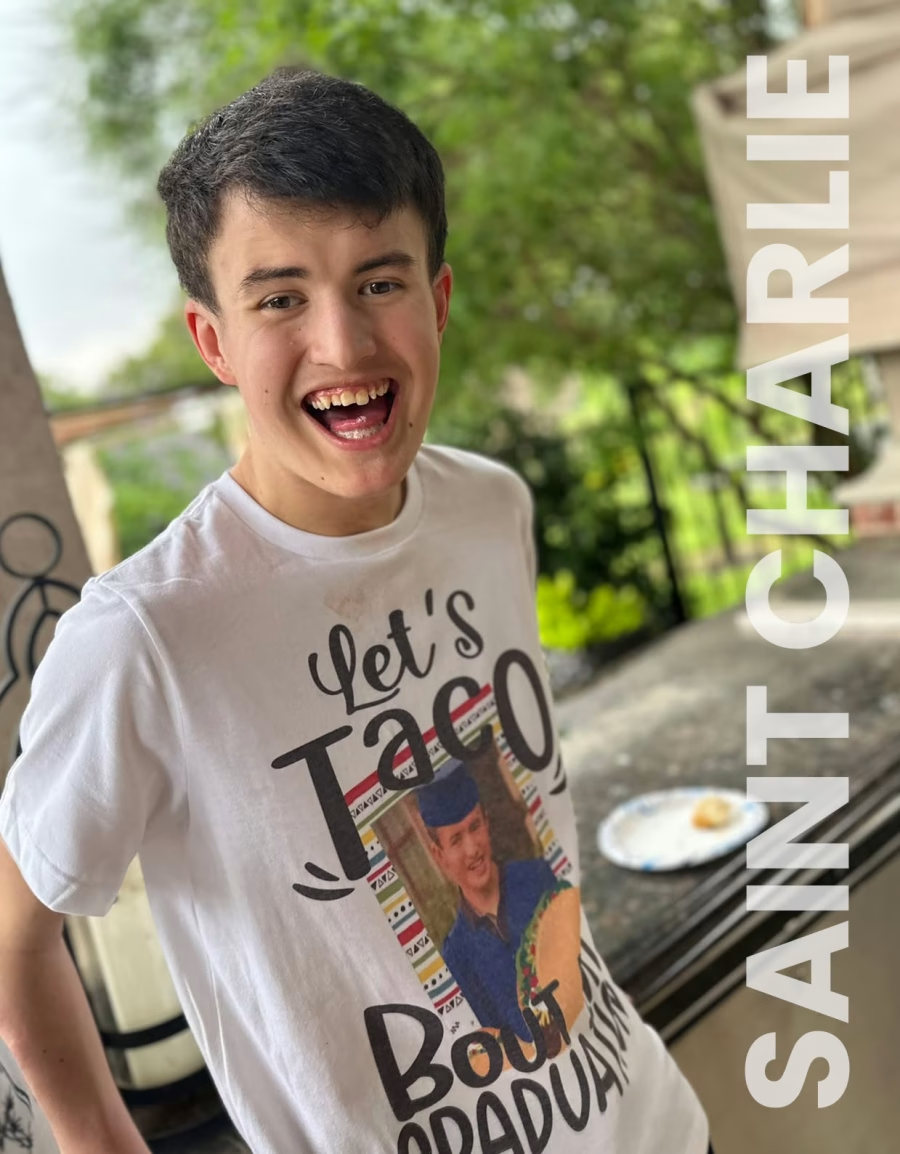
The kids’ clubs are a good example. Charlie didn’t walk until he was eight. He wore diapers until he was out of high school. He speaks only a few words and gets irritated when his needs aren’t understood. He also loved interacting with other kids.
The programs often wouldn’t accept him. They didn’t know what group to put him in or how to deal with him, even when we gave them simple instructions. He didn’t fit the categories they were used to.
So one parent always had to stay with him, whether that was in the room, at the pool, or in the dining areas. The rest of the family would be somewhere else.
We had a room at the resort. What Charlie needed was a way to join in. If someone had taken the time to understand him and help him spend time with the other kids, that would have changed the vacation for every one of us.
Was there a particular holiday or experience when you thought: families like ours deserve something fundamentally different?
Not one. All of them!
It was the same problem showing up in different places. Beautiful destination, same conversation about who was going to stay with Little Charlie while everyone else did the activity. Or the same constant attention to making sure we weren’t disrupting somebody else’s trip.
After enough of that, you start thinking about what it would take to make the experience work for the whole family. That’s what I want Saint Charlie to do. Give families a trained, prepared team they can trust, and a real chance to enjoy being there together.
The phrase “Where Special Is Normal” is striking. What does it mean to you as a father rather than as a founder?
It means Little Charlie gets to be Little Charlie. He doesn’t have to become easier for somebody else to understand before he gets to belong.
I want people to get to know him, what he enjoys, how he communicates, and what helps him have a good day. I want him to have choices. And I’d like our family to sit down for a meal or enjoy an activity without feeling that we owe everyone an explanation.
To me, “Where Special Is Normal” means we expect differences and prepare for them. As a father, I want to feel that my son was thought about before we arrived. If another family feels that, too, then we’ve given those words some meaning.
Designing a Different Kind of Resort
Most accessible hospitality starts with adapting what already exists. You have the opportunity to begin with a blank sheet of paper. What does that allow you to rethink completely?
This is exactly why it took someone from outside the hotel and hospitality space to create the SCR playbook and develop necessary platforms. I don’t think anyone within the industry we spoke with even felt this was possible. I was looking at a problem my family lived with and asking what it would take to solve it.
Even within an existing property, there’s a tremendous amount you can rethink about the experience. It starts before arrival. My WonderMap (over 80 data points on our VSP’s that almost no one considers) is intended to help us understand how someone communicates, what makes them comfortable, what support they need, and what they enjoy. Then that information must reach the people who can do something with it.
You work through the stay. Maybe check-in is overwhelming. Maybe someone needs a quieter route, a different way to order a meal, or a break from an activity. The next staff member needs to know what’s already been agreed so the family doesn’t have to start over. That’s what we’re putting together in the SCR playbook.
When you imagine a family arriving at Saint Charlie, what do you want them to feel in the first hour that perhaps they have rarely felt on holiday before?
Relief. I’d like a parent to feel their shoulders drop a little because somebody has finally prepared for their family.
That comes from ordinary things done thoughtfully. Staff know how the family prefers to communicate. The information they’ve already shared is there. Getting settled makes sense. If a child needs quiet after a difficult journey, we can give them time instead of rushing them into a busy welcome activity.
Parents like us are used to scanning the room and anticipating the next problem. I’d love for them to notice they aren’t doing quite as much of that. We must earn their trust throughout the stay, but the first hour can give them a reason to take a breath.
How do you design for very different disabilities, needs and family structures without allowing the environment to feel medicalised or institutional?
You start by getting to know the person. A diagnosis doesn’t tell you what somebody wants to do on vacation. Two people with the same diagnosis may enjoy completely different things. Even the same person may want music and activity one day and a quieter experience the next.
That means building choices into dining, communication, activities, and the environment. Familiar food can sit alongside adventurous food. Picture-based ordering can help an adult as well as a child. World of Luma is our activity center, and we’re planning ways to participate that respect the person’s interests, age, and comfort.
I want a beautiful resort where that preparation is part of the experience. Staff need the information that helps them support a guest, handled discreetly. Families also need a clear understanding of what support we can provide and what care they arrange separately. Getting those details right helps people enjoy themselves with dignity.
How important will staff empathy, confidence and behaviour be compared with the physical design of the resort?
They’re essential. You can design a wonderful space, but eventually a person must respond when a guest is uncomfortable or the plan changes. That person’s patience, judgment, and behavior matter enormously.
That’s why SCR developed S.N.A.P., our extensive, 80-question screening tool. I consider it a first of its kind for this purpose. It looks at the personality traits and qualities we see as best suited to caring for our VSPs, our Very Special People. We want to understand someone’s empathy, communication, emotional steadiness, and response to another person’s needs. From there we educate extensively based on their job roles.
We also use interviews, checks, training, and observed performance and yearly continuing education. Our training model has four levels, tied to what level of interaction the staff member will have with our clients.
I want people who stay calm, listen, and know when to ask for help. SCR Guardians (extensively trained respite and VSP support staff) are intended to help with participation, transitions, and family coordination within agreed support arrangements. A family needs to be able to trust that preparation when the day doesn’t go exactly to plan.
One of the most interesting aspects of the concept is that families are being invited to help shape it. How central is co-creation to the final model?
Saint Charlie Resorts explicitly asks prospective guests to share their preferences and help influence what is built.
It’s central. To allow only my perspective would invite failure with a need this broad. I know my family’s experience. I need to hear about yours.
Tell us what makes you decide a trip is too difficult. Tell us what your child loves doing, what works at mealtime, and what would give a sibling a great afternoon. Those details can change the room setup, an activity, or how we prepare our team.
And the listening must continue after we open. Families will teach us things we haven’t thought of.
If we ask for their input, we owe them the effort to use it thoughtfully and to be honest about what we can deliver.
The Whole Family
Families with disabled children can spend enormous energy planning, managing risk and anticipating problems. Is one of your ambitions simply to give parents permission to stop managing for a few days?
Absolutely. It’s time to give your DEFCON 2 a little break.
But telling a parent to relax doesn’t do much. They need to know who is with their loved one, what they’re doing, how they’re being supported, and what happens if the plan changes. Trust grows when those answers are clear and the people involved know their jobs.
For one parent, a break might be a quiet breakfast. For another, it’s time with their partner or a chance to do something with another child. The amount of support has to fit the individual, and families remain involved in the decisions and care that belong to them. I want our preparation to make it possible for them to take that break and actually enjoy it.
How do you make sure siblings, parents, grandparents and carers all experience the holiday as their own, rather than as supporting cast around one family member?
You have to ask what each person wants from the trip and take the answers seriously. A sibling deserves something to look forward to that reflects their own interests. Parents may want time together. Grandparents may want an activity they can share.
We’ve lived the experience of dividing up the family to cover Little Charlie. I want to make more room for choosing how you spend the day. Sometimes everyone joins in. Sometimes people do different things and meet back up later.
Good food, recreation, adult experiences, and quiet time all belong in that picture. Supporting the person with additional needs helps make those choices possible, but we have to think about everyone who came on the vacation and satisfy their wants and needs the best we can.

Ambition & Legacy
The plan begins with roughly 75–100 rooms in Cancún, with ambitions to grow to around 500 rooms and potentially replicate the concept in other destinations over the next decade. How far do you believe this idea can go?
The need is enormous. By our current estimate, just reaching 2% of the North American families who aren’t traveling, who have household incomes above $125,000 a year, and who would vacation only once every two years would require about 11,000 keys. That’s 11,000 hotel rooms to serve a very small part of that group.
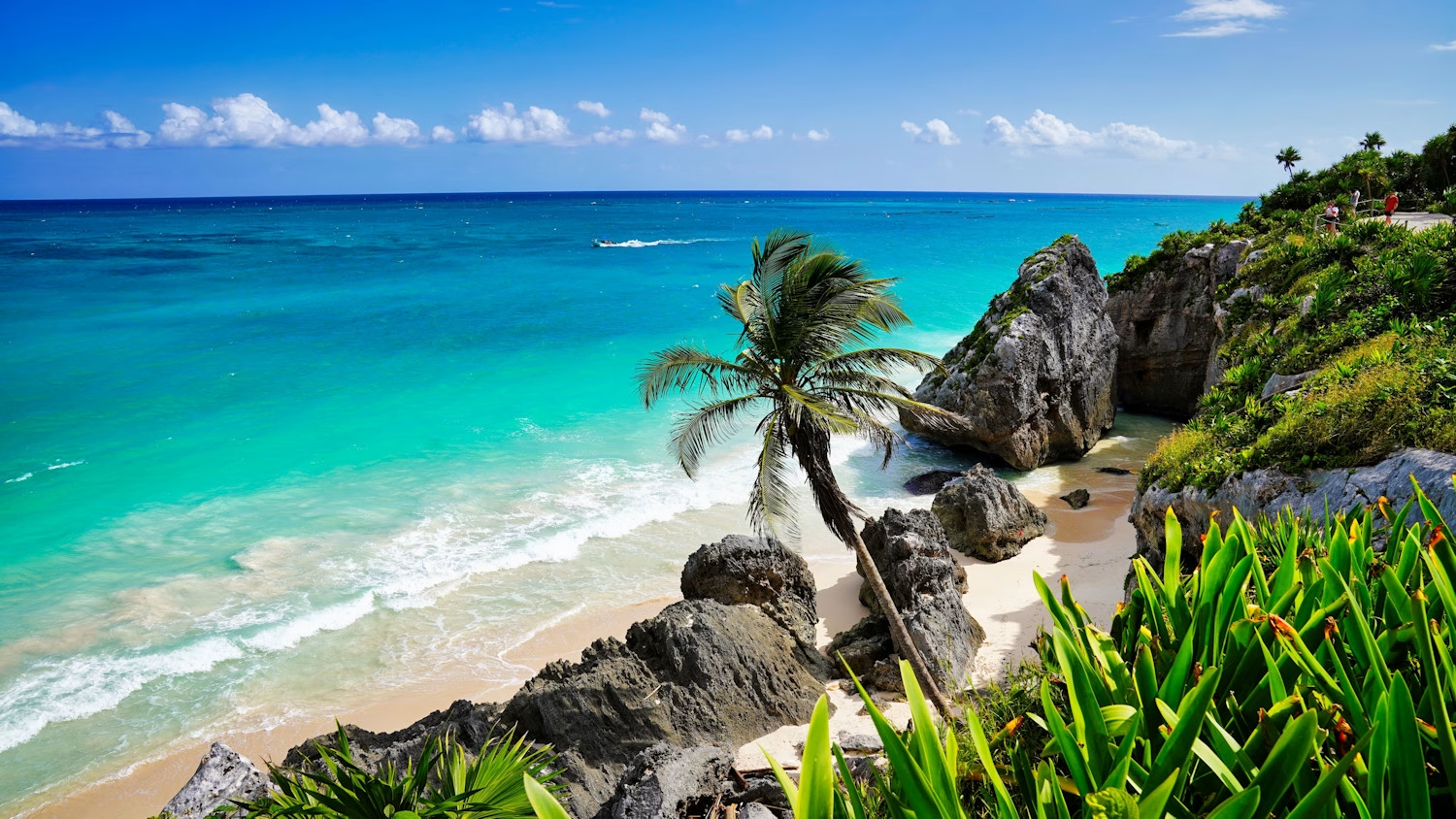
Our property plans have evolved, and the current focus is Tulum with a phased start. We have to get that first operation working well: prepare the team, learn from families, and deliver an experience people want to come back for. The business also has to sustain the support we’re promising.
From there, I see the opportunity for more properties and potentially other destinations. We need to show that the model works and that we can carry the same standard into the next location. The number tells you why I’m thinking beyond one resort.
Do you see Saint Charlie ultimately as a resort company, or as proof that inclusive family hospitality can become an entirely new and commercially credible category?
I see the opportunity for a whole category, and we have to prove it by running a good resort business. Families still want the things that make a vacation enjoyable. They also need preparation and support that let everyone take part.
There’s a real commercial question to solve here. You must pay and train good people, maintain the equipment and property, and be clear about what the guest is buying. The business must support that consistently.
That’s a challenge that interests me. Can we understand these families well enough to build a hospitality model they value and return to? That’s what I want Saint Charlie to demonstrate. If we do it well, other people will see the opportunity, too.
If the first Saint Charlie Resort succeeds exactly as you hope, what would you like the wider hospitality industry to copy?
I’d want them to copy the effort to understand a family before they arrive, then actually use what they’ve learned. That information needs to reach the next person involved in the stay. Otherwise, the family is back to explaining everything again. Put yourself into their situation as best you can. Comparatively their lives are often more challenging in almost every aspect.
Give guests choices. Think about communication, sensory preferences, and familiar food when you’re planning the experience. Prepare staff to respond respectfully when someone is distressed or needs a break. Remember the siblings and adults who came with them.
Then ask the family whether it helped. You can write a great policy, but the family experiences what happens on the property. If other resorts learn from what we’re doing and more families get to enjoy a vacation, I’d be very happy about that.
Looking across military service, medicine, PTSD, fatherhood and now Saint Charlie Resorts, do you see one consistent thread running through your life?
I keep coming back to a person with a need and a system that has recognized the need and opportunity. I want to understand what’s getting in the way and whether there’s a better way to do it. That’s been there through medicine, the military, and the businesses I’ve worked on. With Little Charlie, it’s personal every day.
My own experience with PTSD added something to that understanding. I know how little the outside view can tell you about what someone is carrying or what support they need. That makes listening and dignity very important to me.
I still have ideas and a desire to help. At Saint Charlie Resorts, I can contribute a vision, ask questions, and help connect people. I also rely on others to carry substantial parts of the detailed work. It takes that team to turn the idea into something families can experience.
And finally, if a family leaves Saint Charlie Resorts saying, “That was the first holiday where we all got to be a family,” would that be the ultimate measure of success?
Yes. That would mean a great deal to our whole team because we know what it feels like to take a family vacation and spend so much of it separated from each other, excluded in so many ways and often less than important.
I’d want to hear what made the difference. Did everybody get to enjoy a meal together? Did a parent get a real break? Did a sibling get to do something they loved? Was their child comfortable enough to join in or try something new?
That’s what I want all this planning to make possible. We still have to run a dependable business, but hearing a family say that would tell me we had done something that mattered in their lives. I’d want them to leave with good memories and feel excited about the next vacation.