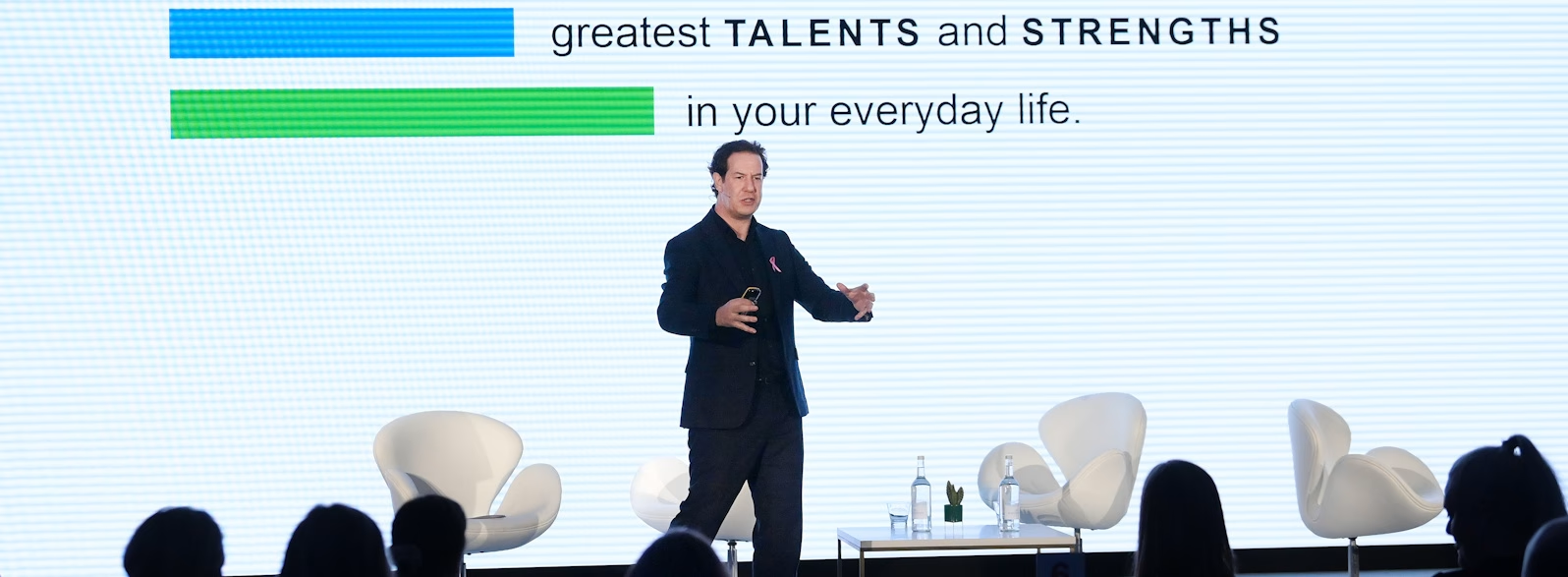
Mark Julian Edwards: Founder, The Strengths Explorer
Mark Julian Edwards is the founder and CEO of The Strengths Explorer, an organisation that helps people, teams, leaders and entire organisations shape work around people’s strengths and, as a result, improve performance.
◦ 16 min readYou describe yourself as an explorer. Where did that mindset begin?
I think it started with a natural curiosity about what might lie beyond the familiar. I have never been comfortable with the idea that there is only one way to live, lead or understand another person. I have always wanted to look around the next corner, ask another question and see what becomes possible when we step outside the boxes we have inherited.
Over time, exploration became about much more than travel. It became a way of approaching people, ideas and my own potential. For me, being an explorer means staying open to the possibility that there is always more to discover, both in the world and within ourselves.
Looking back, what experiences first sparked your curiosity about people, cultures and the wider world?
It was probably not one dramatic experience, but a growing fascination with difference. I was intrigued by why people thought differently, lived differently and could see the same world through completely different lenses.
Later, living and working in places such as Israel, South Africa, Brazil and Mallorca turned that early interest into a lifelong commitment to understanding people across cultures. Studying Intercultural Communication gave me an academic language for something I had felt instinctively for years: our differences are not obstacles to overcome, but invitations to become more curious.
Was there a person or moment that changed how you saw your own potential?
Properly understanding my own strengths was a pivotal moment. It gave me language for qualities I had previously treated as incidental, or even as things I should tone down. My natural ability to communicate, connect people and generate ideas was not a distraction from serious work; it was central to the contribution I could make.
That realisation changed the question from, “What role should I fit into?” to, “What could I create if I fully used what is already strongest within me?” It is the same shift I now try to help others make.
What did younger Mark dream of becoming?
I am not sure younger Mark had one neat job title in mind. I think he wanted a life that felt bigger than a single lane: a life involving people, stories, travel and ideas.
Looking back, perhaps I wanted to become an explorer and storyteller long before I had those words for it. What has surprised me is how the different strands of leadership, photography, writing, coaching and broadcasting have eventually come together as one coherent story.
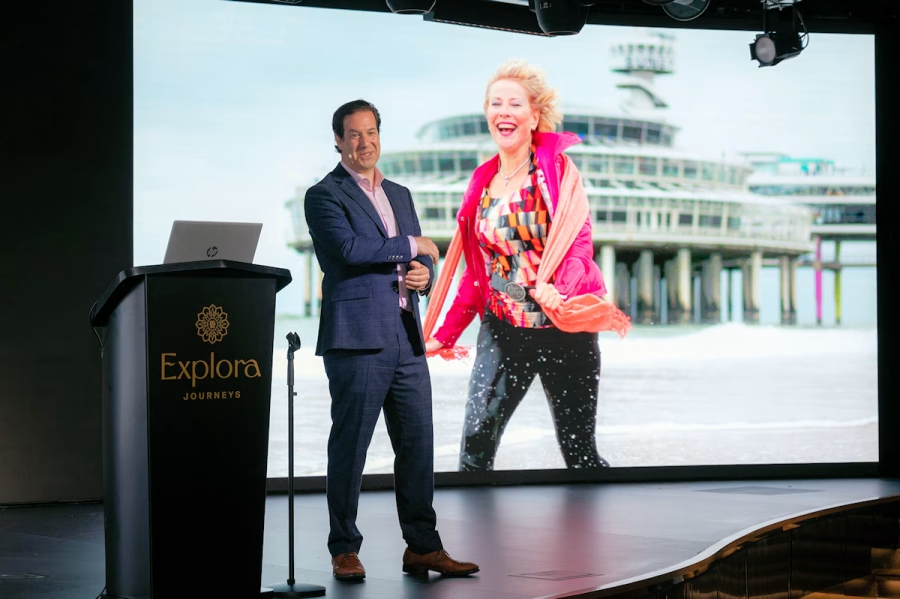
The Corporate World and a New Chapter
You spent many years in leadership and consulting before stepping into a more creative and entrepreneurial chapter. What prompted that shift?
After 25 years in consulting and leadership, I began to recognise that I had divided myself into separate compartments. There was the corporate Mark, the creative Mark, the traveller, the photographer and the storyteller. The shift came when I realised these were not competing identities; they were different expressions of the same strengths.
I did not want creativity to remain something I fitted around the edges of my life. I wanted to find out what might happen if I brought all of myself to my work and built something that reflected who I had become, rather than continuing along a path simply because I had already been successful on it.
In 2018, you chose to pursue dream projects that led you into writing, photography and broadcasting. What did that leap teach you about fear and possibility?
It taught me that courage is not the absence of fear. It is deciding that possibility matters more than certainty.
When we make a significant change, we often wait to feel completely ready. I certainly did not. Yet taking the first step created opportunities I could never have planned, from producing Faces of Mallorca and writing for Lonely Planet to working as a travel broadcaster and eventually giving a TEDx talk. Possibility rarely arrives with a complete map; more often, it presents a doorway, and we have to decide whether to walk through it.
I also learnt something about momentum. In the early stages of developing a vision, people do not always want to join you. Once the idea begins to take shape and gains momentum, that changes. This is exactly what happened with Faces of Mallorca. At first, we had to persuade people to take part. Later, once several respected people were involved and the project had gathered pace, people began approaching us and asking to be included.
You often talk about seeing people through the lens of their strengths. Why do we so often overlook our own gifts?
Our greatest strengths often feel ordinary to us because they come so naturally. We assume that, because something is instinctive for us, it must be easy for everyone, so we undervalue it.
We are also conditioned from an early age to focus on gaps, weaknesses and what needs fixing. Feedback often concentrates on where we fell short rather than where we came alive. Sometimes we need another person to hold up a clearer mirror and say, “Do you realise what you do when you are at your best?” That recognition can be life-changing. Had a friend not told me, very directly, about the impact of my photographs, I do not think I would have had the confidence to create the book.
What is the most powerful transformation you have witnessed in someone who discovered their strengths?
My work with a group of 18 senior female leaders across five countries was particularly meaningful. Through coaching and photography, we were not simply trying to tell them what their strengths were; we wanted to help them see those qualities reflected back at them.
Watching people move from intellectually understanding their abilities to genuinely owning them reinforced my belief that the way we see another person can influence the direction of their life.
The Strengths Explorer
What was the vision behind creating The Strengths Explorer?
The vision was to bring together the rigour of leadership development with the spirit of exploration. I wanted to create work that helped people discover their strengths, experiment with them and use them more intentionally, without reducing anyone to a formula or a set of labels.
It also grew out of my own journey beyond the traditional boundaries of corporate life. I became an explorer of my own strengths and saw what became possible when I stopped trying to conform to a narrow definition of success. The Strengths Explorer is an invitation for individuals, teams and organisations to make that same journey.
How can organisations create cultures where people genuinely feel seen and valued?
It begins with leaders paying attention. Not generic recognition, but specific recognition: understanding what each person contributes, what energises them and how they work at their best.
Strengths cannot be confined to a workshop and then forgotten. They need to become part of everyday conversations, role design, team meetings, development plans and decisions about how work is allocated. Leaders also need to model this by understanding and articulating their own strengths.
People feel valued when their contribution is noticed, named and given room to grow. Feeling seen is not a soft extra; it is fundamental to trust, belonging and performance.
You work with some of the world’s leading brands. What separates exceptional leaders from merely competent ones?
Competent leaders manage performance. Exceptional leaders expand possibility.
They see beyond someone’s current job title or track record and recognise what that person might become. They create clarity, but they also create belief. They know when to challenge, when to listen and when to step back so that somebody else can grow.
Exceptional leaders do not need to be the most impressive person in every room. Their impact is visible in the confidence, capability and courage of the people around them.
A story that has stayed with me involves my best friend’s father, who died in South Africa around 20 years ago. He had been a general manager and was deeply admired; more than 1,000 people attended his funeral. Again and again, people spoke about how he had lifted others, given opportunities to people who might otherwise have been overlooked, and promoted more people than anyone else in the company. That, to me, is the mark of an exceptional leader.
How important are curiosity, empathy and creativity in modern leadership?
They are no longer optional. Curiosity stops us from leading through assumptions. Empathy helps us understand experiences beyond our own. Creativity enables us to respond to challenges for which yesterday’s answers are no longer enough.
Modern leaders are working across cultures, generations, technologies and increasingly complex systems. Technical competence still matters, but it will not be sufficient on its own. Leaders must be willing to ask better questions, genuinely hear the answers and imagine possibilities that are not yet obvious.
That may sound straightforward, but the key is to turn these qualities into habits. Most leaders already have regular one-to-ones, for example. Useful questions might include, “What was the highlight of your week?” or “Which aspects of your role do you most enjoy?” These questions encourage people to talk about what energises them and help leaders notice where a role might be shaped more closely around someone’s strengths.
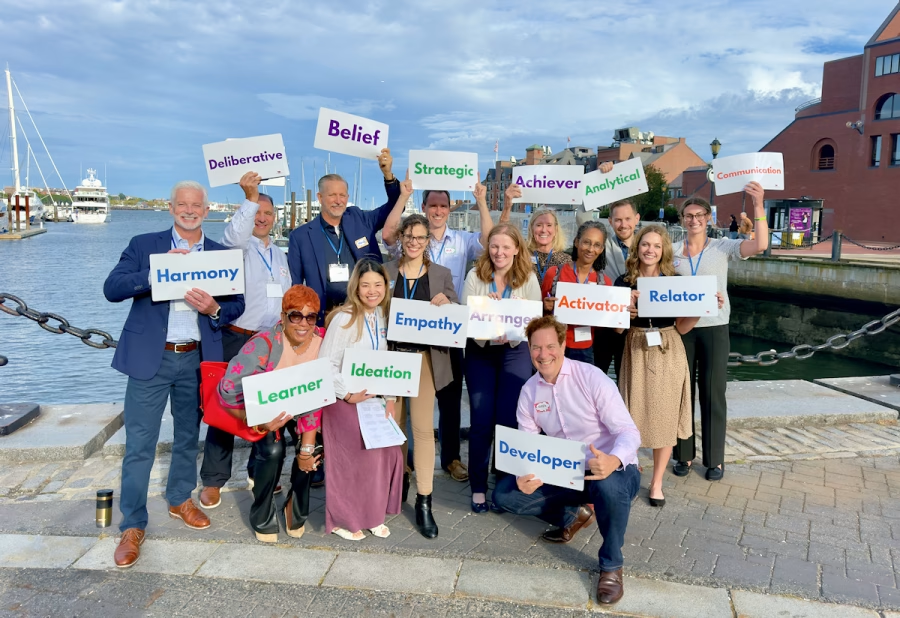
TEDx, Storytelling and The Power of Perception
Your TEDx talk explored how leaders can change lives through the way they see others. What was the most profound lesson from that experience?
The most profound lesson was that being truly seen is one of our deepest human needs. A leader’s perception is never neutral. It can limit a person to their past, or it can help them glimpse a future they had not yet imagined.
Preparing the talk brought together years of thinking about leadership, coaching, strengths and photography. It reinforced my belief that one of the greatest gifts we can offer another person is to recognise a quality in them that they have not yet learnt to recognise in themselves. That is the kind of leadership people remember for the rest of their lives.
People are strongly influenced by the way others see and describe them. When you can point to convincing evidence of someone’s strengths and communicate it in a sincere, affirming way, their view of themselves can begin to change. As their self-perception rises, greater things often become possible.
Why is storytelling such a powerful tool for leadership?
Facts can inform people, but stories help them care. A story gives an idea a human face and allows people to locate themselves within it.
Leadership is partly about helping people move from one version of the future to another. A compelling story gives meaning to that journey. It explains why change matters, honours what has come before and creates a shared picture of where people are going.
Stories also make leaders more human. They replace distance with connection and turn abstract strategy into something people can understand, feel and remember.
As a photographer, what do you see through the camera lens that others often miss?
The camera encourages me to slow down and pay attention. I am less interested in producing a technically perfect representation of a person than in revealing something true about their character. Often, the most powerful image appears just after somebody thinks the photograph has already been taken.
What did Faces of Mallorca teach you about humanity and connection?
It taught me that the true story of a place lives in its people. Mallorca is often presented through beaches, hotels and beautiful landscapes, but the island’s identity is carried by its artists, fishermen, chefs, musicians, shopkeepers, religious communities and families.
To photograph someone meaningfully, you first have to earn a degree of trust. You have to be curious without being intrusive and arrive without deciding in advance what their story will be. Again and again, I found that when people feel respected rather than observed, they share something extraordinary.
The project also reminded me how much richness we miss when we see local people merely as part of the machinery of tourism, rather than as individuals with histories, humour, pride and dreams of their own.
I also believe that we share far more than divides us, even though much of society seems intent on separating people. One powerful moment came when I photographed Jordi, a singer and gay-rights activist. He spoke about how difficult it had been to live openly as a gay man in what was then a conservative society. During the shoot, I asked him to sing, dance and perform. The photographs I took are among the best I have ever produced. Although I am not gay and do not share his life story, I know what it is like to feel nervous or misunderstood. That human connection made the photograph.
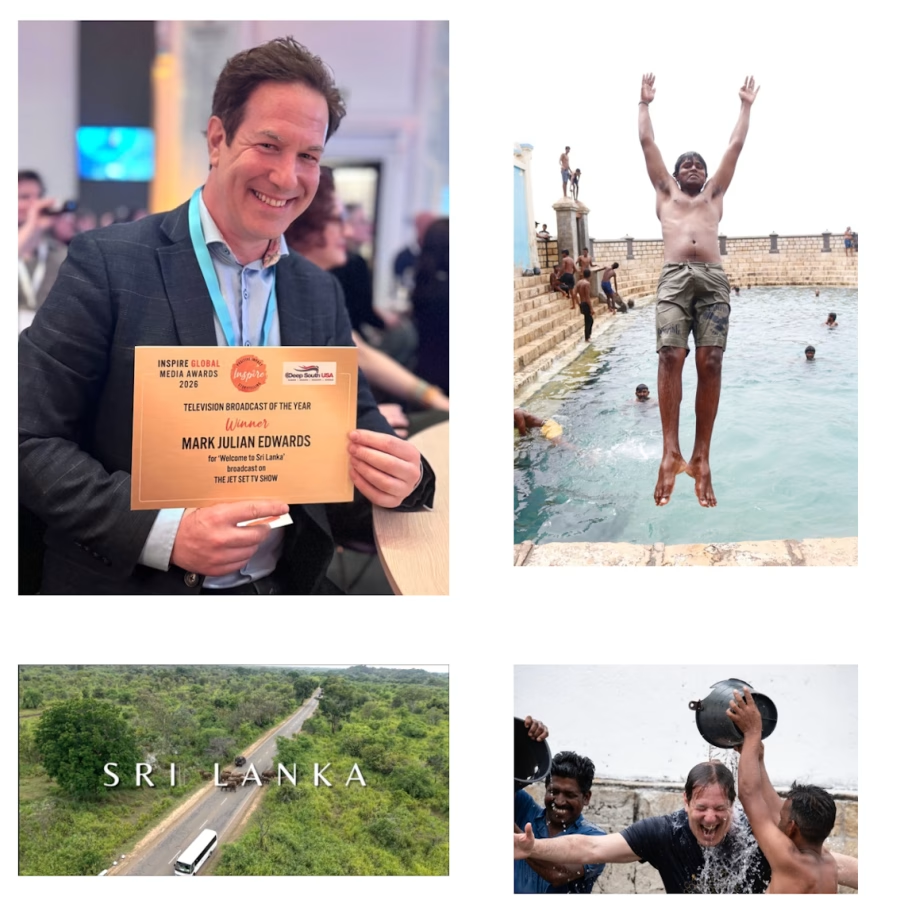
Travel, Culture & Discovery
You have written for Lonely Planet and worked as a travel broadcaster. How has travel shaped your outlook on life?
Travel has made me less certain, and I mean that positively. It has repeatedly shown me that my way of understanding the world is only one perspective among many.
Living and working in different countries taught me to notice context, question assumptions and become comfortable with not knowing.
At its best, travel makes us both larger and smaller. Our world expands, but we also recognise that we are not at its center.
I also include travel as moving between communities at home. I’ll never forget my conversation with Lydia a lady who was on a secondment to the UK from Namibia. One day she asked me, “Mark, why in London when I smile at people do they not smile back”? These small moments contain everything.
What makes a travel experience truly meaningful?
Meaningful travel begins when we stop treating a place as something to consume. It happens when we become participants rather than spectators.
That might mean sharing a meal, learning a few words of the language, listening to a local story or allowing our plans to be disrupted by an unexpected encounter. The most memorable experiences are rarely the perfectly staged ones. They are the moments when we connect with another human being and leave with our assumptions gently rearranged.
I lived in Brazil for eight months and worked hard to learn Portuguese. Halfway through my stay, I ended up at a youth hostel in the north of the country, where an elderly local woman was also staying. That evening, we spoke for more than three hours, entirely in Portuguese. It was a transformative moment: for the first time in my life, I was able to have a long, meaningful conversation with someone in a language other than English.
Is there a person or story you discovered on your travels that has stayed with you forever?
One story that has always appealed to me is that of the Mallorcan street artist Joan Aguiló. He described how, years ago, street artists had to paint quickly and escape before being caught; today, building owners ask him to paint their walls.
It is a wonderful story about persistence, perception and recognition. The talent was always there. What changed was the lens through which the world viewed it. That idea connects closely with my leadership work: sometimes human potential does not need to be created; it needs to be noticed and given permission.
Leadership & Legacy
If every leader embraced a strengths-based approach, how would workplaces change?
There would be less energy spent trying to turn people into versions of somebody else. Work would be designed more intelligently around where individuals naturally contribute, and teams would better understand how their different abilities complement one another.
People would receive more meaningful recognition and have a clearer sense of why they matter. Collaboration would improve because difference would be treated as an asset rather than an inconvenience.
A strengths-based workplace is not one in which weaknesses are ignored. It is one in which we begin with potential rather than deficiency. That changes the quality of almost every conversation. More time would be spent celebrating and lifting others, and less on unhealthy competition.
What do you believe is the greatest challenge facing leaders today?
The greatest challenge is remaining deeply human in a world that is becoming faster, noisier and more technologically mediated.
Leaders are being asked to navigate constant change, uncertainty, dispersed teams and increasingly powerful technology. The temptation is to respond by becoming more controlling or transactional. Yet this is precisely when people most need clarity, connection and the confidence that they are more than a unit of productivity.
The challenge is to embrace progress without losing presence.
What does a life fully explored mean to you?
It is not about visiting every country or pursuing every opportunity. It is about being awake to your own life.
A life fully explored is one in which curiosity remains stronger than complacency. It means continuing to ask questions, meeting people beyond your usual world and having the courage to use your gifts rather than admiring them from a safe distance.
It also means recognising that exploration is not only outward. Some of the most important journeys involve confronting our assumptions, healing what needs to be healed and discovering who we might become next.
Quickfire
A country that stole your heart?
Spain, although Mallorca has a particularly powerful hold on me.
A person you would love to photograph?
Sir David Attenborough. His face seems to carry a lifetime of curiosity, wisdom and wonder.
The greatest lesson travel has taught you?
That there is always another way of seeing the world.
Sunrise mountain walk or sunset by the sea?
Sunset by the sea, ideally followed by dinner outside.
One city you could return to forever?
Palma. It continues to reveal different layers of itself.
A photograph that means the world to you?
One in which the person has momentarily forgotten the camera and allowed me to capture something completely authentic.
Your favourite way to switch off?
Walking somewhere beautiful with my camera, without an agenda.
A meal that instantly transports you somewhere?
Chargrilled sea bass, soft buttered potatoes and a chilled glass of dry white wine, eaten outdoors as the sun begins to set.
Coffee, tea or something stronger?
A cappuccino made by an expert barista, although the dry white wine may make an appearance later.
One strength you admire most in other people?
The ability to see and bring out the best in others.
A piece of advice you wish you had received at 25?
Do not wait for permission to use your gifts, and do not mistake a successful path for the only path available to you.
Your biggest act of courage?
Stepping beyond a successful corporate identity and giving myself permission to pursue the creative projects I had dreamed about.
Three words that define your life journey?
Explore. Connect. Create.