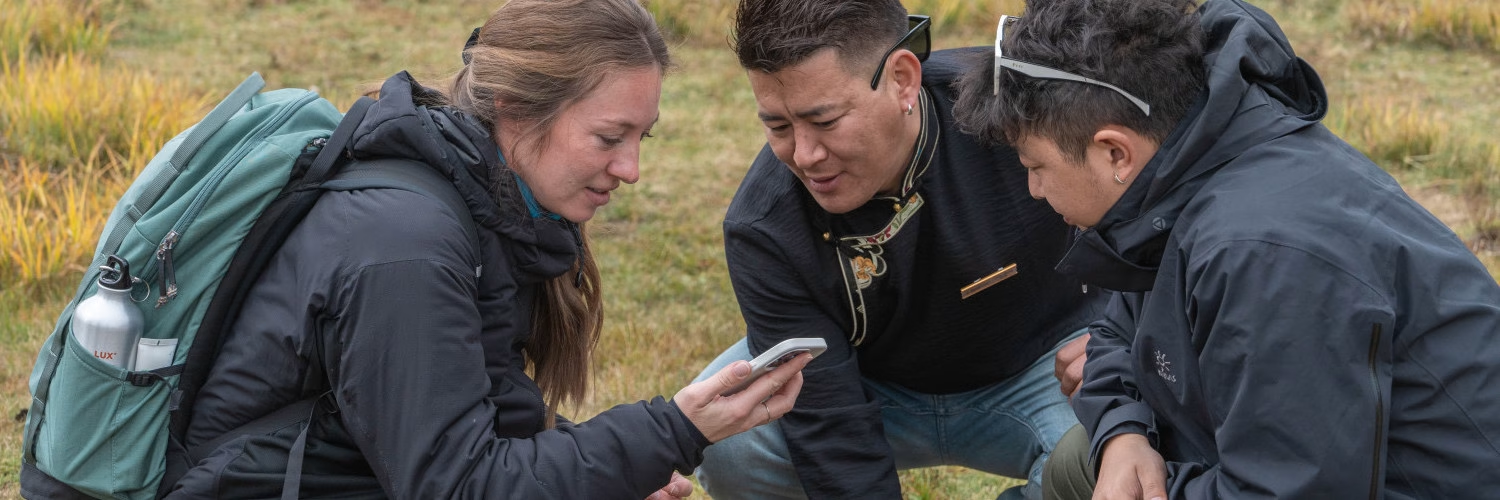
Kendra Tombolato: Co-founder, WildTaiwan & Leisure Managing Director, WildChina
Origins, curiosity & direction You grew up in Boulder, Colorado; a place with a strong outdoor and independent spirit. What early influences there shaped your relationship with exploration and movement?...
◦ 12 min readOrigins, curiosity & direction
You grew up in Boulder, Colorado; a place with a strong outdoor and independent spirit. What early influences there shaped your relationship with exploration and movement?
My childhood home was just outside the city of Boulder, in the Rocky Mountains. Our nearest neighbour was a mile away and everything in between was pure, wild forest. So, I spent a lot of my time just playing outside in nature and feeling very at home in the outdoors.
Travel-wise, my parents took my brother and I on several international trips throughout our childhood and young adult years, so we had a fair amount of global exposure and understanding, despite living somewhere very remote and sheltered.
I think it was this combination of safety and possibility that really shaped my interest in travel: I had very little fear, I was self-assured, and travel always seemed like an adventure where the road ahead was full of possibilities.
When did travel shift from something you loved into something you wanted to build a life around?
I don’t think I was even aware that travel could be a career choice until I got my first job in the industry.
When I went to university (and I think this is still the case now), travel wasn’t something you could study. Maybe business or communications or something tangential but not travel itself.
The only travel jobs I knew of were the store-front-style travel agencies. Everyone in my family booked their own travel, so I had never been in one, but in my mind, they were places that existed solely for people who needed to book a flight or a cruise. I didn’t realize there were more options for travel careers, let alone an entire industry built around it.
So for me, it started with getting my TEFL and applying for English-teaching positions abroad. I moved to China and was able to travel all over Asia on weekends and holidays. After travelling extensively in China and studying the language, I became something of a China travel expert and was able to apply for a specialist job in travel accordingly.
Many travel agents that I know built their careers the same way: travelling extensively themselves and becoming the go-to travel expert for certain areas based on personal knowledge built through first-hand experience.
What first drew you toward Chinese language and culture and what kept you committed to it over time?
I have a very clear memory of the first time I saw Chinese characters. We had to create a banner related to a Chinese dynasty for an art project in elementary school. The context didn’t make much sense to me at that age, but the teacher wrote some Chinese characters on a flip chart and I was completely transfixed. They were so different from English, it was like discovering another world.
I became mildly obsessed with learning Chinese and was only further spurred on by how much this confounded the adults around me. No one at that time (the early 2000s) could understand why I would want to learn Chinese. This made me feel different and encouraged me further.
Unfortunately, they didn’t teach Mandarin in my middle or high school. The only languages offered were Spanish, French, German, Latin (which I chose for the two required years) and Japanese. It wasn’t until university that I finally had the opportunity to study Mandarin.
However, once you start learning Chinese, you realize just how far there is to go. And, of course, the only true way to become proficient in a language is to immerse in it. So, after four years of university I moved to China to continue the language learning journey. I’m still on this journey and have weekly lessons with a Chinese tutor.
Learning places from the inside out
You’ve lived, studied and worked across East Asia rather than just passing through it. How has long-term immersion changed the way you understand a destination?
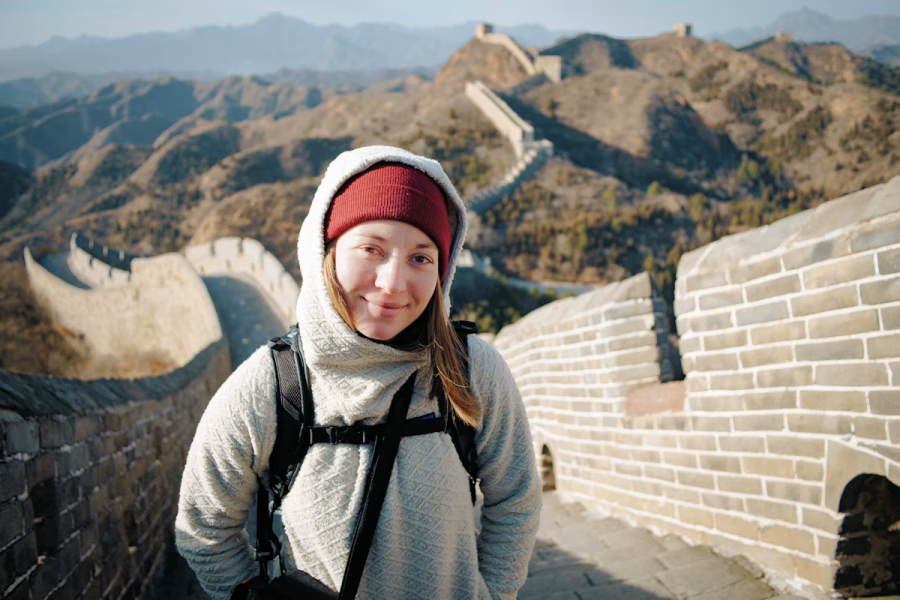
I firmly believe that living somewhere is the best form of travel. Living and travelling are often positioned as antonyms, but if you live somewhere and can still retain the traveller mindset, it’s the same experience without the limitations. This is, in my opinion, the best way to learn deeply about a place. It gives space for spontaneous encounters but also time to understand the cultural nuances.
You once packed your life into a backpack and circumnavigated Taiwan by motorcycle. What did that slow, ground-level journey reveal that no guidebook could?
I have long been a believer in slow-travel, in letting experiences form around you instead of planning out every detail and cramming days full of box-ticking.
For our Taiwan trip, my husband and I carved out two months to make our way around the island. A lot of our travel was guided by pinning areas on a map that looked interesting or following niche blogs to wild swimming holes and remote villages.
One such lead took us to a mountainous village belonging to a Rukai indigenous tribe. We located a homestay in the village and the family there took us in warmly. The wife showed us their traditional clothing and the silver jewellery that she made to sell in a small stall outside her house. The husband showed us his beehives and his black-powder gun for scaring away the monkeys that tried to eat his crops. In the evening we ate crisp, barbequed wild boar meat and in the morning fresh mangoes with locally grown coffee. We didn’t have a plan, we just arrived and let the experience evolve naturally.
From traveller to trip-maker
You began designing China trips for VIP clients. What did that experience teach you about expectation, trust and responsibility in high-end travel?
Being a travel designer was my entry into the industry and the foundation for the career I have built since. I would encourage everyone who works in travel to spend time in a client-facing role. There’s no better way to learn what different travellers want, or what they don’t, than by going through the whole process with them.
Some of my key takeaways include:
Setting expectations
The number one thing that can make or break a trip is setting the right expectations. It’s always better to exceed expectations than to oversell and fall short.
The importance of saying no
There is this idea in luxury that we should always say yes to the client. However, I’ve found that saying no when necessary is actually a more powerful tool for building trust. The agent or client is reaching out to you because you are the expert, and they want your expert advice, not for you to agree to something just because they asked for it.
Attention to detail
Luxury is a mindset more than anything. It’s not defined by how expensive something is, but by the level of detail that has been considered. Luxury can be a hot cup of coffee passed into your tent in the morning before you even think to ask for it or a pair of gloves laid out for you after a passing comment about being cold the day before.
What made Taiwan feel like the right place to focus your creative and professional energy?
I felt that there wasn’t a lot of opportunity for travellers to truly experience Taiwan. The traditional travel options on the island for international visitors are focused around a central sightseeing circuit. People were enjoying these kinds of trips because Taiwan is inescapably beautiful, but they were only scratching the surface. My co-founder Wendy and I felt that this was a shame because the island has so much more to offer, so we founded WildTaiwan with a mission to provide discerning travellers with the opportunity to not just see Taiwan, but experience its nature, culture and cuisine on a deeper level.
How does WildTaiwan differ, philosophically, from more conventional luxury travel models?
WildTaiwan is focused on people, from our staff to the locals we work with and the travellers we serve.
We offer bespoke itineraries featuring cultural immersion and people-to-people exchange. Our travel designers are Taiwan experts committed to the highest level of customer service, customizing each journey to match individual traveller’s specific interests and needs with a particular emphasis on the details and WOW moments. Our products feature local experiences that our team has surveyed and developed in-person and, in addition to top-notch guides, we also work with a range of experts who can add an extra level of detail on topics from tech to history to indigenous culture.
Adventure, access & perspective
Who do you think adventure travel has historically been designed for – and who has been left out?
I think the concept of adventure in general is fluid and open to interpretation. My version of adventure is as different from someone who just went camping for the first time as it is from Alex Honnold. So, in essence, adventure is subjective, and each person should be defining what adventure means to them, not allowing others to define it for them.
Historically and I think unfairly, the concept of adventure in travel has been defined by a certain level of risk or ability. My hope for the future is that when someone says they want to do something, we as the travel specialists work to make that happen regardless of whether we deem it adventure or not. It’s not about labelling but more about enabling through support and advocacy.
What does “experiential” truly mean to you, beyond the buzzword?
Experiential travel to me means having the space and opportunity to feel not as a tourist, but as a guest. Sitting down with a local family for a cup of tea and getting the chance to connect with them in an intimate space. Talking to your guide about their kids, their hobbies, and how the high-school entrance exam differs from that in your home country. Eating at a truly local restaurant where every other table is filled with office workers on their lunch break, not other tour groups on the same loop. It’s these opportunities that give travellers the space to listen, to observe, to ask, to learn and to share. Experiential travel is not a one-way channel, it’s an exchange between cultures.
Culture, respect & responsibility
How do you ensure that cultural depth doesn’t become cultural performance for visitors?
The simple truth is that travel is not purely observatory, it influences the cultures through which it passes. Local people around the world are harnessing this new economy, trading access to their lives and cultures for a fee. I don’t think the importance lies necessarily between cultural depth and cultural performance, but more how transparently these experiences are presented.
A recent experience in Taiwan really put this in perspective for me. I was visiting an indigenous Amis village so remote that we had to four-wheel up the side of a mountain to reach it. The tribe only accepts 30 visitors per day. Nor do they allow visitors to stay overnight, explaining that, as soon as they do, their home becomes a 24-hour place for tourism and no longer an active, living village.
At one point, one of the local guides was showing us a snare hidden in the foliage for catching wild chickens. After explaining how it worked, he stopped to say, very clearly, that this particular snare was just an example to show to visitors. Nowadays, everyone in the village raises domestic chickens as it’s much easier than trapping wild ones. For me, this was the ultimate form of cultural depth: the local guide did not have to tell us this truth, but he chose to level with us to show how his community really lives.
Where do you see well-intentioned travellers most often getting it wrong in East Asia and how can the industry do better?
A lot of travellers are using social media to plan their trips. This has the potential to be a great tool, but often it falls short and recommendations are unqualified, unresearched and even misleading.
An example of this is Chongqing, a city in China which has blown up on social media in the last year or so. Someone at some point dubbed it the “cyberpunk city” and the name has stuck. The result is a huge increase of interest in Chongqing as a travel destination, with people asking specifically to see all the futuristic technology there. The issue here is that Chongqing isn’t one of China’s tech hubs like Shanghai or Shenzhen. Tech exists there, of course, as it does everywhere in China, but Chongqing is best known for incredibly spicy food, creative architecture adapted to the verticality of the city and being a main port on the Yangtze River. Almost all of this gets overlooked with crowds of people instead lining up to get the same Instagram shot at the most “cyberpunk” inspired spots in the city.
Personal perspective
What keeps you curious after more than a decade working in the region?
I’m a firm believer that with a traveller’s mindset there are always more places to explore, more people to meet and more things to learn. As long as you stay curious, there is always more to experience.
Quick fire
Mountains or coast? Both (which is why you should go to Taiwan).
Sunrise hike or late-night street food? Sunset hike and street breakfast.
One place in Taiwan you never tire of returning to? The breakfast shops.
Coffee before adventure – essential or optional? Coffee before everything, always.
Favourite way to get around: on foot, by bike or by motorbike? On foot.
A sound that instantly reminds you of East Asia? Fleur de lis. IYKYK 😉
Street market or remote trail? Remote trail.
Something you always carry in your backpack? A headlamp.
A moment in nature that stopped you in your tracks? Swimming alongside the highly venomous banded sea krait in Taiwan.