Amal Ishtar: Oriental Dance Artist & Cultural Storyteller
Sensory immersion gives people the rare opportunity to experience a culture firsthand and form their own judgments, rather than just consuming narratives filtered through the media or social media. It brings a culture that feels geographically distant right to their doorstep.
◦ 22 min readLeadership, Identity & Cultural Storytelling
You describe yourself as both an Oriental Dance Artist and a Cultural Storyteller. How do those two worlds connect for you personally?
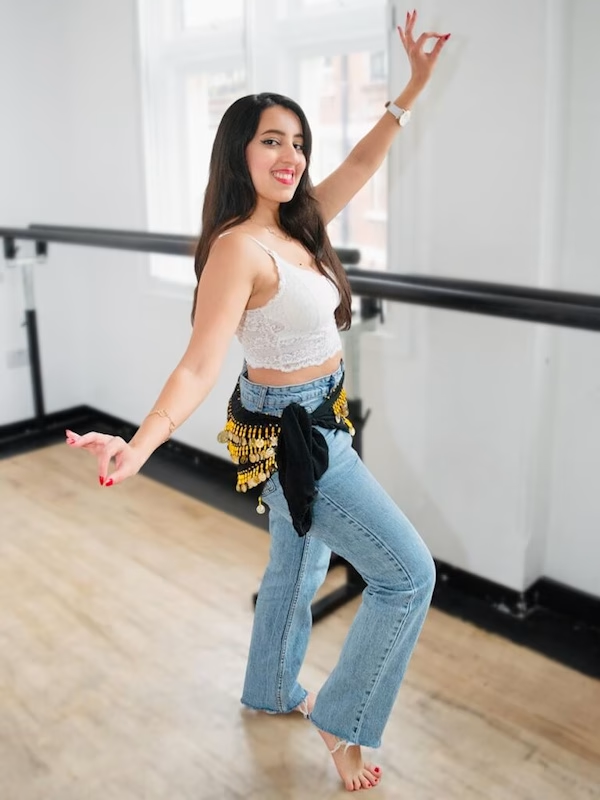
Since I was a teenager, dance has been my sanctuary, a place to heal and let emotion out. When I moved to London, I found it was the best way to break barriers and connect with people, simply as people. For me, dance and cultural storytelling can’t be separated; every traditional movement carries a story, a history, and a piece of a people’s soul. Whenever I meet someone from a different background, I ask about their traditional dances and learn their movements, and after they share a piece of their culture, I show them ours. It’s how I open up dialogue, celebrate difference, and find the things we share.
Your work goes far beyond performance – it’s about creating immersive cultural experiences. What emotions or conversations do you hope people leave with after meeting you or joining one of your tours?
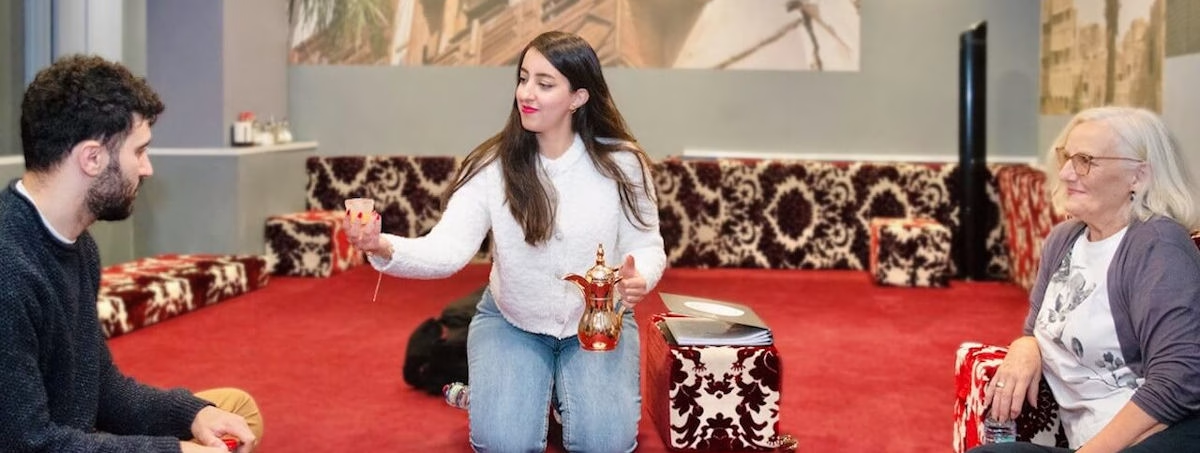
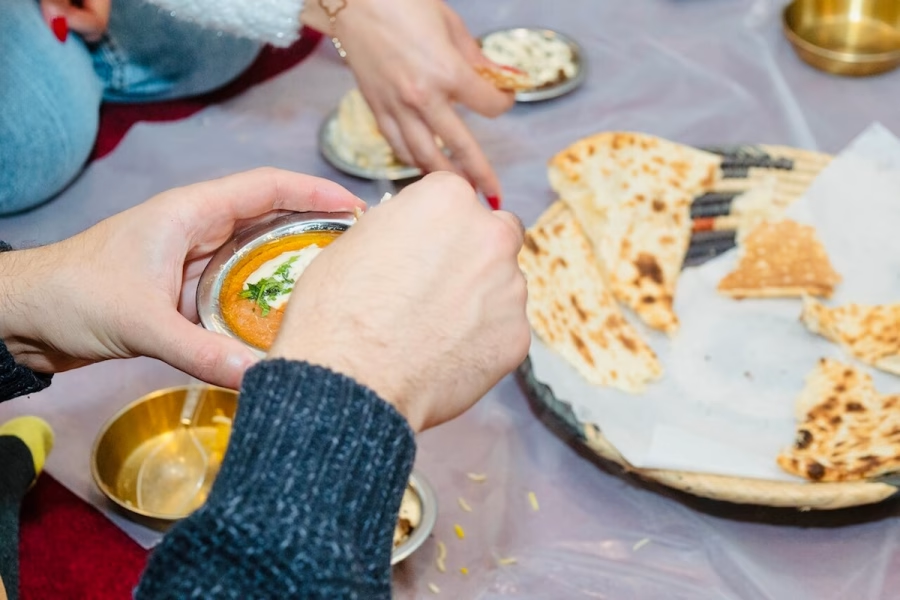
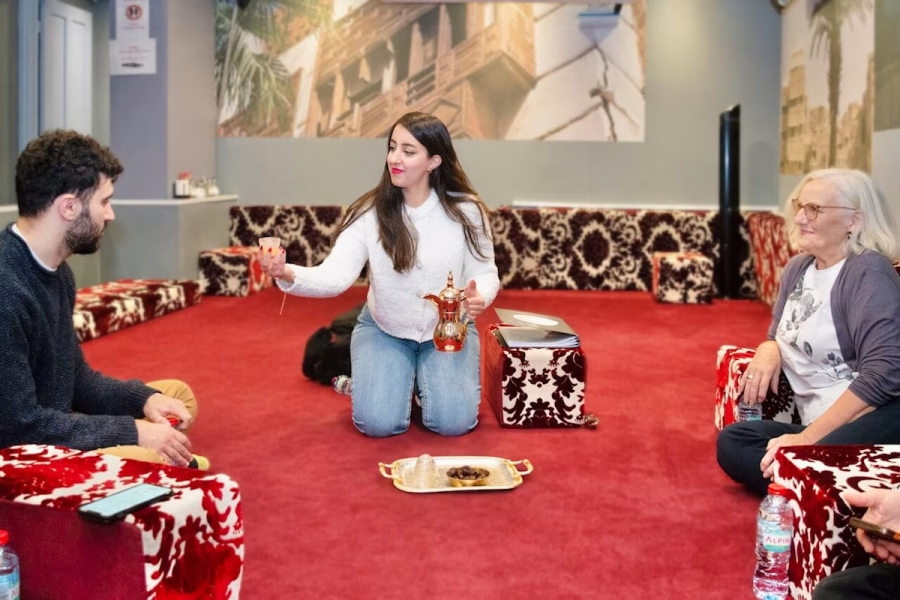
I always say my experiences aren’t tours; they’re an invitation into a Saudi home. I want guests to feel our hospitality, taste our food, and see a glimpse of our ordinary daily life. We travel together from our past into our present, and I show them how we lived through huge, fast changes using our music and art. What I really want is for people to leave feeling welcomed, curious to know more about us, and with a genuine respect for how layered and real our culture is.
You’ve spoken about dance becoming “a way of expressing identity, culture and womanhood beyond expectations.” What does that mean to you today?
Today, it means reclamation and liberation. Society often places rigid expectations on how women, especially Arab women, should behave, look, or express themselves. To me, dance is a powerful tool for emotional release and body positivity. It allows women to reclaim their narrative, celebrate their natural femininity, and connect with their inner strength on their own terms, entirely free from external judgment.
How has moving from Saudi Arabia to London influenced the way you express your culture creatively?
Moving to London gave me a broader mirror and a completely new perspective on my own roots. I was deeply inspired by London’s rich cultural and ethnic diversity, but what truly fascinated me was realizing how much it mirrors the cultural and ethnic diversity back home in Saudi Arabia, contrary to the flat stereotypes people often have about us. This realization gave me a wider, more nuanced angle to look at my heritage. London simply provided the global platform and the diverse space to share my personal heritage as an immersive, relatable art form that connects with people from all walks of life.
Saudi Culture Through Experience
Your Saudi Experience Tour in London offers a multisensory lens into Saudi culture. Why did you want to create something experiential rather than educational in the traditional sense?
Traditional education often relies on passive listening, which can easily be forgotten. In my experiences, we engage almost all the senses: hearing, smell, sight, taste, and touch, because sensory immersion creates an immediate emotional connection. When you combine the aroma of authentic Bukhoor, the distinct taste of Arabic coffee, and the rhythmic beat of our music and dance, you aren’t just learning facts; you are feeling them. From a psychological perspective, connecting information to emotions and senses drastically deepens memory retention. Our guests don’t just leave with information; they leave with a lasting sensory memory that stays with them forever.
What are the biggest misconceptions people often have about Saudi culture before they join your experiences?
The biggest misconceptions often stem from flat media narratives that paint our culture and society as entirely monolithic. For instance, people in the West often assume that everyone in Saudi Arabia belongs to the exact same ultra-wealthy social class, which completely erases our rich social fabric and diverse working communities.
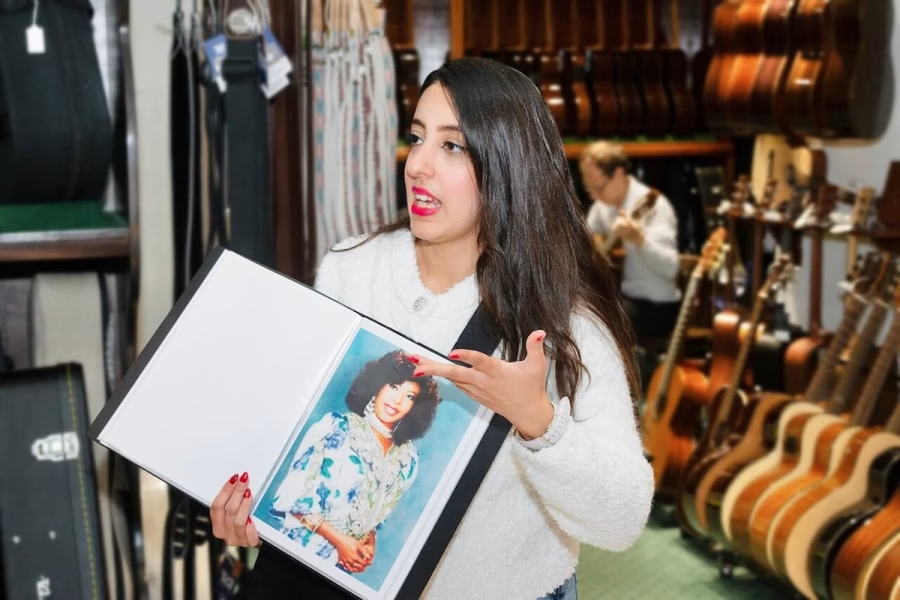
This monochrome view extends to our lifestyle and fashion; many in London assume the black abaya is our only traditional attire. During my tours, I love to challenge this by showing historical photos of our heritage, revealing a stunning world of vibrant, colorful, and richly embroidered traditional dresses.
Similarly, to break the stereotype that Saudi women have historically been disconnected from art, I share inspiring stories of remarkable Saudi women pioneers in music and performance. My goal is to show that our culture is multidimensional, rich, and full of joy and female creativity.
You introduce guests to music, movement, food, storytelling and ritual. Why is sensory immersion such a powerful way to build cultural understanding?
Sensory immersion gives people the rare opportunity to experience a culture firsthand and form their own judgments, rather than just consuming narratives filtered through the media or social media. It brings a culture that feels geographically distant right to their doorstep.
I always say that this experience is like a portal for cultural and time travel; in just three hours, guests are transported thousands of miles away and decades back into our heritage. By hearing, tasting, and feeling the culture ourselves, we bridge that geographical gap, creating a close, human connection that no screen or textbook could ever replicate.
What moments during your tours tend to surprise or move guests the most?
While guests genuinely enjoy and engage with every part of the experience, there are two distinct moments that move them the most.
The first is a delightful sensory surprise, tasting traditional Arabic coffee and our authentic food. The flavors are completely new to many of them, and seeing their faces light up with enjoyment is beautiful.
The second, and perhaps most impactful moment, is when I share my personal journey. They are deeply moved when I talk about how I became a professional dancer in an environment with no formal schools for music or dance. I open up about how movement became my sanctuary and my way of navigating personal and emotional challenges, leading to the pivotal moment I decided to pursue this art professionally. It bridges a deep human connection, showing them that behind the culture, there is a real story of resilience.
How important is human connection in breaking down cultural stereotypes?
In today’s world, there are countless forces driving us apart: the relentless pace of life, the endless negative news, political conflicts, and economic pressures. We have become so consumed by daily survival and global noise that we often drift away even from our own families and friends. If we look closely, almost everything around us isolates us.
The only force I have found that truly bridges these divides and brings nations together is art, in all its forms. Art and storytelling are the universal languages of human connection. When we sit together, share a story, and feel the rhythm of music or dance, all those manufactured barriers dissolve. We remember our shared humanity, and that is how real cultural empathy is born.
Dance, Movement & Empowerment
Belly dance is often misunderstood in Western culture. What do you wish people understood about its heritage and meaning?
Belly dance has a long history that has been whitewashed or misunderstood in the West. Its roots go back more than 7,000 years to ancient Egypt, where it began as a sacred ritual in the temples.
Old temple carvings show dancers in minimal dress, cut to highlight the movement of the body with the music.
Over the centuries, it spread across the Middle East. For us in Saudi Arabia, it reached our homes through the golden age of Egyptian cinema in the 1950s and 60s, and we grew up watching icons like Samia Gamal, Taheyya Kariokka, and Naima Akef, copying their movements at our own celebrations, just for women.
But this art has had a hard time. It has been suppressed by religious extremism, objectified by modern attitudes, and distorted by European colonial travellers, whose orientalist gaze reduced it to something crudely sexual and gave it the name‘belly dance’. We call it Oriental or Egyptian dance because it is tied to heritage, storytelling, and emotion, not just stomach movements.
And now, psychology and medicine are catching up to what we always knew: that the dance is genuinely good for women, physically and mentally, and helps them feel at home in their bodies again.
You’ve used dance as a tool for confidence, joy and self-expression. How transformative can movement be, especially for women?
Dance changed me, in a really personal way. For a long time, I struggled with social anxiety and shyness, but belly dance became how I healed. The more I learned about its history, the more I realised it was originally made to celebrate the female body, its strength and its fertility, from a time when womanhood was honoured rather than shrunk down.
That’s the opposite of today’s modern reality, where women’s bodies are constantly objectified, not just in dance but across society. Through movement, I learned to take my body back, to love it, to make peace with it. It gave me my voice and my confidence. That’s what I try to pass on to other women now: helping them get free of the anxiety, feel good in their bodies, and find their own real strength.
Teaching dance requires vulnerability, trust and energy. What have your students taught you in return?
Teaching dance is a profound exchange of energy and trust, and my students teach me so much in return. The group that has impacted me the most is mothers.
Mothers are always giving everything they have to their families and children, often putting themselves last. When they come to my class, they tell me they finally want to do something just for themselves, to reclaim a piece of who they are.
Seeing them let their guards down and hearing them describe how this movement indirectly transforms their daily lives has a massive, deep meaning to me.
I have never experienced motherhood myself, so the moment they open up and share these maternal vulnerabilities and emotions completely mesmerizes and inspires me. They have taught me that joy is a form of resistance against daily exhaustion, and that when women create a safe space to lift each other up, deep healing happens naturally.
You’ve worked with different age groups and communities. How do you adapt your teaching style depending on who’s in the room?
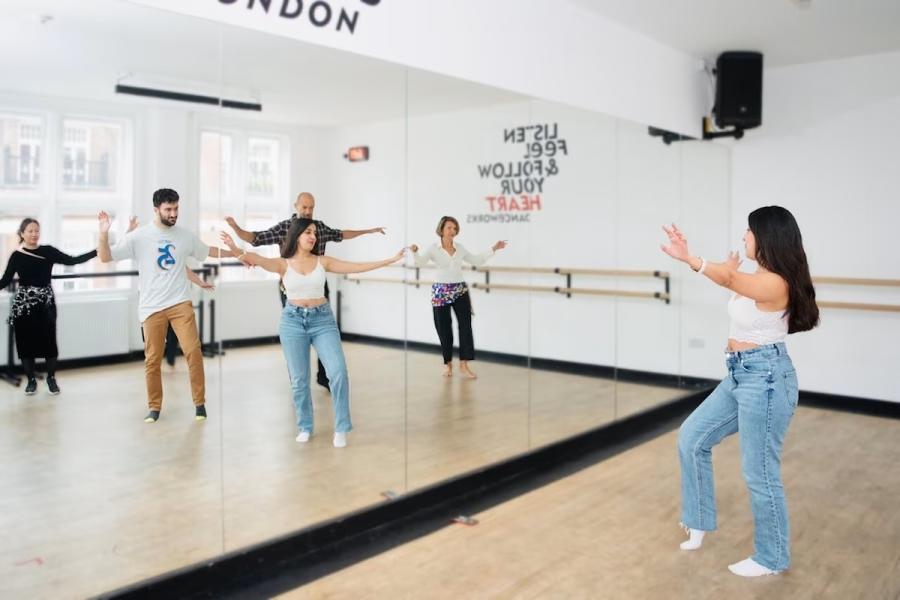
Adapting to the room is the most important skill for a dance instructor. It’s not just about teaching steps; it’s about reading the energy and backgrounds of the people in front of you.
When I work with older age groups or beginners who might feel intimidated, my focus is on breaking down the techniques gently, prioritizing comfort, body awareness, and making sure they feel safe and free from judgment.
If I have students from Western backgrounds, I spend more time explaining the cultural context, the rhythm, and the emotional expression behind the movements so they can connect with the soul of the dance, not just the physical technique.
For women from Arab or migrant communities, the class often becomes a beautiful space for nostalgia and cultural reclamation.
My ultimate goal is to meet every woman exactly where she is, adapting my pace and language so that everyone leaves the room feeling seen, capable, and uplifted.
What role does femininity play in your work and artistic identity?
Femininity in my work is about being unapologetically visible. It is a profound source of inner strength and creative power, far beyond any shallow societal mold. For me, embracing femininity means performance and spectacle without apology.
My presence in the room or on the stage is a bold declaration of my existence, exactly as I am, without making myself smaller or shrinking to fit into anyone else’s expectations or spaces.
Society often tries to police women’s bodies and expressions, but through Oriental dance, I celebrate a femininity where softness meets fierce power. It is about helping women feel at home in their own skin, standing tall, owning their space completely, and recognizing that our natural essence is fluid, powerful, and deeply sacred.
Travel, Inclusion & Representation
You work within the travel and cultural experience space at a time when travellers are seeking deeper authenticity. Do you think tourism is becoming more emotionally driven?
Absolutely. Seasoned travelers today are no longer satisfied with standard sightseeing; they are driven by a deep cultural and intellectual curiosity. They want to experience true authenticity and encounter perspectives that enrich their worldview.
However, there is an incredible, untapped opportunity for the wider tourism industry to embrace this shift.
By collaborating more closely with local individuals and impactful social enterprises, like Women in Travel CIC, companies can expand beyond traditional itineraries. True, emotionally driven tourism is built through genuine partnerships with the people who live and breathe the culture, and bridging this gap is the next exciting step for modern travel.
How can immersive experiences help travellers move beyond “surface- level tourism”?
Surface-level tourism views a destination merely as scenery or a backdrop for photos. Immersive experiences, on the other hand, invite travelers to step inside the living room of the culture.
When a traveler sits with local people, shares an authentic meal, listens to our traditional instruments like the Oud, or learns the cultural context behind our movements and hospitality, a profound shift happens. They stop observing and start connecting.
These experiences humanize history and culture. By engaging all the senses and fostering personal interactions, immersive tourism transforms a trip into an emotional and educational journey, leaving the traveler with a deep understanding and empathy rather than just a collection of souvenirs.
Why is representation and cultural nuance so important in modern travel experiences?
Representation and cultural nuance are absolutely vital because, for too long, the culture of the Khaleej and the wider Arab world has been viewed through a flattened, monolithic, or external lens. True representation means that we, the people of the culture, stand as the authors of our own narratives. When I share my heritage as a Saudi woman, artist, and professional, the culture is spoken through its authentic voice, not filtered through a stranger’s gaze.
This is where cultural nuance becomes magical. To an outsider, dance or traditional clothing from the Khaleej might all look the same, but the beauty lies in the rich diversity. Even within Saudi Arabia itself, traditional costumes, rhythms, and dances vary immensely from one region to another; what you experience in the Hejaz is entirely different from Najd, let alone the rest of the Arabian Gulf and Arab world.
Recognizing the symbolism behind a specific hand movement, understanding the distinct regional styles, or knowing the precise etiquette of serving Arabic coffee, these are the nuances that give a culture its dignity and true value. Modern travel must honor these details, because moving beyond surface stereotypes is the only way to show the world the true depth and sophistication of our heritage.
What does inclusive cultural storytelling look like to you?
To me, inclusive cultural storytelling means weaving a narrative where no one feels like a stranger.
Historically, cultural stories have focused on grand official timelines, overlooking the shared human threads that connect us all. In my work, inclusive storytelling is about bringing these connections to light.
For instance, look at music: the guitar was originally inspired by the Oud, and as my mentor Alessandra, the founder of Women in Travel CIC, once shared with me, the soulful melodies of the Oud resonate deeply and feel so close to traditional Italian music.
We see similar threads in how something as sacred as incense (Bukhoor) is used across various African cultures, or in the thousands of shared Arabic words found in languages worldwide. When I share my heritage, it is not to show how different we are, but to create a safe, welcoming space where people from all walks of life, regardless of their background, age, or heritage, can recognize a piece of their own human story in our culture.
Do you believe travellers today are more curious about local voices and perspectives than they were a few years ago?
Yes, absolutely. Even though my journey in the travel space is a recent one, looking at it through the lens of an artist and content creator gives me a very clear perspective.
Social media has sparked a massive knowledge revolution, fueling a deeper curiosity in people worldwide. Because of this, we are seeing a beautiful shift toward true cultural appreciation rather than just superficial inspiration.
Travelers today are no longer satisfied with standard, curated packages; they want to take what they see on their screens and turn it into genuine, real-life human connection. In my experience, when people engage with a culture or join a dance workshop, they don’t just want to copy movements; they come with deep, thoughtful questions about the history and the roots.
They want to hear from local voices directly because they know that true respect and understanding cannot be found in a traditional guidebook.
Creativity, Courage & Personal Growth
Building a career around culture and creativity takes courage. Were there moments where you doubted yourself or felt misunderstood?
To be honest, I have often felt misunderstood, but instead of letting that discourage me, it became my greatest inspiration. It is exactly what pushed me to express myself and to create artistic and cultural dialogues that prove dance is a profound language, not just entertainment.
Of course, there were heavy moments where self- doubt crept in, and I wondered if I could truly translate these big, deep ideas into reality. I still carry so much more within me, and while I may feel limited right now by many circumstances, I remind myself that every great journey must have a beginning, and this is mine.
What has been the biggest personal challenge in pursuing an unconventional path?
The biggest personal challenge has been standingfirmin my truth while facing the heavy, objectifying gaze that society often casts upon a woman’s body and the art of dance.
When you choose an unconventional path that challenges deep-rooted cultural taboos, you become a target for harsh criticism and judgment, especially on social media. Under the weight of these social pressures and the daily financial struggles of living in an expensive city, it would have been so easy to capitulate, to hide, choose a predictable job, and let my old anxieties and inner doubts take over.
But the real victory was in refusing to let that fearful part of me win. I had to transform that intense pressure into fuel, choosing to look past the superficial stereotypes and remember that my work is about restoring dignity to this heritage. It is about proving that movement is a profound language of expression, culture, and women’s empowerment, not a space for judgment.
How do you stay connected to your roots while also evolving creatively in a global city like London?
Living in London has actually given me the space to see my roots with much greater clarity and to evolve them artistically.
Having been born and raised in Saudi Arabia, that culture is naturally deeply embedded in who I am.
However, it was only when I interacted with the vast diversity here that I truly realized the uniqueness of my difference, which filled me with a deeper sense of pride. In our Arab culture, traditional hospitality is beautiful, but it can sometimes come with a lot of social pressure and rigid expectations.
What I love about London is how simple, practical, and authentic daily life is; people connect comfortably without pretension. This environment has allowed me to shed the unnecessary societal pressures while holding on tightly to the essence of my heritage.
Even though my current lifestyle is different, I still deeply love the Arabic language, my coffee, and sharing our traditions. I have managed to merge the best of both worlds, creating a balanced space where I evolve creatively without ever feeling lost.
What motivates you to keep creating and sharing your culture with others?
To be honest, being the first performance artist and dancer from Saudi Arabia to take this path means the road is rarely smooth.
The vast majority of comments I receive from the Arab world are filled with backlash, judgment, and harsh bullying. It is a heavy thing to face. Yet, amidst all that noise, I receive messages of pure gratitude from time to time. These rare, deeply moving messages come from people, often Arabs themselves, who tell me that what I am doing is exactly what they needed to see.
They see my work as a breath of fresh air in a world full of superficiality. These notes of appreciation are my true motivation.
They remind me that real impact isn’t about pleasing the masses; it’s about touching the lives of those who crave depth and cultural dignity. Knowing that I can provide that safe space and artistic depth for even a few people is what keeps me creating, no matter how loud the rejection gets.
What does success look like for you beyond career achievements?
Beyond career achievements and numbers, success to me is deeply personal.
I often speak about women’s empowerment and wanting to help others, but the truth is, this journey is about empowering myself first. Everything I create, every movement I perform, is a profound declaration of my own existence, my art, and my freedom.
For a long time, I searched for a certain kind of inspiration and strength in the people around me, but I couldn’t find it. So, to me, success means becoming the very inspiration I always looked for in others.
By liberating and healing myself through my art, I naturally create a map for other women to do the same. Success is standing fully in my own power, knowing I refused to be erased.
The Future
What kinds of cultural experiences would you love to create next?
Looking ahead, my vision is to bring belly dancing into the world of wellness tourism, integrating it alongside practices like yoga for relaxation and healing.
I want to transform my framework into evidence-based tools, showing that belly dance is not just for entertainment, but belongs in clinical settings and wellness retreats alike.
My goal is to design immersive wellness travel experiences where women can use the emotional power of this movement to overcome social anxiety, blending travel, cultural heritage, and mental well-being into a scientifically grounded method.
Do you see immersive cultural storytelling becoming a bigger part of the future of travel?
Absolutely, I see it becoming highly popular in the near future. Travel is no longer just about sightseeing; it’s about searching for meaning and human connection.
Organizations like ‘Women in Travel CIC’ have already spearheaded this movement by launching non-traditional, immersive cultural experiences.
As with any highly innovative concept, it takes time at first for the public to fully grasp it. However, I am incredibly optimistic. Once travelers experience this depth and live the stories firsthand, it will spread rapidly.
People are craving authenticity, and immersive storytelling is the future of how we experience the world.
What would you love people to feel when they think about your work?
I want people to feel a sense of authenticity and inspiration. When they think of my work, I want them to connect with the genuine, raw depth of our cultural heritage, free from any superficiality.
At the same time, I want my journey to spark an inner inspiration within them, giving them the courage to embrace their own freedom, connect with their bodies, and stand proudly in their truth.
If you could change one perception about Arab women through your work, what would it be?
I don’t set out to represent all Arab women, and many may not see me as their representative, because the path I’ve chosen is an unusual one.
Arab women, like women anywhere, simply want to be treated as equals, with full humanity. For myself, I refuse to be seen through a lens of pity. I’m not here to fit a stereotype, and I don’t need anyone’s condescending validation.
I live with dignity, I make my own choices, and I stand in my own power as an independent creative.
Quickfire
Desert nights or city lights?
City lights
Coffee ceremony or dance workshop?
Dance workshop
Silk costumes or everyday denim?
Silk costumes
Favourite Saudi dish to introduce to first-time visitors?
Areekah
Music that instantly transports you home?
A traditional folk song called Khatwa Junobiyah (southern step)
London hidden gem?
A small, quiet park right near my home. I prefer to keep its name a secret, it’s my personal sanctuary where I can just be with myself and connect with nature.
A scent that reminds you of childhood?
Fresh basil and Taif rose. This kind of rose you can’t find anywhere else.
Sunrise dancer or midnight creative?
Both
Tea house conversations or rooftop gatherings?
Rooftop gatherings
One place in Saudi Arabia everyone should experience?
Red Sea coast
Favourite way to instantly connect with new people?
Asking them to teach me a word from their language or a move from their traditional dance.
Traditional rituals or modern reinventions?
Modern reinventions
Most unforgettable audience reaction you’ve had?
After performing Moroccan Chaabi, a Moroccan woman told me, ‘You must be Moroccan. In our culture, when we grieve, we don’t cry, we dance.’ Hearing that my emotion reached her that deeply was unforgettable.
One item always in your bag?
My cell phone
A song you could dance to forever?
Dom Dom – Mahmoud El Esseily
What does luxury mean to you personally?
The luxury of being completely myself.
Your dream cultural collaboration?
Nora Fatehi
One thing people never expect about you?
Crazy in a good way ^_^
Favourite way to unwind after performing?
Scrolling social media
If your work had a single message, what would it be?
Be yourself