Adrián García: Reimagining the wild – Luxury. Nature. Inclusion.
Meaningful inclusion requires co-design with people who experience barriers, investment in universal design principles from the beginning, deep staff training in empathy and adaptive service, multiple pathways to experience (physical, assisted, sensory-rich, virtual hybrids), and honest measurement of who actually participates and how they feel.
◦ 21 min readReimagining the wild
Luxury. Nature. Inclusion.
Innovation, Technology & Purpose
You’ve built a career spanning venture capital, academia, technology and entrepreneurship. What initially drew you into the intersection of innovation and impact?
I was drawn by the conviction that technology and innovation are most powerful when deployed in service of human flourishing and planetary health — especially in regions like Central America with immense untapped potential. Founding and leading Carao Ventures allowed me to back purpose-driven founders tackling real problems in fintech, healthtech, and sustainability. Joining Böëna Lodges as CIO has made that intersection tangible: I now apply data, AI, systems thinking, and digital tools directly to enhance guest experiences while advancing biodiversity conservation across thousands of hectares and creating meaningful opportunities for local communities. It is impact you can see, feel, and measure in the wellbeing of guests, ecosystems, and people.
You played an important role in shaping startup and venture ecosystems across Central America. What excites you most about the region’s future today?
What excites me most is the powerful combination of world-class talent, extraordinary biodiversity as a living laboratory for climate and biotech innovation, and a cultural resilience best captured by ‘pura vida.’ Central America is no longer just adopting global tech — it is leapfrogging in areas like regenerative tourism tech, inclusive fintech, and AI applied to conservation and agriculture. The next decade will see home-grown solutions with global relevance, driven by founders who understand both local realities and planetary challenges. I am particularly optimistic about ecosystems that blend technology with nature-based solutions and community empowerment.
How did your experience at Amazon influence the way you think about leadership, systems and guest experience within hospitality?
Amazon deeply shaped my thinking through its customer obsession, data-driven rigor, and leadership principles — ownership, frugality, high standards, and delivering results. I learned to build scalable systems that remove friction and create seamless experiences while empowering teams. At Böëna, I translate this into hospitality by designing guest journeys that feel magical because they are intelligently orchestrated behind the scenes. We use analytics and AI to anticipate needs and optimize operations (energy, personalization, predictive service), yet the front stage remains profoundly human: our local guides and staff delivering warmth, storytelling, and genuine care. The Amazon mindset helps us deliver consistent excellence at scale without ever losing the soul of place and people.
Technology Meets Luxury Hospitality
At Böëna Lodges, you oversee IT, AI strategy, analytics and ESG initiatives. How can technology elevate luxury hospitality without losing authenticity or human connection?
Technology elevates luxury when it works invisibly to remove friction and enable anticipation, while the visible experience stays rooted in human warmth and nature. At Böëna we deploy AI and analytics for predictive personalization — suggesting the right activity or preparing a guest’s preferred tea after a rainy hike — and smart systems for sustainability and operational excellence. But we deliberately keep tech in the background. Our lodges have no intrusive screens or gadgets in guest spaces. The magic comes from our people: Cabécar guides sharing ancestral knowledge, staff remembering a returning guest’s favorite birding spot, or a spontaneous moment of connection. Technology amplifies care; it never replaces it. Authenticity is non-negotiable.
What role do you see AI playing in the future of sustainable travel and guest personalisation?
AI will be transformative in two interconnected ways. First, hyper-personalization at scale: understanding a guest’s pace, interests, energy levels, and even unspoken preferences to craft journeys that feel bespoke and emotionally intelligent. Second, sustainability intelligence — optimizing energy and water use in real time, predicting maintenance needs to reduce waste, monitoring biodiversity through camera traps and acoustic sensors, and enabling transparent impact reporting. The future belongs to ‘quiet AI’ that anticipates needs so seamlessly guests feel deeply cared for, while simultaneously helping us protect the very ecosystems they come to experience. The human handoff remains essential; AI handles complexity so people can focus on presence and magic.
Böëna’s lodges are deeply immersed in Costa Rica’s natural ecosystems. How do you approach integrating advanced technology into environments rooted in wilderness and conservation?
We integrate technology with humility and restraint. Every solution must answer: Does this protect or enhance the wilderness character? Does it reduce our footprint? Does it empower staff and guests without distraction? Examples include AI-powered biodiversity monitoring and anti-poaching camera systems, renewable energy optimization platforms, low-impact guest apps that encourage mindful exploration rather than screen addiction, and digital tools that help our teams deliver more personalized, anticipatory service. We avoid anything that feels extractive or visually intrusive. The best technology in wilderness settings is often the one you barely notice — it simply makes the experience safer, more comfortable, more insightful, and more regenerative.
How can data and analytics help create more emotionally intelligent hospitality experiences?
Data becomes emotionally intelligent when it informs empathy rather than replacing it. By analyzing preferences, past stays, feedback, and even subtle signals (time spent on certain activities, weather correlations), we can anticipate needs and create thoughtful surprises — a favorite book left in the room, a guide briefed on a guest’s birding passion, or a private sunrise moment prepared for a couple celebrating an anniversary. Sentiment analysis from reviews and direct feedback helps us address friction before it becomes disappointment. The key is the human layer: data surfaces insights; our team, trained in genuine care and local knowledge, turns those insights into moments of connection and delight. Data removes guesswork so humanity can shine brighter.
Sustainability & Conscious Luxury
Luxury travellers today increasingly seek meaning, purpose and environmental responsibility. How do you define luxury in 2026?
Luxury in 2026 is the rare combination of profound restoration, authentic connection, and quiet purpose. It is not ostentatious display but the feeling of being truly well — in body, mind, and spirit — because you are immersed in pristine nature, cared for with thoughtful anticipation, and confident that your presence contributes positively to the places and people you encounter. At Böëna, our name itself comes from the Cabécar word for a deep sense of wellbeing. Luxury is the freedom to be fully present, the joy of unexpected wildlife encounters, the warmth of horizontal conversations with local staff, and the knowledge that these wild places will endure for future generations. It is transformative, not transactional.
Böëna places sustainability and environmental stewardship at the centre of its identity. How important is conservation to the future of luxury hospitality?
It is existential. The pristine ecosystems we protect — thousands of hectares of primary rainforest, cloud forest, and coastal habitats — are our greatest asset and the foundation of every guest experience. Without robust, measurable conservation (carbon-positive operations, biodiversity monitoring, habitat restoration, community partnerships), there is simply no long-term product to sell. Conscious travelers increasingly choose and pay premiums for operators who can prove positive impact. Conservation is also risk mitigation against climate disruption and brand differentiation in a crowded market. Most importantly, it is the right thing to do. Luxury hospitality that ignores its ecological footprint is building on sand.
Do you believe travellers are becoming more mindful about the environmental and social impact of where they stay?
Yes, and the trend is accelerating. We see it in booking inquiries, guest conversations, and post-stay feedback. Families and younger travelers especially want verifiable impact — carbon accounting, community benefits, wildlife protection metrics, and transparent ESG practices. They research operators, ask hard questions, and are willing to pay for authenticity. This is reshaping the industry toward regenerative models. Operators still treating sustainability as marketing theater will lose trust and relevance. The shift is healthy and long overdue; it rewards those of us who have always placed stewardship at the core.
Costa Rica has become a global benchmark for sustainable tourism. What lessons can the wider hospitality industry learn from the country’s approach?
Several powerful lessons: First, long-term vision — protecting over a quarter of the territory created a unique asset that now drives the economy. Second, community at the center — local hiring, training (like our School of Guides), and benefit-sharing build resilience and authenticity. Third, innovation rooted in place — ecolodges pioneered experiences that competitors now copy worldwide. Fourth, cultural foundation — ‘pura vida’ is not a slogan but a lived ethos of resilience, warmth, and harmony with nature. Finally, measuring what matters: biodiversity health, guest transformation, and local prosperity alongside revenue. The world can learn that nature is not a constraint on luxury but its highest expression.
Entrepreneurship & Leadership
You’ve founded, advised and invested in numerous ventures. What separates ideas that succeed from those that fail?
Successful ideas solve a real, painful problem for a defined audience with a clear, defensible value proposition and a team capable of relentless execution and adaptation. They achieve product-market fit quickly, demonstrate traction (users, revenue, or impact metrics), and attract aligned capital and talent. Failures most often result from building something nobody truly needs, weak or misaligned teams, running out of runway before finding fit, or losing sight of the original purpose in pursuit of growth for growth’s sake. The differentiator is usually founder resilience, customer empathy, and the discipline to kill or pivot ideas based on evidence while holding the vision steady.
How has leadership changed in a world shaped by AI, digital transformation and shifting global priorities?
Leadership has become more human, adaptive, and purpose-driven. Technical competence remains essential, but the ability to navigate ambiguity, foster psychological safety, champion ethical technology use, and build inclusive, resilient cultures now defines great leaders. Command-and-control is obsolete; influence through clarity, empathy, and shared purpose is ascendant. In hospitality specifically, leaders must model genuine care while leveraging AI and data as powerful tools rather than ends in themselves. The best leaders today are comfortable being learners, empower distributed decision-making, and hold themselves accountable to broader stakeholders — guests, teams, communities, and the planet.
Many businesses pursue innovation for growth alone. How do you ensure innovation remains connected to human and environmental impact?
We anchor every initiative in a clear purpose statement and evaluate it against multiple bottom lines: guest wellbeing and emotional resonance, measurable conservation outcomes, team empowerment and fulfillment, and long-term financial sustainability. We ask hard questions early: Does this deepen connection to nature or distract from it? Does it create dignity and opportunity for local people? Is it ethical and privacy-respecting? We involve diverse voices — including frontline staff and community partners — in ideation and testing. We are willing to slow down or abandon projects that feel extractive or inauthentic. Innovation without purpose is noise; innovation in service of flourishing is the only kind worth pursuing.
You’ve worked extensively as a professor, mentor and advisor. What advice do you most often give emerging entrepreneurs and leaders?
Stay relentlessly curious and humble — the world changes too fast for expertise alone. Build authentic relationships; your network is your greatest asset and often your safety net. Focus on solving real problems with integrity; impact and opportunity follow purpose more reliably than chasing trends. In our region, root deeply in local realities and strengths while thinking and acting with global ambition. Treat failure as high-quality data, not personal defeat. And never lose sight of the human element — whether you are building AI, investing in startups, or running lodges, success ultimately comes down to how you make people feel and the positive change you leave behind. Be the leader you would want to follow on your best and worst days.
Travel, Culture & Perspective
What do international travellers often misunderstand about Costa Rica beyond its reputation for eco-tourism?
Many visitors arrive expecting a beautiful but perhaps simplistic ‘nature playground.’ They often miss that Costa Rica is a sophisticated, innovative society with one of the world’s highest literacy rates, a long democratic tradition, vibrant arts and culinary scenes, and a deep entrepreneurial energy. Our biodiversity is unmatched in such a small territory — you can move from cloud forest to coral reef in a few hours — but it is the people and their genuine warmth that create the magic. ‘Pura vida’ is not marketing; it is a lived philosophy of resilience, gratitude, and harmony. Travelers who slow down and engage locally discover a country far richer and more nuanced than the postcards suggest.
What transforms a hotel stay into a truly memorable experience?
It is the accumulation of thoughtful, anticipatory details combined with moments of genuine human connection and awe. When a team notices your preferences without being asked — your preferred coffee after a long hike, a quiet corner prepared for reflection, a guide who remembers your fascination with a particular bird — it feels like magic. When you share laughter or stories with local staff who treat you as a guest in their home rather than a customer, the experience becomes emotional and relational. And when nature delivers an unexpected gift — a resplendent quetzal appearing at dawn, bioluminescent waves, or a perfect sunset — the stay becomes a story you carry for life. Perfection is forgettable; authentic care and wonder are transformative.
In a world increasingly driven by automation, why does human connection still matter so much in luxury travel?
Because luxury, at its deepest level, is emotional and relational. Automation and AI excel at efficiency, personalization at scale, and removing friction — all valuable. But they cannot replicate empathy, shared humanity, cultural storytelling, spontaneous joy, or the quiet comfort of being truly seen and cared for by another person. In wilderness lodges especially, the local guide who shares ancestral knowledge or points out a hidden orchid creates a memory no algorithm can manufacture. Human connection is the rarest luxury in an automated age. It is what turns a beautiful property into a place that changes how you see the world and your place in it. Technology should amplify humanity, never replace it.
Inclusive Hospitality & Accessibility
Böëna Lodges are immersed in remote natural environments that are not always traditionally associated with accessibility. Why has it been important for Böëna to actively pursue a more authentically inclusive approach to hospitality?
Because the restorative and inspirational power of pristine nature should not be reserved for the young and able-bodied. These wild places belong to everyone, and experiencing them can be profoundly healing and perspective-shifting for people of all abilities, ages, and backgrounds. We pursue authentic inclusion because it aligns with our values of stewardship and wellbeing for all. It also makes business sense — there is significant underserved demand — and it enriches our teams and culture. Designing for diverse needs often improves the experience for every guest. We see it as an extension of our conservation mission: protecting these places while ensuring more people can access their gifts with dignity and joy.
Luxury hospitality often speaks about inclusivity, but accessibility can still feel overlooked – particularly in nature-based travel. How do you move beyond surface-level inclusion toward something more meaningful and genuine?
Surface-level inclusion is ramps and policy statements. Meaningful inclusion requires co-design with people who experience barriers, investment in universal design principles from the beginning, deep staff training in empathy and adaptive service, multiple pathways to experience (physical, assisted, sensory-rich, virtual hybrids), and honest measurement of who actually participates and how they feel. We listen to feedback from guests with diverse needs, iterate constantly, and communicate transparently about what we can and cannot yet offer. Genuine inclusion feels invisible when done well — every guest, regardless of ability, has an equally magical, dignity-preserving experience and leaves feeling they truly belonged.
What are the challenges of creating more accessible experiences within protected wilderness environments, and how do you balance those realities with conservation priorities?
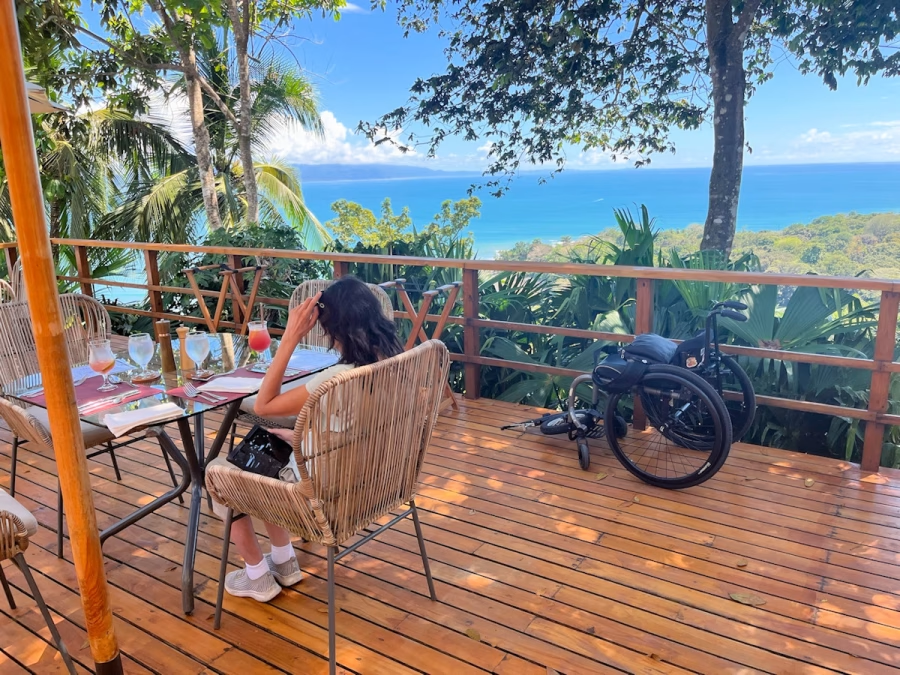
The challenges are real: rugged and protected terrain limits structural interventions, costs are high in remote locations, there is risk of visual or ecological intrusion, and safety considerations are complex. We balance by prioritizing low-impact, reversible solutions that enhance access without compromising wilderness character — elevated boardwalks designed to blend aesthetically, adaptive equipment (all-terrain wheelchairs, supported e-bikes), highly trained guides for assisted experiences, and creative programming that brings nature’s gifts to guests through multiple senses and formats. Every project undergoes environmental review. Conservation remains the non-negotiable foundation; accessibility expands the circle of people who become advocates for these places. Done thoughtfully, the two reinforce each other.
Do you think the travel industry still underestimates how many travellers want immersive nature experiences but are excluded by traditional assumptions around accessibility?
Yes, I believe the industry significantly underestimates this demand. Traditional adventure marketing often portrays extreme, physically demanding experiences aimed at young, fit travelers. Yet feedback from our guests and broader market signals show strong desire among seniors, families with diverse needs, people with disabilities, and those seeking gentler but still immersive nature connection. The benefits of time in wild places — restoration, wonder, perspective, connection — are universal human needs. By clinging to narrow assumptions, the industry misses a large, loyal, and growing market segment while also limiting who gets to become a lifelong advocate for conservation. Changing these perceptions is both an opportunity and a responsibility.
What would you like the wider hospitality industry to better understand about inclusivity within sustainable and experiential luxury travel?
I would like them to understand that genuine inclusivity and robust sustainability are not competing priorities but deeply synergistic. Universal design often creates better experiences for all guests. Broadening access builds a larger, more diverse constituency for conservation. Regenerative tourism — net positive for people and planet — is inherently inclusive. The industry should see inclusion as an investment in resilience, innovation, and moral leadership rather than a compliance burden or niche offering. It requires creativity, humility, and resources, but the return is stronger brands, more loyal guests, and a more just and sustainable form of travel. Nature’s gifts are too precious to keep exclusive.
What does authentic inclusivity mean to you personally as a leader, particularly within spaces that have historically been perceived as exclusive or inaccessible?
To me, authentic inclusivity means creating environments — physical, cultural, and emotional — where every person feels they have a rightful place and can participate fully with dignity. As a leader in remote luxury wilderness lodges that were once seen as exclusive domains, it means proactively removing barriers (physical, perceptual, economic, and cultural), amplifying voices that have been underrepresented in decision-making, and modeling curiosity, humility, and respect. It is personal because I believe access to nature’s transformative power is a fundamental human right, and leadership is a form of stewardship. My responsibility is to expand who gets to experience these places while protecting them for future generations. It is about widening the circle without diminishing the soul of the wilderness or the depth of the experience.
Personal Reflections
Was there a pivotal moment that fundamentally shaped your professional journey?
One defining moment was the decision to transition from the fast-paced worlds of venture capital and Amazon into the role of CIO at Böëna Lodges. It crystallized for me that the most meaningful innovation happens at the intersection of advanced technology, deep respect for nature, and genuine human care. Seeing how thoughtful systems, data, and AI could directly enhance guest wellbeing, support the protection of thousands of hectares of rainforest and cloud forest, and create dignified opportunities for local communities gave my work a new and profound sense of purpose. It felt like coming home — applying global lessons to the landscapes and people that raised me.
What is one professional setback that ultimately became one of your greatest lessons?
Early in my investing career, a venture that did not succeed as hoped taught me the irreplaceable importance of deep founder empathy, rigorous validation of real problem-solution fit, and building resilient, values-aligned teams over simply backing brilliant ideas or market trends. It sharpened my ability to assess not just the ‘what’ but the ‘who’ and the ‘why’ behind any venture or project. That lesson has served me equally well in technology leadership at Böëna: always start with the human fundamentals and the intended impact. Failure, when met with honest reflection, becomes some of the highest-quality data a leader can receive.
What continues to inspire your curiosity today?
I am continually inspired by the intelligence and resilience of Costa Rica’s ecosystems — every visit to the Osa or Monteverde reveals something new. I am inspired by the curiosity of children encountering wildlife for the first time, by the rapid evolution of AI as a tool for conservation and human flourishing when guided ethically, and by leaders who successfully blend technological sophistication with deep humanity and environmental stewardship. The stories of transformation we hear from guests, the progress of local guides we have trained, and the quiet wisdom available in moments of stillness in the rainforest keep my curiosity alive and my work meaningful.
When you think about the next decade, what kind of impact would you most like your work to have?
I hope to help establish Böëna Lodges as a global reference point for regenerative, inclusive, technology-enabled eco-luxury hospitality — a model that measurably protects and restores biodiversity, creates meaningful and dignified livelihoods for local communities, and offers transformative experiences that reconnect people with nature and with themselves. I would like to contribute to scaling these principles across Costa Rica’s tourism sector and sharing them with like-minded operators worldwide. On a personal level, I want to mentor the next generation of purpose-driven leaders and build a legacy my children can be proud of — one that demonstrates business can be a powerful force for human and ecological flourishing when rooted in principle, curiosity, and care.
Quickfire
Travel & Escape
Jungle lodge or contemporary city hotel? Jungle lodge — always. The immersion, the soundtrack of the forest, and the reset are unmatched.
Sunrise rainforest walk or sunset by the ocean? Sunrise rainforest walk. The dawn chorus as light filters through the canopy is one of the most magical experiences on Earth.
Carry-on only or impossible? Carry-on only. It keeps travel light, flexible, and focused on experience rather than logistics.
One destination you never tire of returning to? The Osa Peninsula and Lapa Ríos. Every single visit reveals new layers of wonder in the primary rainforest.
Favourite place in Costa Rica to completely switch off? A quiet deck at one of our lodges overlooking the forest or ocean, or the canals of Tortuguero at golden hour — pure nature, zero screens.
Innovation & Perspective
One technology that will redefine hospitality? Predictive, ethical AI that anticipates needs so seamlessly it feels like thoughtful human care — combined with invisible IoT for comfort and radical sustainability.
AI assistant or human concierge? A thoughtful hybrid. AI handles complexity, personalization, and logistics at scale; humans deliver empathy, local wisdom, storytelling, and the irreplaceable magic of presence.
A startup idea you wish you’d invented? A transparent, blockchain-verified platform that connects travelers directly to measurable regenerative projects and local community enterprises — impact you can see and trust.
Innovation should always be guided by…? Human flourishing, ecological integrity, and genuine empathy. Technology without soul or stewardship is just sophisticated noise.
One business trend you’re most excited about? The convergence of regenerative tourism and ethical AI — travel that actively heals people, places, and communities, powered by intelligent systems that reduce harm and amplify good.
Sustainability & Luxury
What does luxury mean to you personally? Time in wild nature with people I love, deep physical and mental restoration, meaningful conversations, and the quiet satisfaction of knowing my presence helps protect and regenerate the places I cherish.
One sustainability habit every traveller should adopt? Choose operators with transparent, third-party verified positive impact on biodiversity and communities; travel slower and deeper; offset unavoidable emissions; and engage respectfully as a guest, not a consumer.
Most unforgettable eco-luxury experience you’ve had? A private early-morning wildlife tracking session in the Osa that turned into a profound encounter with the intelligence of the forest — or sharing a perfect sunset with family after a day of discovery at Lapa Ríos.
A place where nature left you speechless? The primary rainforest of the Osa Peninsula at golden hour, when the light slants through the canopy and the forest feels ancient, alive, and deeply intelligent.
Leadership & Mindset
A mentor who shaped your thinking? Leaders at Amazon and MIT Sloan who modeled customer obsession and systems excellence with humility and high standards; also Costa Rican entrepreneurs who blend global ambition with deep local roots and integrity.
One quality every entrepreneur needs? Resilience — the capacity to absorb setbacks, extract the lesson quickly, and keep moving forward with purpose and curiosity intact.
Best leadership lesson you’ve learned? Culture and genuine care outperform strategy and systems alone. Invest in your people, model the values you preach, create space for others to contribute their best, and results — and loyalty — follow naturally.
Coffee meeting or boardroom presentation? Coffee meeting, without question. Real connection, trust, and the best ideas emerge in relaxed, human conversation far more often than in formal presentations.
One word that defines your approach to life? Purposeful. I strive to bring intention, principle, and care to everything — family, work, conservation, and the legacy I hope to leave for my children and the places I love.