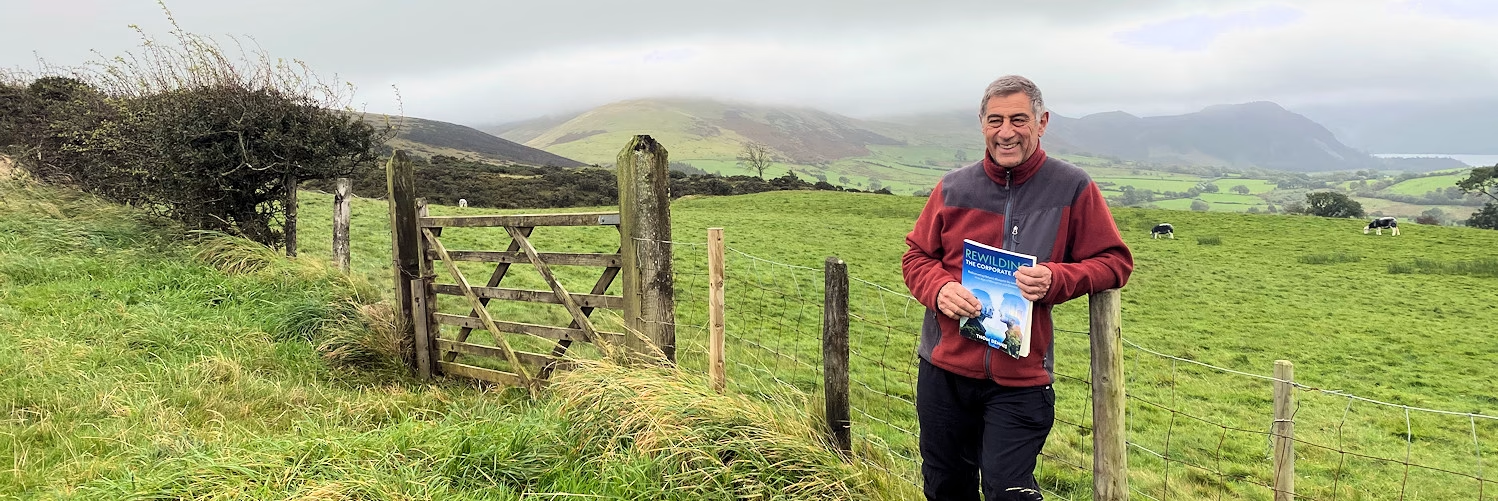
Thom Dennis: Conscious Leadership Development and Author
Today I see the harm leaders are wreaking on those for whom they are responsible, and also the surrounding communities and environment. Rewilding is where that realisation has brought me and it’s still about helping leaders take responsibility for their actions but now with the wisdom of nature as the mainstay.
◦ 11 min readThe Man Behind The Mission / The Journey
Thom, you have lived many lives – Royal Marines officer, corporate executive, entrepreneur, facilitator, executive coach, healer and now the author of Rewilding the Corporate Mind. When you look back, what thread connects every chapter of your life?
In 1992 I wrote a mission statement: “… I want to influence those in power so that their actions are directed to the greater good rather than self-glorification …” The root of this goes back to my treatment at prep school and later on it developed into taking healing into business. Today I see the harm leaders are wreaking on those for whom they are responsible, and also the surrounding communities and environment. Rewilding is where that realisation has brought me and it’s still about helping leaders take responsibility for their actions but now with the wisdom of nature as the mainstay.
You spent years in one of the world’s most disciplined military environments. What did the Royal Marines teach you about leadership – and what did you later have to unlearn?
The Royal Marines’ ethos has four values: Excellence, Humility, Integrity and Self-Discipline, and four elements making the Commando Spirit: Courage, Determination, Unselfishness and Cheerfulness in the Face of Adversity. I always aspire to live up to these very high bars. What I had to unlearn was the certainty that came with these standards. If you’re leading marines into a dangerous situation you need to demonstrate self-assuredness, and in a civilian humanistic environment I discovered that same quality closed people down. That was a hard learning.
Was there a defining moment when you realised traditional corporate leadership was no longer enough?
Yes! Two moments stand out. While I was still serving, a government minister directed me to adjust the facts in a briefing I’d submitted so they’d be palatable in the House of Commons. Later, having left the Corps, attending a major Oil & Gas conference in the US, I sat through an ethics briefing and realised the entire room was there for an annual sign-off, not to learn or examine their behaviour. In both cases the appearance of integrity was maintained while the substance was amoral. The capitulation to expediency is a place where integrity dies.
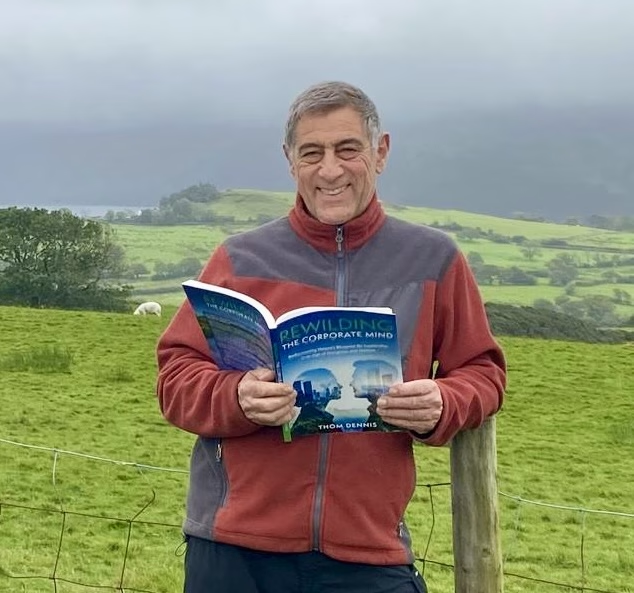
Rewilding leadership
The title of your new book is incredibly powerful. What exactly has the corporate world become disconnected from?
From itself as part of a wider system, primarily. Organisations are living systems, made of people, embedded in communities, and dependent on relationships. And yet the dominant model treats them as machines to be optimised. If you apply mechanical logic to something alive it doesn’t perform better, rather it’s more likely to break down. Look around, and we see the signs: burnout, stress, fear and imbalance. Nature isn’t the answer as metaphor, it’s a working template for how living systems actually sustain themselves. We’ve forgotten we’re one of them, and it’s a disconnection that comes at a huge cost.
You often draw parallels between organisations and natural ecosystems. What would businesses look like if they operated more like nature?
They would be characterised by trust, mutual respect, diversity of thinking, care for the individual and systemic awareness. They would also have a sense of purpose that extends beyond the quarterly return. Decision-making would be more distributed (nature has no head office). Failure would be understood as part of the cycle rather than something to conceal – in a forest, dead wood feeds new growth. And the organisation’s relationship with its surrounding environment would be one of reciprocity rather than extraction. Some organisations already operate this way, and they tend to be the ones people actually want to work for, when money does not trump purpose.
Is the biggest crisis facing organisations today really a crisis of humanity rather than performance?
I believe so. So much is changing all at the same time, and many leaders are clinging on to what they know in the hope of retaining a certain sense of equilibrium. Organisations underperform because the people leading them are operating from fear, disconnection and a deep uncertainty about their own worth which they mask by exerting control. Fix that, and performance tends to follow, but leave it untouched and no restructuring or target-setting will make much difference. A fever is not the illness; it’s evidence of it. In this case the illness is the loss of the capacity to see people as people – in leaders first, and then in everything they build. Most organisations fixate on the fever.
The Hidden Forces Inside Organisations
You work systemically, looking beyond visible problems to what lies underneath. What are the conversations leaders are most afraid to have?
The conversations leaders avoid most are the ones that require them to sit with uncertainty. In practice it sounds like: ‘If I address this, it may be right long-term but I’m not going to make my numbers this quarter.’ Or more simply: ‘It will make me look weak.’ Confrontation gets postponed because it’s uncomfortable and the outcome can’t be controlled. And anything that approaches a leader’s own limitations – the gaps they suspect are there but haven’t examined – tends to get routed into displacement activity or managed with aggression instead.
What doesn’t get said doesn’t disappear. It goes underground and shapes the culture from below.
Psychological safety has become a leadership buzzword. What does genuine psychological safety actually look like in practice?
It looks like a leader who can be disagreed with and remain curious rather than defensive. It looks like mistakes being named quickly rather than managed quietly. It looks like the quietest person in the room speaking, and being heard. A reliable signal of its absence is people saying in the corridor what they couldn’t say in the meeting.
It starts with the leader’s own relationship with uncertainty. You cannot create safety for others that you don’t have in yourself. So many organisations have the language of psychological safety and the architecture of its opposite.
What are the warning signs of an unhealthy organisational culture before anyone openly acknowledges there’s a problem?
The signals tend to be apparent long before anyone names them. Watch the jokes – dark humour directed at the powerless is an early indicator. How is power held and distributed? Watch whether people ask questions in meetings or have simply stopped offering their contribution. Watch how failure is handled: is it examined collectively with the aim of learning, or just assigned to someone? Blame, scapegoating, whistleblowers pilloried, communication that doesn’t move in either direction between the C-suite and the rest of the organisation – by the time these are visible, the culture has been unwell for some time. The earliest sign is usually the simplest: people stop saying what they actually think.
The Power of Unconventional Learning
You use methods ranging from Bohmian Dialogue and systemic constellations to equine-guided transformational learning. Many executives might see these as unconventional. What do horses and nature reveal that a spreadsheet never can?
You cannot lie to a horse! Ask a horse to walk with you and if it feels your authenticity, it likely will. Come with a dysfunctional team, tell the horse that everything is fine and watch the horse walk away; they are prey animals with huge hearts and a supremely developed sense of safety – inauthenticity creates unsafeness.
Nature works similarly but more slowly. Take someone out of the boardroom and into a landscape and the usual architecture of authority dissolves. The silence doesn’t defer to rank. What’s left is the person, often more clearly than they’d like. The patterns that drive decision-making in organisations – the anxieties, the defences, the habitual responses – become more easily observable. A spreadsheet tells you what happened, the natural world tends to show you why.
What has been the most profound transformation you have witnessed during a leadership retreat?
An executive realising in the middle of a session that his attitude and mindset had been poisoning his (and therefore the company’s) relationship with a customer. He immediately got up, went out of the room and phoned the customer, owned up to the part he had been playing in souring things, apologised and asked whether they could start again. The customer said yes and as a gesture of goodwill said he would pay the $5M he had been withholding.
Do the most powerful breakthroughs come from finding answers or asking better questions?
The question assumes the breakthrough happens in language. Often it doesn’t. The executive in the previous answer didn’t arrive at a better question, he had a moment of realisation that bypassed analysis entirely and sent him straight to the phone. Speaking as a coach, questions can be very useful for loosening the grip of certainty. And sometimes the breakthrough itself arrives in silence, or through the body, or from an unexpected direction. You cannot always think your way to finding an answer. What a good question can do is create the conditions in which something else becomes possible.
After more than 30 years working with senior leaders, what qualities separate those who truly inspire from those who simply hold authority?
Humility and curiosity as genuine orientation. The leaders who inspire tend to actively encourage people around them who think differently, which requires a security most authority figures don’t have. They also carry an integration of their own masculine and feminine – qualities that organisations often treat as opposites like strength and receptivity, decisiveness and genuine openness – they don’t default to one register. And almost without exception, they have done some honest reckoning with their own history and early traumas. Leaders who haven’t tend to need the room to confirm them. Leaders who have don’t need it, which is precisely what makes them safe to follow.
The Future of Humanity & Leadership
As AI becomes increasingly intelligent, what uniquely human qualities must we protect at all costs?
This is the question of the moment! I hear all sorts of ‘experts’ reserving certain qualities for us humans, and then hear of AI exemplifying that quality. One thing that programs designed to show up AI creations look for is perfection, and we as human beings are flawed. It is in this incompleteness that drives us toward each other. The great leader is not a sole operator. Their judgement may be strong but it needs the village around them. That need for others, not as weakness but as something closer to a structural feature of being human, is what generates genuine relationship and genuine care. I’m not sure AI will ever need anything, and I’m not sure what we become if we stop needing each other.
If leadership itself could heal from one thing, what would it be?
The need to be right.
TILT Quickfire
Desert, ocean, mountain or ancient forest? Mountain
A place in nature where you feel most like yourself? Where I feel the wind, and hear the water flowing
A military lesson that still guides you today? Trust my inner voice
A belief you held at 25 that you no longer believe? That marriage was necessary to complete myself
A person – living or dead, you would choose to sit around a fire with? Winston Churchill
A book everyone in leadership should read? Mine, honestly it honours the past but looks to the future and quotes so many leadership books along the way
The most courageous conversation you have ever had? Perhaps a podcast with Anita Nowak, the specialist in empathy
A moment in your life when you completely changed direction? When I left my marriage and all my security to go and live in the US.
One thing the corporate world desperately needs to let go of? Growth for its own sake
One word you hope defines the next generation of leadership? Self-Awareness
The most misunderstood quality in a strong leader? Strength. The protective shell people mistake for it is usually just protection. The real thing looks quieter.
If you could whisper one sentence into the ear of every CEO on Earth, what would it be? The world needs the real you; let him/her out now
TILT Signature Closing Question
“Thom, you have spent decades helping leaders navigate power, conflict, culture and change. If humanity could rewild one part of itself tomorrow, what would you want it to rediscover?”
That we are part of this living world. We don’t stand apart without harming ourselves and everything we touch