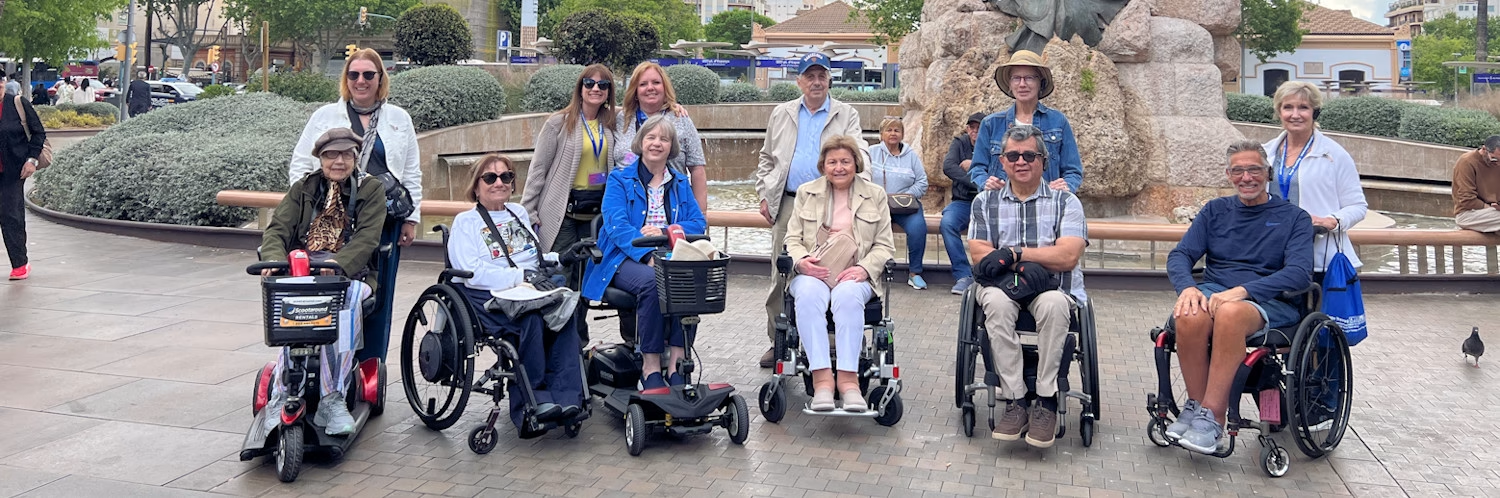
John Sage: Founder & CEO of Accessible Travel Solutions and Sage Traveling
Through innovation, advocacy, and real-world solutions, John Sage is helping the travel industry move from compliance to true inclusion.
◦ 10 min readRedefining Accessibility in Global Travel
Through innovation, advocacy, and real-world solutions, John Sage is helping the travel industry move from compliance to true inclusion.
Introduction
John Sage is widely recognised as one of the leading voices advancing accessibility across
the global travel and meetings industries. A manual wheelchair user who has travelled to more than 50 countries, John brings both lived experience and deep industry expertise to his work. He is the founder and CEO of Sage Traveling, the largest provider of accessible travel in Europe, and Accessible Travel Solutions, a global consulting firm helping destinations, cruise lines, hotels, and event planners create more inclusive travel experiences. Through these organisations, John and his team have helped shape accessibility strategies for destinations, tourism boards, convention centres, and travel providers around the world.
He advises some of the most influential organizations in tourism and business events, including the World Travel and Tourism Council (WTTC), UN Tourism, the Global
Sustainable Tourism Council (GSTC), the World Sustainable Hospitality Alliance (WSHA), Cruise Lines International Association (CLIA), Airports Council International (ACI), the Global Business Travel Association (GBTA), and the Events Industry Council (EIC).
Through his companies and advisory roles, he has spent more than fifteen years helping the travel industry understand that accessibility is not simply about compliance. It is about creating better, more inclusive experiences for millions of travellers worldwide.
You’ve spent over a decade building accessible travel solutions across cruises, land
programs and global partnerships. What first moved this from a business opportunity to a personal mission?
For me, it began with personal experience, long before I recognized it as a business opportunity.
As a manual wheelchair user who has traveled to more than 50 countries, I have experienced both the beauty of travel and the barriers that still exist for many people with disabilities.
In the spring of 2008, after my sixth trip to Europe, I realized there had to be a better way to plan a wheelchair accessible trip. I had spent dozens of hours researching accessibility for a trip to Southern France and Italy, yet I still encountered unexpected barriers along the way. The available accessibility information online was often sporadic, vague, non-existent, or
simply incorrect. Some destinations were described as “totally inaccessible for wheelchairs,” such as Venice, yet with the right information they can absolutely be visited by wheelchair users.
At that point, I realized there was no comprehensive resource providing the level of detail someone with mobility challenges would need to confidently plan a trip to Europe. That is what led me to start Sage Traveling. No one had brought together accessibility information in a clear, practical format, similar to a guidebook with maps and photos, and I was determined to change that.
Over the following years, I learned accessibility terminology in multiple languages so I could communicate directly with hotels, museums, and attractions. I made numerous trips across
Europe to personally verify accessibility and build a reliable foundation of information. After years of research and development, I launched Sage Traveling in December 2009.
“Accessible” travel often speaks of seamlessness. From your perspective, what does seamless truly mean for travellers with disabilities?
Seamless travel happens when accessibility is built into the entire traveler journey.
At Accessible Travel Solutions, we talk about the Three Pillars of Accessible Travel, accessible facilities, accessible customer service, and accessibility information.
Most of the industry focuses on facilities and service. But the pillar that often determines whether a trip succeeds or fails is information.
Travelers need to know what to expect before they arrive. When accessibility information is accurate and transparent, people can plan with confidence. When it is missing, uncertainty becomes the barrier. That is why the Three Pillars of Accessible Travel must work together.
You’ve worked with cruise lines, global tourism boards and advisory boards. Where is the industry making real progress – and where is it still mistaking compliance for inclusion?
We are seeing real progress in parts of the industry, particularly in the cruise sector and the events sector, where organizations are investing in accessible design and staff training.
But there is still confusion between compliance and inclusion.
Compliance focuses on meeting regulations. Inclusion focuses on delivering a complete experience. Some organizations are still focusing primarily on compliance, which can result in accessibility being treated as a checklist rather than a core part of the experience.
You can meet accessibility requirements on paper and still create barriers in practice. True inclusion happens when accessibility is fully integrated into design, operations, customer service, and information.
That is where our accessibility training and leadership workshops play an important role, helping organizations shift their mindset from compliance to inclusion.
When you look at mainstream travel today, what are they still getting wrong about accessibility?
One of the biggest misconceptions is that accessibility only means wheelchair access.
Accessibility actually spans a much broader spectrum. We often talk about five major disability categories: mobility, vision, hearing, neurodivergent travelers, and allergies.
When travel providers design with these needs in mind, they improve experiences for everyone.
Another major challenge is accessibility information. Travelers with disabilities often spend hours researching whether a destination or venue will work for them. Too often the information simply is not there.
And when the information is missing, travelers lose confidence.
You operate at both micro and macro levels; individual traveller experiences and global policy conversations. How do those two worlds inform each other in your work?
Everything begins with the traveler experience.
Our team has spent more than 200,000 hours planning accessible trips and working directly with travelers with disabilities. That real world experience informs everything we do.
When we work with tourism boards, cruise lines, or international organizations, we bring those practical insights with us. That helps ensure accessibility strategies work in real life, not just on paper.
What does dignity in travel mean to you?
Dignity in travel means independence.
It means travelers with disabilities can navigate the world without constantly having to advocate for basic access.
When accessibility is done well, it becomes almost invisible. Travelers are simply welcomed and supported, just like any other guest.
How do you define the difference between “accessible” and “inclusive”?
Accessibility removes barriers.
Inclusion goes further. It means people with disabilities are considered from the very beginning when travel experiences are designed.
Accessibility makes travel possible. Inclusion makes it truly welcoming.
You’ve helped thousands travel confidently and independently. Is there a particular story that stays with you; one that reminds you why this work matters?
We’ve heard countless stories of our Sage Traveling trip planners making accessible
vacations possible. One that stands out was from a family of someone with ALS. They knew it was their last vacation together and wanted to create meaningful memories.
This individual had some pretty significant accessibility and medical needs, and after the trip, the family told us they could not have done it without our help. I’m proud that our team was
able to make those memories possible.
The future of travel is increasingly digital and AI-driven. How can technology genuinely advance accessibility rather than unintentionally deepen exclusion?
While we use AI inside our company, we’ve found that it often provides false or vague information when it comes to accessibility. It can be difficult to tell what is accurate and what is not.
Technology can play a huge role in improving accessibility, particularly when it comes to information. But that information must be accurate, verified, and detailed in a way that
travelers can trust.
We always recommend that travelers with disabilities either directly or indirectly verify accessibility information, especially when it is generated by AI.
The key is inclusion in design. People with disabilities must be part of the process. When they are, technology becomes a powerful tool for expanding access rather than creating new barriers.
If you could redesign one aspect of the global travel ecosystem tomorrow, what would it be?
We are actively working on it right now. For too long, travel associations and sectors have been addressing accessibility in silos without talking to each other. We are now making meaningful progress in bringing alignment and standardization to accessibility in travel.
From your vantage point in the U.S., how do you see global collaboration shaping the next decade of accessible tourism?
Accessibility is increasingly becoming a global priority.
Organizations across tourism, hospitality, aviation, cruise, and events are recognizing that accessibility is not a niche issue. It touches every part of the travel ecosystem.
What the industry needs now is stronger coordination across sectors. No single organization can solve accessibility alone. It requires collaboration between destinations, travel providers, industry associations, and global organizations.
One of the ideas we are exploring is bringing together leaders from across the industry to form a global alliance focused on advancing accessibility in travel and events. The goal
would be to share best practices, align standards, and accelerate progress across the industry.
The next decade will be defined by this kind of collaboration.
What does inclusive travel look like in 2035?
It brings a smile to my face to think about the progress that will be made over the next decade. I expect that many major travel companies will have addressed accessibility in a
comprehensive way, integrating it into their core business processes rather than treating it as an afterthought. It will positively impact both the traveler experience and their bottom line.
At the same time, there will still be businesses that move more slowly. Those organizations will likely struggle to capture market share from the nearly 20% of the population that
benefits from accessible travel.
What legacy do you hope the Sage family of companies leaves behind?
For the last 16 years, much of our focus has been on helping people with disabilities and their family’s travel.
Ultimately, I believe our legacy will be that we helped empower the travel industry to become more accessible.
I look forward to seeing that.
Quickfire
- A destination that surprised you most?
Kigali, Rwanda - The one accessibility detail most hotels overlook
Detailed information about bathrooms - A leadership trait the travel industry needs more of?
Transparency - Cruise or land… and why?
Land, I like to visit smaller towns and interact with locals in their native language - One word that defines your mission?
Memories - Early mornings or late nights?
Early mornings - A city that feels truly welcoming?
Madrid - A travel moment that made you emotional?
Being denied boarding an airplane because I didn’t give them enough notice. - If accessibility were universally solved tomorrow, what would you work on next?
Improve my Spanish, French, Italian, and German speaking skills. - Coffee order?
Cappuccino
Closing
As the travel industry continues to evolve, accessibility is increasingly recognized not as a niche concern but as a fundamental part of the future of tourism. Through his work with
destinations, cruise lines, hospitality groups, and global industry organizations, John Sage has helped move accessibility from the margins into mainstream travel strategy. By combining lived experience with practical industry solutions, he continues to push the conversation forward, helping organizations understand that inclusive travel is not only the right thing to do, but one of the greatest opportunities for innovation and growth in the global travel economy.