Jayni Gudka: Founder, Sama Sama International
At its heart, being a story-listener means co‑creating experiences with communities rather than extracting stories from them. They are the experts, and I have the honour of learning from them, following their lead and helping them to shape and share their stories with confidence and dignity that they deserve.
◦ 23 min readYou describe yourself as a “community-led story listener.” What does that mean in practice, and why is listening such an important skill in tourism?
I really believe that we are spoiled with so many great storytellers in our industry. We have tour guides who can bring an unassuming London alleyway to life, revealing the secret lives of spies and troublemakers who walked on the same cobblestones centuries before us. We have birdwatchers who can identify a species by its call as quickly as they are able to vividly describe the elegance of that same bird’s dance, delivered with such humour and detail that you don’t even mind that you missed the quick glimpse of the bird as it disappears back into the Amazon’s treescapes. We have homestay owners who welcome you to enjoy Chereh, a traditional Gambian breakfast of millet porridge whilst sharing the tales of the Ninki Nanka dragon-serpent that lurks in the nearby river, convincing you of the good luck it will bring you if you spot it as they playfully argue with their neighbours who insist that it is merely a mythical creature found in kids stories. And we have aunties running local market stalls who introduce you to fruits you did not even know existed, laughing with you as you pull all sorts of faces as you sample the sweetest mango, sourest tamarind and bravest bite of durian, sharing stories about how they’re grown, cultivated and made into local dishes which they also give you recipes for.
These, for me, are the stories that really make the places that we visit become memorable. And yet, I also feel that as an industry, we perhaps don’t do enough to give these storytellers and the stories that they share the attention that they deserve. This is what being a community-led story-listener means to me – spending time in a community, building mutual trust, understanding, and being open to finding stories in almost every interaction with communities, and then working with them to see if this is a story that they would like to share as part of a tourism experience or not. The community-led element of this is hugely important to me because it means that I do not begin with a set outcome or idea in mind about what stories I want the experience to focus on. It means that it is the community that has the agency to decide, and my role is to facilitate, to ask questions that tease out elements of stories in a trauma-informed way that respects emotional boundaries, whilst ensuring that the storyteller has the confidence to share as much or as little of their lived experience as feels right to them, without pressure or expectation. I let communities show me which parts of their world they want visitors to enter and experience, and which should remain sacred or private.
Of course, listening requires care. Not every story is ours to hear. Not every question needs to be asked. Consent matters in storytelling just as much as anywhere else.
At its heart, being a story-listener means co‑creating experiences with communities rather than extracting stories from them. They are the experts, and I have the honour of learning from them, following their lead and helping them to shape and share their stories with confidence and dignity that they deserve.
Your work often focuses on helping communities tell their own stories. What changes when people move from being “subjects” of tourism to storytellers themselves?
I think one of the most significant changes that takes place is around respect and dignity. When we offer people the opportunity to tell their stories in their own way, and let them decide what they want to share and what they want to keep for themselves, we allow them to take the power back. They move from being subjects who are passively and sometimes voyeuristically observed, to people with full autonomy over how they present themselves and their communities. They decide which areas to show, which stories to attach to the places they take people, and what meaning to attach to that also.
An example of this is the work that we did helping a survivor of human trafficking and modern slavery, to create a walking tour of East London and share elements of her story in the process. The experience that was curated ended up focusing on the story about how she escaped from her traffickers and how her life had been since then, with stories about how local organisations along the route helped her (a local primary school and a food bank), whilst others (like the local job centre) created more problems for her and her family. Though there were many other elements of her own story that were just as powerful to listen to, we collectively decided that they would not be included in the final experience because they risked re-traumatised her each time she shared them and could even have a profoundly negative impact on the participants who may in some circumstances have had similar experiences themselves. Another example of this was the decision by some of our guides to not share their personal stories and experiences of homelessness, but have a more general conversation about the causes and possible solutions to end homelessness instead.
In this way, storytelling also helps communities that have historically had little control over how they’re represented to start to heal from that, and rebuild trust and positive connections with the tourism industry as well as visitors. It also means that these opportunities for communities to share their own stories as part of the tourism experience can also help communities reclaim their narratives, repair historical imbalances, and restore a sense of relational harmony.
I think it’s also important to acknowledge that visitors also bring their own stories and perspectives, which can also be transformative to the host community when they are shared with positive intention. The conversations that follow can contribute to community learning and connection in a way that the whole interaction starts to feel less like a guided experience and more like a genuine conversation.
So the real benefit of communities becoming storytellers rather than just the subjects of tourism is not just about communities presenting and tourists listening. It is about co-creating meaning and meeting each other with mutual respect as part of that storytelling process. In many cultures, and especially first nation communities, storytelling also comes with responsibilities to the ancestors, the land, and future generations. When people decide how to share their stories, they are carrying all of that with them.
Beyond the individual interactions, I have seen that the destinations also benefit from having communities share their own stories in this way because it enables communities to feel more personally invested in making sure visitors have a good experience because they are part of the process, and feel valued.
Through your leadership at Unseen Tours, you helped redefine walking tours by centring the voices of people with lived experience of homelessness. What did that experience teach you about the power of narrative in travel?
I owe so much to the wonderful tour guides who I had the honour of working with and learning from at Unseen Tours, they helped change the way I see the city I grew up in. Walking with someone who has navigated the city having experienced homelessness in the same city previously transforms familiar streets into entirely new landscapes, filled with stories you may not otherwise get to hear.
The guides showed me stories I had either been too busy to notice or would never have had access to otherwise. They told me about how major world events like the London Olympics or royal weddings were occasions when people sleeping on the streets of London were temporarily removed from these places as the city wanted to have a more polished image of London when the world was watching, and yet not enough was being done to provide sustainable longer term solutions to ending homelessness. They helped me better understand how regeneration can polish a place until the people who shaped its original character cannot afford to stay there. They shared stories about how many people living on the streets become dependent on each other for safety, and have their own community, which is especially important considering how many times they are attacked whilst sleeping on the streets. And they also shared surprising stories, like the fact that Charlie Chaplin had himself experienced homelessness in London as a child.
The Unseen Tours guides taught me the value of being a tourist in your own city, which was a great reminder that travel is not defined by distance. It is defined by perspective. And sometimes the most powerful perspective is waiting right outside your front door.
Tourism has often been criticised for telling simplified or romanticised versions of places. How can the industry create more honest and inclusive storytelling
I think the only way is by allowing for multiple narratives to co‑exist, and creating platforms and opportunities for many different people, with many different perspectives, to confidently contribute to those narratives. These single narratives often exist because they are easier to market because they provide what is expected. They are also less threatening to existing power structures. Stories do not need to all be from the same perspective for them to be true. People are drawn to places because they want to connect with something meaningful, so when destinations open themselves up to complexity, contradiction and lived experience, they offer visitors a new appreciation for the destination and perhaps even a different reason to come.
At Unseen Tours, we found that many people who joined our tours knew London fairly well already. They had either lived in the city for a long time, or had visited so many times, that they were consciously searching for new experiences. We provided them with a new experience in a part of London that they perhaps didn’t know as well, as well as the added opportunity to make a positive social impact through that experience too!
I am so grateful for organisations like The Conscious Travel Foundation for bringing together so many tourism organisations of all sizes, and from so many different parts of the world, because they support projects that amplify community stories through their Community Impact Fund, and have regular sessions where organisations share new ideas that they’re working on, and learn from best practices for inclusive tourism.
This is how I think tourism will be able to tell better stories. Through dialogue and by making space for many truths to exist side by side, especially those that challenge us to do better.
Your approach blends storytelling, community engagement and tourism development. Where do you see the greatest opportunity for change in the industry right now?
I think there is a big opportunity for change in the official tour guiding systems in most countries where guides are trained through ministries of tourism or national institutions that require guides to stick to one official narrative and present it as the full story, even when they know there are missing voices and perspectives. You see this everywhere. In cities like London, where so many landmarks carry complicated histories, the Blue Badge guided routes often sanitise the version of the past that they present. And in places like Brasilia, the official tour guide qualification revolves around presenting national buildings through one approved lens, focusing on state narratives rather than community ones.
One of my favourite experiences in Brasilia, the Brasilia Negra Tour led by Bianca D’Aya, was the complete opposite of that. During the tour, Bianca used museum exhibits as starting points to speak about the contributions of Black communities to the development of Brazil’s capital city, and is a story that is largely left out of the official narrative. The way that she uses the architecture and public spaces as prompts to talk about the labour, creativity and contributions of communities whose stories were deliberately left out of the official narratives – in other guided tours as well as museums – and the impact that hearing these stories as part of our TransHistorias training process in Brasilia was immediate, because people finally felt included and seen. So I do continue to question why we still confine ourselves to limited perspectives when the world is so much richer than a single narrative.
You speak about consent in storytelling – a concept rarely discussed in tourism. Why is it so important?
I think consent is important because without it, storytelling becomes extractive, and this leads to an unequal power dynamic between the visitor and visited. I don’t think anyone should be made to feel obliged to share their personal experiences simply because a traveller is curious or a company wants a compelling narrative, and that’s why I feel consent is important. It helps protect boundaries and ensures that the stories remain in the ownership of the communities who lived them. Consent also reminds us that some stories are simply not ours to tell, even if we really want to.
Another aspect of consent that I feel is not spoken about enough is asking for consent before taking photos of people. We wouldn’t think it appropriate to take a photo of a random child that we see on the streets of London for example, without getting permission from parents or guardians, so it frustrates me when people feel that the same reasoning does not apply when visiting a different country.
Through Sama Sama International you work with organisations and communities globally. What are some of the most inspiring examples of community-led storytelling you’ve encountered?
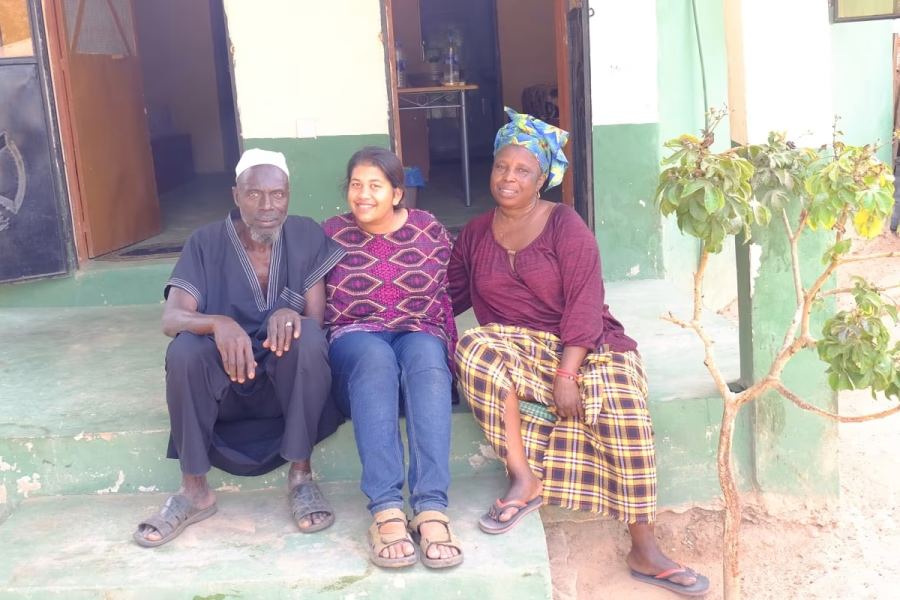
One really impactful community led storytelling initiative is Ninki Nanka encounters in The Gambia. The way that they developed the community storytelling experience in the village of Ndemban for example so that it includes stories and interaction with head teacher, baker, blacksmith, women in the community gardens, weavers, traditional fortune teller and the village elder (Akalo) created a deep sense of connection. It allowed for genuine engagement with the community, where visitors felt truly welcomed and were invited to listen, participate and learn. Through these encounters, you hear a wide range of stories while experiencing daily life and local culture in a way that feels authentic and grounded. What makes the initiative even more powerful is how these stories are carried across visits to multiple villages through the shared myth of the Ninki Nanka dragon serpent, creating a collective narrative that connects different communities while still honouring each place’s unique voice and perspective.
Another example is the Refugee Voices Tours in Berlin, where the guides use the city’s familiar landmarks as starting points for storytelling, but what makes the experience transformative is the way each of those sites juxtaposes Berlin’s own turbulent past with the war torn countries the guides have fled. By placing these stories side by side, the tour opens space for understanding rather than distance. It helps visitors see that displacement, fear and rebuilding are not abstract ideas but lived realities. And for many refugees, telling their stories in this context creates a sense of belonging at a time when they often feel misunderstood, while gently reducing the hostility or suspicion that some locals may still hold.
And finally, an experience that felt deeply personal and emotional for me was taking part in the smoking and ochre ceremonies with Uncle Terrence in the Flinders Ranges in Australia. Standing on Adnyamathanha Country and hearing him speak about land, ancestors and responsibility was profoundly grounding. It was a reminder that storytelling is not just about sharing information. It is about relationships, reciprocity and honouring the knowledge holders who have cared for these places for thousands of years.
Each of these experiences reflects what sama sama is all about: stories shared with openness in a way that invites people to connect more deeply with one another.
What role should travellers themselves play in creating more respectful and meaningful travel experiences?
Travellers play a huge role in ensuring that travel experiences are respectful and meaningful, and I think that intentionality is a big part of it. One thing I’d encourage travellers to do is to seek out community-led experiences that are rooted in local community life. They could be cooking classes, neighbourhood walks, or meals in a local restaurant. Experiences that are not necessarily on the main tourist trail, but allow travellers to engage with people from the local communities, and also support their local businesses too.
But beyond choosing the right kinds of experiences, I think travellers also need to recognise the unequal power dynamics that often shape tourism. When you arrive as a visitor, you can sometimes have more social and economic power than the people hosting you. That imbalance can sometimes make it difficult for communities to set boundaries or decline requests. This is why I also encourage tourists to think about the impact that their questions could have, and try to balance curiosity with care, especially if they are around challenging subjects. I suggest offering people an easy way out of answering questions without losing face, and indeed this is an important part of our sama sama training.
You often work at the intersection of creativity, research and social impact. How do you maintain curiosity and humility when entering new communities and stories?
This, for me, is the most enjoyable part of my work. Maintaining curiosity and humility is an ongoing practice, and is something that has always come quite naturally to me. Growing up in London as a child of Indian heritage, I often found myself dipping in and out of different worlds where I was frequently the outsider looking in, navigating multiple communities that were quite different, while also never being entirely detached from any of them either. That experience also made me acutely aware of how easily people can be misunderstood or reduced to stereotypes. So, from an early age, listening became my way in and I paid attention to small details, and asked questions because I genuinely wanted to understand how someone else experienced the world.
So when I enter new communities now, I try to lead with that same instinct. Our sama sama co-creation process doesn’t begin with a fixed idea of what the outcome will be. We just start with a community (or an individual) that we’re co-creating the new experience with, and to allow stories to emerge at their own pace rather than rushing them towards something consumable. Curiosity, for me, is less about asking the right questions and more about being willing to sit with uncertainty.
Where it becomes more intentional, and sometimes more challenging, is in the unlearning that needs to happen alongside that curiosity. During the co-creation process of the TransHistorias project in Brasilia for example, it took time for the Trans women we were working with to truly accept the idea that they were the experts in the room, and that my role was to listen, to support their ideas, to ask questions that helped deepen understanding, and to gently challenge assumptions when it felt helpful. Over time, something shifted. The ownership of the project became theirs in a very real way.
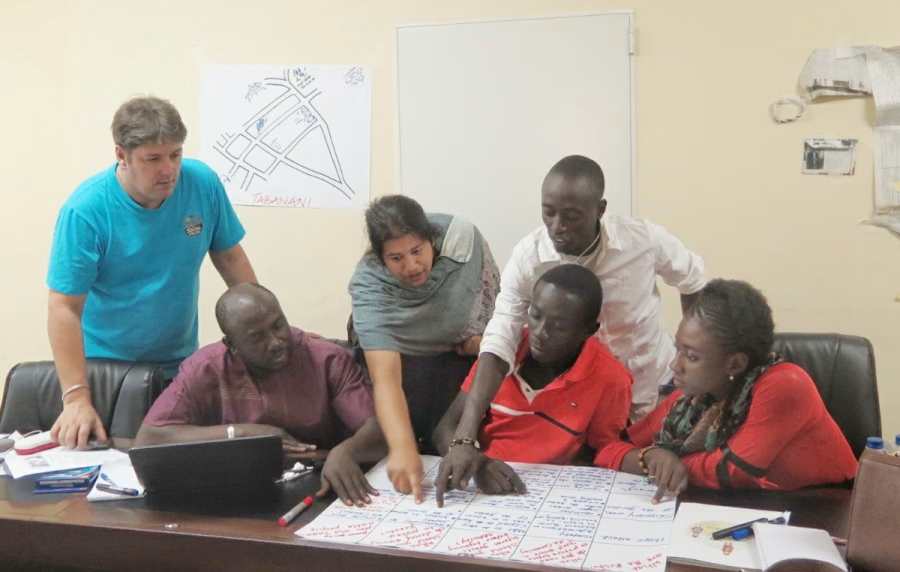
Interestingly, being an outsider can sometimes help with this because it means that I arrive with fewer preconceptions and bring instead an openness to being led by the community group, which helps them define what matters to them. At the same time, I am very aware that this doesn’t make me neutral, so humility really matters in this context because it requires me to be clear about my role, and constantly self-reflecting about the impact my facilitation is having on the output of the project. For our TransHistorias, this meant that the group led decisions around everything from the logo design, to which stops to include or exclude, to which stories felt safe to share and which they wanted to avoid, and even how the stories should be told. In practical terms, it looked like flip charts covered in post it notes, and lots of moments of reflection and conversations. There were also moments when stories surfaced that had never been spoken aloud in that way before, and tears were part of that process.
Creativity also comes from the process of being open to the output of the co-creation being almost anything. For the TransHistorias project in Brasilia for example, it included snap-fans and voguing. In the experience we co-created with a guide on the autism spectrum in London, it includes asking customers to estimate the width of dockworkers’ bunks with their hands, and then taking out a tape-measure to see who was closest. These ideas would probably not have developed, and the opportunities for interaction would not have been the same, if listening and learning from the community, and brainstorming creative approaches for sharing stories with customers, was not part of the process.
The whole process does require a lot of constant self-reflection and learning on my part though.
Looking ahead, what does truly inclusive tourism look like to you?
A world where stories are not filtered through a single lens. A world where communities decide how they want to be represented. A world where travellers arrive with curiosity and leave with connection. And a world where the people most often overlooked are finally centred.
Quickfire
A place where the stories are louder than the landmarks?
Any place where meaning comes before monuments, where the emotional texture of communities are more powerful than the landmarks. For me, I almost instantly think of Berlin.
The most unexpected storyteller you’ve ever met?
I truly believe that everyone is a storyteller, even if they don’t already realise it. Some of my favourite storytellers are community elders who carry decades of change in their memories and share them with a kind of gentle mischief.
A conversation that changed the direction of your life?
One about the ethics (or lack thereof) of some INGOs and seeing how they worked with local communities. It made me realise I could not continue working in that space, and led me to Unseen Tours, and then to responsible tourism and community-led storytelling.
A sound that instantly tells you where you are in the world?
The musical lorry horns in India. You can be standing on a roadside drinking chai, and suddenly a lorry will drive past with a little melody announcing its presence on the road. To me, I think of them as lorry drivers acknowledging each other and weaving small moments of connection.
A moment when listening taught you more than speaking?
I’ve always preferred listening to speaking, which means that I enjoy moments of listening and learning pretty much all the time. Through the co-creation process where listening is the most important part of our sama sama methodology, I’m constantly reminded about how powerful a tool listening is for the storyteller and story-listener, and am really grateful to have had recent opportunities to learn from Brazil’s trans community which has taught me how to be a better ally and so much more.
A street you could walk again and again?
The path around Hoan Kiem Lake in Hanoi. It always feels like several parallel worlds happening at once, which made it the perfect walk to and from work when I lived there. People exercising, families feeding the fish in the lake, teenagers practising K-pop dance routines, couples taking pre-wedding photos in their traditional Áo Dài clothing, the elderly practicing their early-morning Tai chi, there was always something new and interesting taking place. And then the lake itself offers so much calm that time seems to stretch as the evening sky shifts from blue to pink to a quiet, reflective purple.
The most surprising thing someone has ever shared on a tour?
Sometimes our guides are surprised at the common life experiences that our guests share with them when they come on our tour. These moments serve as reminders to us about how interconnected we all are in ways that we don’t always see or expect.
If cities could introduce themselves, which one would you want to hear speak?
I would love to hear how Australian cities would introduce themselves because I think they’d focus even more on acknowledging the Traditional Custodians. I imagine it feeling like a welcome to Country in the city’s own voice in a way that recognises how places have shifted and grown while carrying ancient knowledge at their core. I think a place like Palawa Country (Hobart, Tasmania) would be especially powerful with the difficult stories of the last few hundred years and the ongoing work of truth telling taking place there would make for quite a profound introduction I think.
Hearing cities speak this way would remind us that places are not just destinations. They are relationships.
A question travellers should ask locals more often?
One thing I love to ask locals is to teach me really random phrases in their language. This started during a cultural exchange in Mexico where my host family taught me the phrase “entre menos burros mas olotes” (Less donkeys, more food). I have never since found myself in the situation which required the phrase since learning it, but the phrase and the laughter it still continues to bring every time I speak with my host family has inspired me to ask this question to locals when I travel to other places too.
A smell that feels like a memory?
The smell of the yellow thanaka paste that women and children apply to their faces to protect their skin from the sun in Bagan, Myanmar, where I spent some time researching the impacts of tourism and cultural heritage preservation on the land rights of communities living there.
A place where tourism still hasn’t learned how to listen?
Official tour guiding programmes in most countries.
The most powerful reaction to a story you’ve witnessed?
Tears. With the type of experiences we help communities co-create, and the kind of conversations we have about quite difficult topics on these, we see tears pretty frequently.
If you could amplify one unheard voice in travel, whose would it be?
Porters and street cleaners.
And finally…
What makes a story truly belong to the person telling it?
That they have the autonomy and agency to share their story in an unfiltered way and have the ability to change which elements of their stories they share or decide not to share, or even take elements of the stories that they previously shared back, with dignity and respect, and without any negative repercussions.