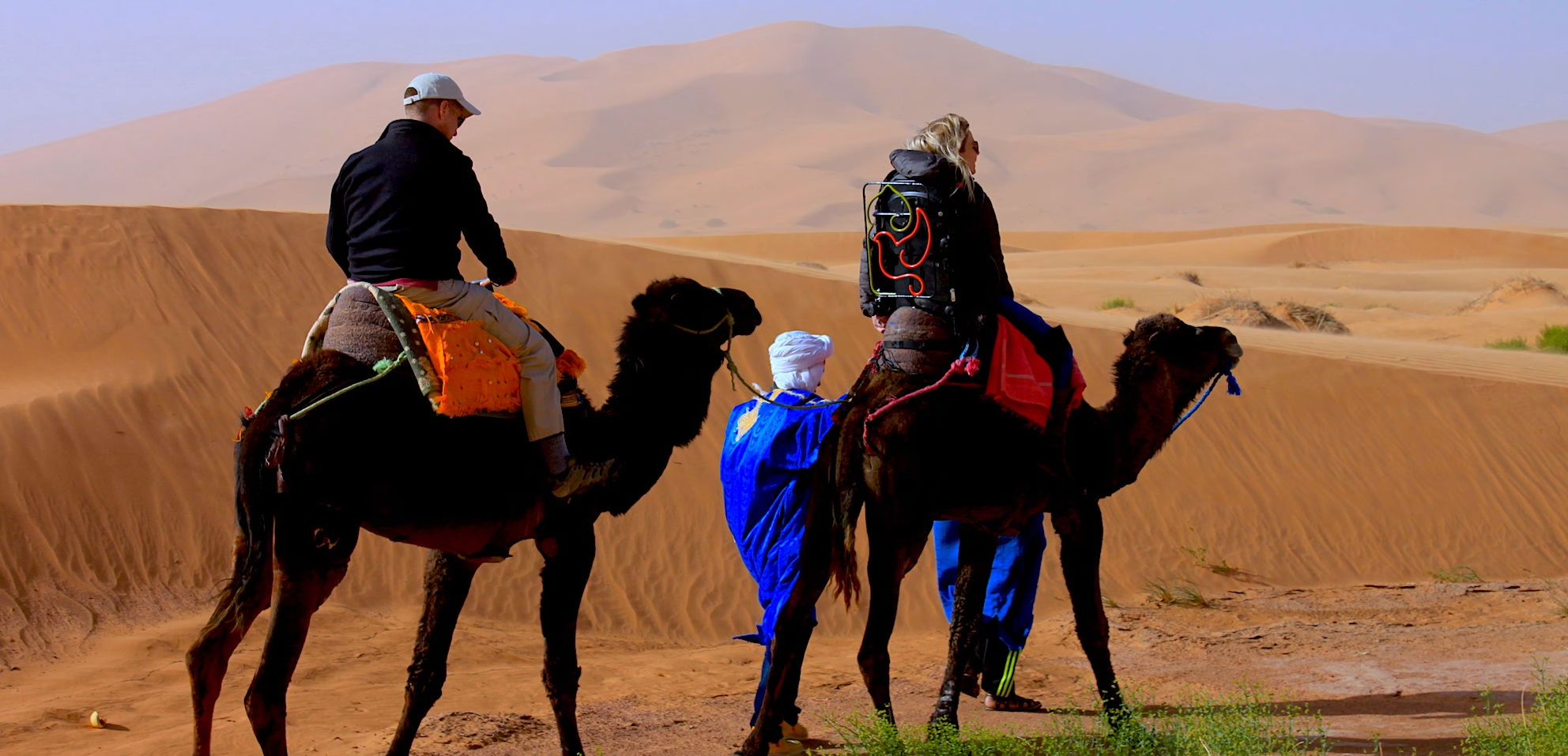
Erik Neufeld: Founder of Morocco Accessible Travel
I originally came to Morocco with my family, settling in the ancient medina city of Fès. It’s a place of staggering beauty, but it's also a 1,200-year-old UNESCO World Heritage site filled with narrow alleys, steep steps, and seemingly impassable barriers. I fell in love with the culture, but as a climber and a builder, I couldn't ignore the gaping void in accessibility.
◦ 12 min readEarly Life
Before accessible travel became your life’s work, what experiences first shaped your love of exploration?
Before I ever worked in tourism, I was an aircraft mechanic by training. My world was about understanding how complex systems function, how things are built, and how to fix them when they break. But my love for raw exploration came from being a rock climber. Climbing teaches you to look at a solid, intimidating rock face not as an impassable wall, but as a puzzle of tiny holds and alternative routes. That mindset of looking at an environment and figuring out exactly how to navigate it safely is what ultimately drove me to explore the world and look at travel through a totally different lens.
Looking back at your childhood, what values have stayed with you throughout your life?
A stubborn refusal to accept the phrase “it can’t be done.” Coming from a mechanical and outdoor background, if a tool didn’t exist, you built it. If a route was blocked, you found a workaround. Alongside that was a deep-seated belief that every single individual is uniquely formed and equally valuable. Treating people with dignity isn’t a luxury or an afterthought; it’s a baseline human right.
Was there someone who inspired your curiosity about different cultures and places?
My curiosity was really unlocked when I stopped looking at places from the outside and started trying to understand them from the inside. Living in North Africa, I realized that language is the ultimate key to cross-cultural connection. Learning to speak Darija (the local Moroccan Arabic dialect) fluently changed everything for me. It allowed me to sit down, share tea, and build genuine rapport with people. It taught me that curiosity isn’t just about seeing a new landscape; it’s about having the tools to listen to the people who live there.
Finding Your Purpose
What first brought you to Morocco, and why did you decide to make it such an important part of your life?
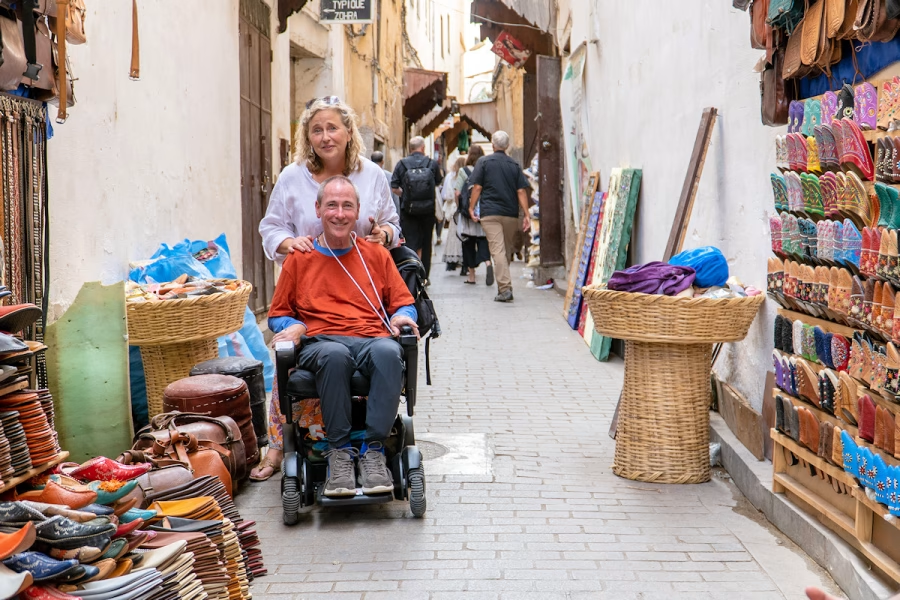
I originally came to Morocco with my family, settling in the ancient medina city of Fès. It’s a place of staggering beauty, but it’s also a 1,200-year-old UNESCO World Heritage site filled with narrow alleys, steep steps, and seemingly impassable barriers. I fell in love with the culture, but as a climber and a builder, I couldn’t ignore the gaping void in accessibility. I realized that one of the most vibrant, compelling countries on earth was completely cut off from millions of people simply because the infrastructure didn’t exist. I wanted to change that. I realized that accessible travel could be a vehicle for change not just of the travellers but for the people in the communities they visited. I wanted to show people how they could be seen when we take away our own biases, awkwardness and discrimination and experience divine love manifest in a life lived compassionately.
Can you remember the moment you realised accessible travel wasn’t simply a niche – it was something that could genuinely change lives?
It hits you the moment you see a traveler realize they don’t have to stay behind in the van. For so many people with limited mobility, traveling means constantly encountering an inaccessible bathroom or a step that cancels their entire day. When we realized we could remove that baseline anxiety—allowing a family to explore together seamlessly regardless of physical limitations—it stopped being just a business idea. It became a moral imperative.
What motivated you to establish Morocco Accessible Travel?
My co-founder, Jeremy Schmidt (who is a Doctor of Physical Therapy), and I saw that disabled travelers didn’t want a watered-down, hollow version of a Moroccan holiday. They wanted the real Morocco—the sensory overload of the souks, the mountains, and the desert. We realized that by combining his clinical understanding of what the human body needs with my mechanical background and understanding of Arab culture, we could bridge the gap and make the seemingly impossible completely possible.
What were the biggest obstacles you faced in those early years?
The absolute lack of standardized equipment and infrastructure. You couldn’t just call up a local rental agency and book an accessible van. In the early days, we had to rely on poorly adapted vehicles, which made it impossible to guarantee the level of safety and dignity our clients deserved. We realized that if we wanted it done right, we had to bring it in-house. That’s why we launched TPMR Maroc, building a dedicated fleet of vehicles with industry leading power lifts and Q’Straint anchor systems for maximum security.
Accessible Adventure
Many people still assume adventure travel isn’t possible for travellers with disabilities. How do you challenge those perceptions?
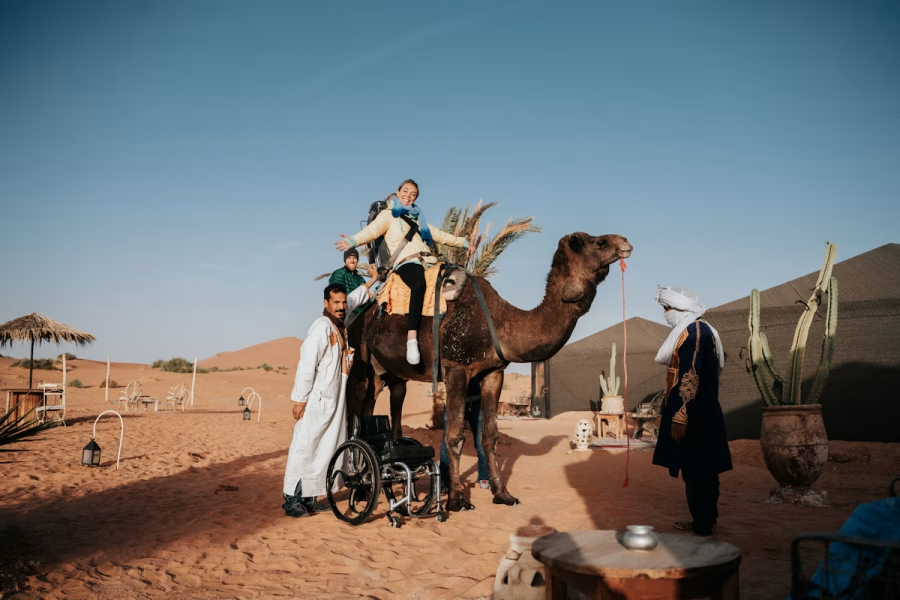
We challenge them by engineering our way through the problem. A perfect example is our adapted camel saddle. For generations, riding a camel into the Sahara dunes was completely untouchable for anyone without core strength or lower-limb mobility. So, we sat down with Mbark, a local Moroccan camel handler, and spent months designing, prototyping, and testing a custom, high-backed fabric and metal seat that stabilizes a rider on a camel’s back. I tested the saddle myself first on a camel named Omalise because if I was going to invent this, I would be the one to risk in the dynamic testing phase. When people see a power-chair user trekking through the deep Sahara sands, the old perceptions drop instantly.
What has surprised you most about Morocco’s willingness to embrace accessibility?
The incredible openness of the local people. While Morocco doesn’t have strict ADA or Western accessibility laws on the books, the culture possesses an innate, deep-rooted hospitality. When we approach local businesses, they don’t fight us—they want to learn. I’ll never forget stopping at a rest stop on the long 8-hour drive from Fès to the desert. The ramp was as steep as the mountains we were driving through, but the owner, Hassan, was so proud of it. We sat, drank tea, and discussed how a few modifications could make it truly workable. Three weeks later, I came back out of the office with a hammer drill, a masonry bit, and grab bars, and we modified his restrooms together. That is the spirit of Morocco.
Can you share a story of a traveller whose journey profoundly affected you?
Every time a client tells us they felt “ordinary” while doing something extraordinary, it sticks with me. We had a group where a driver refused to let a client sit out in the van while the rest of the family ate, spending his evening running from restaurant to restaurant across a town until he located a fully workable restroom setup. It proved to me that our hand-selected, English-speaking drivers aren’t just employees—they are true advocates who understand that a successful trip hinges on absolute dignity and comfort.
Beyond ramps and adapted transport, what does true accessibility mean to you?
True accessibility is the Freedom of Confidence. It means a traveler can look at a 10-day itinerary through an exotic country and not have to spend weeks worrying, “Will my chair fit? Can I get into the bathroom? Is the vehicle safe?” We use an intensive Mobility Information Questionnaire for every single guest to map their exact physical requirements to our researched database of accessible accommodations and routes. True accessibility means taking the logistical stress completely off the traveler’s shoulders so they can just focus on the magic of travel.
How important is dignity, independence and choice when creating memorable travel experiences?
They are non-negotiable. If you are forced to follow a rigid, hyper-sanitized path where you have no say in your day, you aren’t an adventurer—you’re cargo. Whether it’s providing a portable ramp for an unplanned stop or arranging assistance for a custom medina tour, we want our clients to feel lavished, independent, and completely in control of their journey.
Leadership & Community
Building partnerships with local communities must be essential. How have local people contributed to your success?
Our business model is entirely circular. When we work with local hotels, gas stations, and restaurants to install grab bars or correct ramp slopes, we aren’t just helping our international clients. We are creating permanent, barrier-free infrastructure that stays in Morocco, opening up the tourism economy for local businesses and increasing accessibility for Moroccan citizens with disabilities as well.
What qualities do you believe define compassionate leadership?
Humility and a willingness to do the grunt work. You can’t lead a team in this industry from a distant laptop. You have to be out there on the road, testing the equipment, checking the bathroom measurements yourself, and supporting your drivers. Compassionate leadership means building a team culture where everyone—from the founders to the mechanics and the guides—is fiercely protective of the guest’s experience.
Has there been a moment when you questioned whether your vision was achievable?
When you’re trying to figure out how to balance a metal-framed seat on a moving camel in the middle of a desert storm or modifying heavy vehicles to meet rigorous safety protocols in a country with limited specialized supply chains, you definitely face moments of intense pressure. But where others see a wall, our team’s natural reflex is to look for a solution. The vision becomes achievable the second you refuse to give up on the problem.
What keeps you optimistic about the future of inclusive tourism?
Seeing the tangible momentum. From speaking at the first Moroccan Disability Congress to watching local riad owners proactively ask us how they can make their properties more inclusive, the needle is moving. Inclusive tourism is no longer a footnote; it’s becoming a standardized, recognized part of the global travel landscape.
Looking Forward
If every destination embraced accessibility, how would travel be transformed?
The travel industry would finally reflect the true diversity of the world. About 10% of the global population lives with some form of mobility or accessibility need. If every destination embraced universal design, we would unlock a massive, untapped collective of global storytellers, adventurers, and families who have been stuck on the sidelines for far too long.
What advice would you offer tourism businesses that genuinely want to become more inclusive?
Don’t get paralyzed by trying to achieve instant, flawless perfection. Start with the small, high-impact things. Grab a tape measure, check your door widths, listen to the disability community, and don’t be afraid to pull out a drill and change the orientation of a bathroom door so a wheelchair user can actually close it. Subtle, practical changes on the ground mean infinitely more than an empty corporate promise.
What legacy would you most like Morocco Accessible Travel to leave?
I want Morocco to be known globally as a premier, bucket-list destination for accessible travel. I want our legacy to be the permanent, physical infrastructure we’ve built—the adapted vehicles, the accessible rest stops, the trained local guides—proving that if you can conquer accessibility in an ancient kingdom like Morocco, you can do it anywhere on earth. I want Moroccans to know that their country is accessible to them, not just to tourists and that together we made it more accessible.
Finally, when people think of Erik Neufeld many years from now, what do you hope they’ll remember?
I hope they remember a guy who loved God and people, embraced a challenge, and used his hands and his heart to build a world where anyone—regardless of their physical body—could experience the untamed wonder of an adventure.
Quickfire
Sahara sunrise or Atlas Mountains sunset?
Sahara sunrise. Watching the golden light slowly hit the crests of the dunes in total silence is unforgettable.
Tea with a Berber family or dinner in a Marrakech riad?
Tea with a Berber family. That’s where the true, unfiltered heart of Moroccan hospitality beats.
One place in Morocco everyone should experience at least once?
The ancient walled medina of Fès—it’s like rolling directly into a living history book.
Your favourite Moroccan dish?
A perfectly slow-cooked beef and prune tagine garnished with sesame seeds and almonds.
Desert camel or adapted 4×4?
The adapted camel with our custom saddle for the pure, barrier-breaking magic of the experience.
Which country has surprised you most?
Morocco. No matter how many years I live, play, and work here, it always finds a new way to surprise me with its beauty and diversity.
What item never leaves your travel bag?
A tape measure and a multi-tool. When you’re managing accessibility on the move, you have to be ready to measure, adapt, or fix a grab bar at a moment’s notice.
If you could invite any explorer – past or present, to Morocco, who would it be?
Nicholas James Vujicic. His love for life, Jesus and inspiring others through his writing while living with tetra-amelia syndrome are things I deeply admire.
What’s the greatest lesson travel has ever taught you?
That the world is a whole lot easier to navigate and much more welcoming than we are led to believe. Learning a few words in someone else’s language can open amazing doors of connection and shared humanity.
Complete this sentence: “The world becomes a better place when…”
“…we stop viewing physical barriers as permanent limits, and start treating accessibility as an open door to shared human dignity.”