
Juan Paredes: Group Product & Strategic Projects Director at Destination Asia
The shift toward quiet luxury is clear. Travellers are moving away from opulence toward understated, meaningful experiences which matter far more than visible extravagance. The difference between a good experience and a great one is increasingly found in the small elevated details.
◦ 10 min readGlobal Perspective on Travel & Transformation
You’ve built a career across five continents, spanning airlines, hospitality, and destination management. What core insight has stayed with you across these diverse markets?
Working across different travel verticals and multicultural environments taught me that adaptability and resilience are essential. The industry demands them, usually in situations you did not see coming and in markets that operate nothing like you expected. But the insight that has truly stayed with me is that despite all that cultural and operational diversity, the recipe for driving real transformation stays remarkably consistent. People respond to a shared vision, to energy, and to leaders who genuinely believe in what they are building. When those three things are in place, everything else tends to follow.
How have global shifts in travel behaviour over the past decade reshaped how destinations and travel brands must think strategically?
For decades, success in travel was measured almost entirely by tourist arrival numbers, with destinations competing to rank as the most visited in the world. That mindset is finally shifting. The conversation is increasingly about quality over quantity, driven partly by the very real consequences of overtourism that destinations from Barcelona to Bali have had to confront. What is emerging in its place is a more intelligent approach where the focus shifts to attracting fewer but higher-value visitors and delivering a richer experience per trip.
Strategy Meets Experience
In your current role, you translate group-level strategy into execution across multiple markets. What does successful strategy-to-delivery look like in travel today?
In a multi-country operation, the gap between strategy and execution is almost always a people problem before it is a process problem. Every market has its own priorities and its own way of doing things that has worked well enough for years, so when change arrives, the natural reaction is resistance. Not because people are difficult, but because the benefits are not immediately obvious across teams with different day-to-day realities.
That is why articulating the why clearly and at every level of the organisation is the single most important thing you can do. When people understand the purpose behind a change rather than just the mechanics of it, resistance softens and execution follows.
How do you ensure consistency in product and experience across such culturally and operationally diverse regions?
Strong documentation and clear standards are the foundation, but understanding localisation is equally critical. What works in Thailand may not be applicable in Vietnam or Indonesia and getting that balance right takes genuine local knowledge rather than assumptions made from a regional office.
At the end of the day consistency lives with people, not documents. Training is where standards become real, and in an experience-based industry where service delivery sits at the core, the quality of that human touch is what clients actually remember.
The Evolution of Destination Management
Destination management has evolved far beyond logistics. How do you define its role today in shaping traveller experience?
Destination management has come a long way from its logistics roots. The role today is about translating destination knowledge into meaningful, seamless experiences for the traveller. The best DMCs operate as true local partners, providing end to end turnkey solutions across different business segments, while ensuring the traveller on the ground experiences authentic local access that no amount of online research can replicate.
What distinguishes a high-performing destination management company in an increasingly competitive and globalised market?
Authenticity and local connection are the starting point, but what truly separates a high performing DMC is service quality on the ground. In an experience-based industry, trust, consistency, and value are what bring clients back.
Increasingly though, technology is becoming just as critical, particularly at the discovery and booking stages of the customer journey. Clients expect a frictionless experience from the first enquiry through to final delivery, and the companies investing in that are pulling ahead. Sustainability sits in the same category. It has moved well beyond a nice to have and clients across all segments are now expecting a genuine commitment.
Luxury Travel Reimagined
From your perspective, how is luxury travel evolving – particularly in Asia and emerging markets?
What are today’s high-value travellers really seeking beyond traditional luxury markers?
The shift toward quiet luxury is clear. Travellers are moving away from opulence toward understated, meaningful experiences which matter far more than visible extravagance. The difference between a good experience and a great one is increasingly found in the small elevated details.
Asia is exceptionally well placed to deliver this. The region offers extraordinary cultural depth and a remarkable variety of experiences that few other luxury destinations can match. It has become an increasingly compelling choice for high-net-worth travellers seeking wellness, authenticity, and a hospitality culture genuinely centred around the guest. Small boutique properties in offbeat destinations are winning in this landscape, offering the kind of intimacy, exclusivity, and personalised attention that today’s luxury traveller seeks.
Mega Events & High-Demand Delivery
You played a role in preparing for large-scale demand around global events such as the FIFA World Cup. What does it take to successfully deliver at that level?
What lessons from high-pressure, large-scale operations can be applied to everyday travel experiences?
Managing transport and logistics for corporate clients across a FIFA World Cup is as complex as it sounds. The scale is one challenge, but what stood out most was navigating the multicultural landscape of South Africa, which is extraordinarily diverse. That diversity, combined with vehicle shortages that required coordinating across neighbouring countries, meant keeping clients on schedule demanded a level of real-time problem solving that no plan fully prepares you for.
What that experience taught me stays with me in every operation since. Brief your teams in person, always, and give them information in small manageable chunks rather than overwhelming them with everything at once. Anticipate delays and service failures before they happen, because at scale they will, and the difference between a crisis and a managed situation is entirely in the preparation that preceded it.
Entrepreneurial Mindset & Scaling Businesses
As a founder who scaled a travel business across multiple markets, how does that entrepreneurial mindset influence your corporate leadership today?
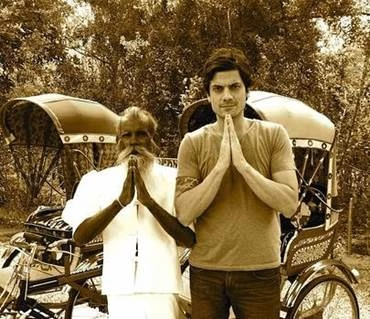
Having built Large Minority Travel across multiple markets gives you a certain instinct that is difficult to develop any other way. Working inside large, structured organisations where processes are rigid and approval chains are long, that entrepreneurial background becomes genuinely useful.
The skill that translates most directly is resourcefulness. Knowing how to build a compelling case, find the right people, and push it up the chain is something entrepreneurs do instinctively. I have taken decisions all the way to the top simply because I was willing to back my conviction and take full ownership of the outcome.
Building from scratch is the other side of that. When I built a safari operation from the ground up, training drivers, leasing vehicles, and setting up a desert camp in the middle of nowhere to create a product that did not exist before, you learn very quickly how to stay agile and make things happen despite the hurdles that corporate structures inevitably create. That experience shapes how you approach every new challenge inside a corporate environment, because you have already done the harder version of it.
What advice would you give to travel entrepreneurs looking to scale internationally?
The foundation is everything. Focus on quality through strong partnerships and resist the temptation to scale before you truly understand what you are selling. Get boots on the ground, visit your destinations, and invest time in knowing your partners.
The biggest mistake I see travel entrepreneurs make when scaling internationally is taking a cookie cutter approach, replicating the same product across markets without localising it. What works in one country rarely translates directly to another, and clients feel that immediately. The businesses that scale well are the ones that treat each destination on its own terms.
Technology, AI & the Future of Travel
You’ve recently explored AI in business transformation. How do you see AI reshaping the travel and hospitality sector?
Where can technology enhance the experience – and where must the human touch remain central?
AI is reshaping travel faster than most operators realise. A third of US travellers already use AI tools to plan trips and a growing number are open to booking through AI assistants entirely, which represents a fundamental shift in how travel decisions are made. What has been missing until now is the bridge between inspiration and actual booking capability, and that gap is closing quickly.
On the operator side, most businesses are still using AI for surface level tasks like product descriptions and social content, and honestly that is where most of us started. But the more you explore it, the more you realise the opportunity runs much deeper. From my point of view, the real value starts to show up in three areas: reducing costs, increasing revenue, and opening up entirely new ways to serve clients. Back-end efficiencies are the starting point, and when those are right they translate directly into a faster, more frictionless end to end customer journey.
As for where the human touch must remain central, no technology replaces the instinctive local expertise, judgement, and genuine care that defines a great travel experience on the ground. AI improves the process. People deliver the experience.
The Future of Inclusive & Responsible Travel
How do you see inclusivity and accessibility shaping the future of global travel strategy?
What responsibility do large travel organisations have in ensuring travel is more equitable and accessible?
The starting point for any honest conversation about inclusivity in travel is infrastructure. The physical infrastructure to serve travellers with accessibility needs does not yet exist at meaningful scale across most markets, and Southeast Asia is a clear example of that gap. Japan remains the exception in the region, having genuinely built accessibility into its tourism infrastructure at scale.
Large travel organisations have a responsibility to lead on this, but the honest reality is that most will only move meaningfully when commercial demand or legislation requires it. The starting point is awareness and having minimum operating capabilities in place, because without those basics even the best intentions fall short. Until accessibility becomes a genuine commercial driver, progress will remain slower than it should be.
Exotic Quickfire
Global Mindset
A destination that always inspires you
Thailand
An underrated destination more people should discover
Sri Lanka
A place that defines the future of travel
Japan, because no other destination has mastered the balance between welcoming the world and staying entirely true to itself.
Luxury & Experience
Luxury today is…
Quiet
A travel moment you’ll never forget…
Trekking the Annapurna Circuit in Nepal
A destination that delivers effortless excellence…
Indonesia
Travel Style
City energy or remote escape?
Both!
Fast-paced itineraries or slow immersion?
Slow immersion, preferably self-driving a tuk tuk!
Business travel or leisure travel?
Leisure travel.
Industry Insight
One trend that will define the next decade?
Personalization.
One outdated travel concept that needs to go?
Seat In Coach.
One innovation you’re most excited about?
Without a doubt AI.
Leadership & Perspective
A quality every great leader must have?
Empathy
The best advice you’ve ever received?
Always know your audience.
Your leadership style in one word?
Transformational