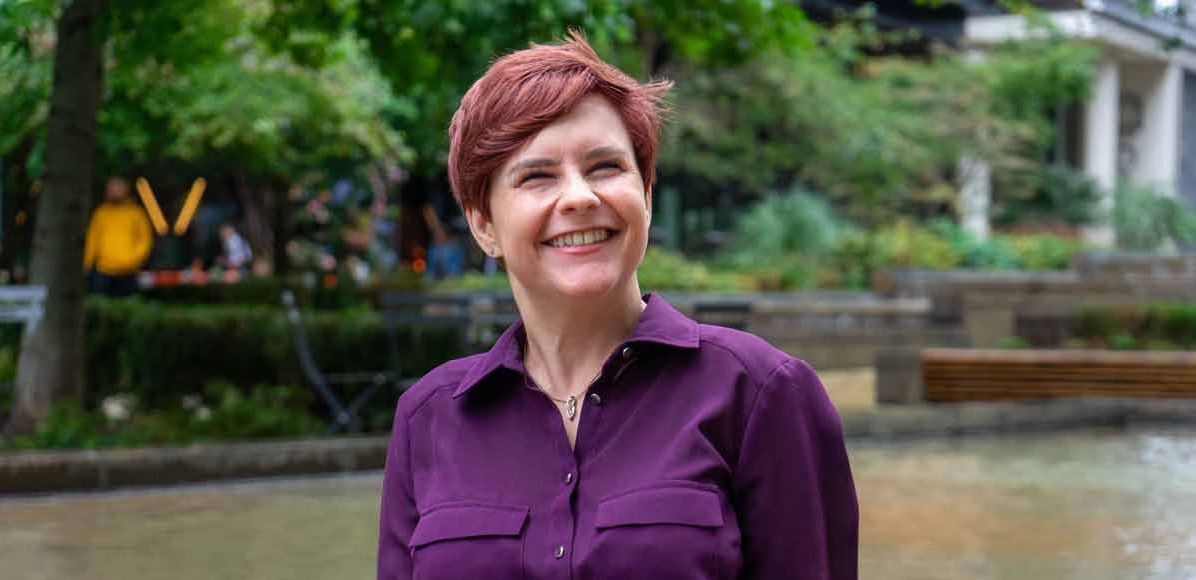
Sassy Wyatt: Founder, Blind Girl Adventures
Sassy Wyatt - award winning blind travel journalist, accessibility consultant and author.
◦ 12 min readBackground & Identity
Can you introduce yourself and share how you describe the work you do today?
I am Sassy Wyatt, an award winning blind travel journalist, accessibility consultant and author. My work sits at the meeting point of culture, curiosity and human connection. I help the travel, tourism and marketing industries understand what real access looks like in practice and I take my community with me as I explore the world with my guide dog Ida and my husband Grant, showing that blind travel is full of joy, nuance and possibility.
Where did you grow up, and how did those early environments shape your relationship with independence, confidence, or curiosity?
I grew up in Cornwall, surrounded by wild coastline, open skies and an unspoken culture of independence. The landscape itself taught me to be curious and adventurous. Spending eight years of my childhood as an ambulatory wheelchair user because of arthritis shaped me just as deeply. Cornwall’s steep rocky cliffs made wheelchair access impossible, so I often relied on friends and family to help me struggle down uneven paths and onto the beach. Those moments opened my eyes early to the barriers disabled people face when accessing nature and experiencing freedom. They shaped my understanding of access long before I had the language for it and they instilled a determination to create change.
Which parts of your identity feel most influential in the story you’re telling through your work?
The parts of my identity that influence my work most are my blindness, my love of adventure and my belief that access is a shared responsibility. I do not separate my lived experience from my professional world. They inform each other. I tell stories that reflect a full and layered life rather than one that has been reduced by assumption.
Blindness and a Defining Turning Point
What do you feel comfortable sharing about your journey into blindness, and how did it shape your sense of self?
I lost my sight at twenty two after eight years of gradual decline. My vision disappeared in chunks that were unsettling and disorientating, yet slow enough for me to keep adapting. The final loss, though, happened overnight. One day I could still make out shapes and light, and the next morning that world had gone. That mix of long decline and sudden finality forced me to rebuild my identity quickly. It also sharpened my appreciation of the beauty around me. I notice small acts of kindness from strangers. I feel the pride when locals guide my hands to a tactile structure they want me to experience. I hear the affection in their voices when they describe the landscapes they love. Those moments anchor me.
How did losing your sight re-route your relationship with adventure, risk, and possibility?
Losing my sight changed my relationship with adventure in a powerful way. It made me braver. When you face something life altering, you stop waiting for the perfect moment to live your life. You say yes more often. You trust yourself more deeply. You realise that adventure is not limited to one sense.
What helped you rebuild identity, agency, and joy during that transition?
Community, travel, Ida and purpose rebuilt me. Blindness pushed the world out of reach for a moment, but travel brought it back. It gave me space to discover what independence felt like on my own terms.
Personal Journey
What were the first invisible barriers you noticed as a blind young woman navigating education, public life, and culture?
The invisible barriers I noticed as a blind young woman came on top of eight years of sight loss. By the time my remaining sight disappeared overnight, I already knew the world was not designed with me in mind. That understanding came from childhood as well, when I struggled down Cornwall’s cliffs as an ambulatory wheelchair user. Those experiences taught me early that access is often dependent on goodwill rather than design. Blindness made those barriers sharper and more obvious, but they were always there.
Who or what influenced your resilience, mindset, and sense of voice?
My resilience comes from the people around me. My family, Grant and the blind community who lead by example. They taught me that confidence grows through practice and that your voice becomes stronger every time you use it.
What assumptions about blindness have you had to challenge—internally and externally?
The internal and external beliefs I have had to challenge run deep. Externally, there is an assumption that blindness shrinks your world or limits your ambition. Internally, I had to unlearn the idea that I needed to soften my access requirements or apologise for needing information. Neither narrative is true. Blindness has expanded my world. It made me more adventurous. It made me more aware of the beauty in people and places. It sharpened, not reduced, my life.
Blind Girl Adventures
What sparked the creation of Blind Girl Adventures, and what stories felt urgent to document?
Blind Girl Adventures was born from a desire to tell my own story rather than have others tell it for me. I wanted to show the truth of disabled travel, not the stereotypes. I wanted to capture the humour, the messiness, the connection and the genuine joy that comes with exploring the world as a blind woman.
How do you balance lived experience with joyful curiosity, humour, or vulnerability?
I balance lived experience with humour and vulnerability because that is how I move through the world. Travel is never perfect. I get lost. I laugh. I swear. I ask strangers for help. I find moments of calm and clarity in unexpected places. Showing the full experience gives people a more honest understanding of disabled life.
What do you want sighted audiences to understand about travel as a blind person?
Many sighted people assume blind travel is defined by loss. In reality, my blindness deepens my connection to the places I visit. I notice more. I listen more closely. I experience places through storytelling, touch, sound and human kindness. Locals often take the time to show me tactile structures or describe something important to them, not out of obligation but out of pride and connection. Travel is not only about sight. It is about relationship.
Travel, Hospitality & the Built Environment
What are the most persistent accessibility gaps you encounter in hotels, airports, and public spaces?
The most persistent accessibility gaps include inconsistent staff training, inaccessible booking platforms, chaotic signage, silent information points and lighting that either overwhelms or disappears. These details shape my sense of comfort and safety far more than people realise.
Which sensory design details matter more than people realise?
Sound, texture, predictable lighting and intuitive layouts matter deeply. They guide me, orient me and allow me to move through spaces confidently. These are not extras. They are fundamental.
How does uncertainty—signage, layout, lighting, contrast—shape emotional safety?
Uncertainty adds extra labour. When I cannot read a room or understand a layout, I have to rely on memory, instinct and trust. Emotional safety comes from clarity and predictability.
Representation & Cultural Context
How does representation of blindness in media and advertising shape public perception?
Representation shapes public perception before I even arrive. When blind people are only portrayed as tragic or inspirational, those are the boxes we are expected to fit into. We need representation that reflects the reality of our lives: nuanced, joyful, messy, ordinary and adventurous.
What narratives do you wish we could retire immediately?
I would retire the narrative that losing your sight ends your life. I would also retire the idea that blind people have magical hearing or supernatural wisdom. These tropes flatten us and miss the point entirely.
What do you hope young blind people feel when they see your work?
I want young blind people to feel recognised when they see my work. I want them to feel possibility rather than fear. I want them to see a future they can grow into rather than one they have to shrink themselves for.
Digital & Assistive Technology
What role does assistive tech play in your independence and mobility?
Assistive tech is central to my independence. VoiceOver on my iPhone, navigation tools, audio description and well structured websites allow me to navigate the world with confidence.
Which tools are empowering—and where are the gaps?
The most empowering tools are intuitive ones. Gaps appear when technology is layered over poor design. If a platform is confusing, it is rarely a failure of the technology. It is almost always a failure of inclusion.
What design principles should all digital platforms adopt tomorrow?
Accessibility must be baked into digital design from the start. I always use the blueberry analogy. When you make blueberry muffins, you fold the blueberries in early so they flavour every bite. You cannot sprinkle them on top at the end and expect the same result. Accessibility works the same way. It must be part of the recipe.
Language, Etiquette & Respect
What language shifts would create more dignity in conversations about blindness?
Direct language matters. Blind. Sighted. Access requirements. Plain language keeps dignity intact.
What’s the difference between helping and disempowering?
Helping means offering with respect. Disempowering means deciding for me without asking. The difference is simple. It begins with a question.
Which everyday micro-behaviours mean the most?
Small moments matter. Introductions. Clear directions. Patience. These micro behaviours make a space feel respectful and safe.
The Emotional Landscape
What invisible labour do blind travellers navigate that sighted people often never see?
Blind travellers carry a lot of invisible labour. Pre-planning routes. Memorising layouts. Checking access repeatedly because past experience has taught us to expect gaps. Managing the emotional reactions of strangers. Yet we also experience small moments of beauty others miss, especially when someone takes the time to connect or share something meaningful.
How does emotional safety – predictability, orientation, time – shape every experience?
Emotional safety comes from orientation, time and clarity. When I understand where I am and what to expect, I can relax and enjoy myself.
How do you protect your energy when navigating inaccessible environments?
I protect my energy by taking breaks, choosing when to engage and walking away from environments that make access an afterthought.
Creativity, Storytelling & Influence
What role does creativity play in reframing disability narratives?
Creativity lets me shift disability narratives away from pity and towards possibility. It opens space for nuance and humour.
How can storytelling create empathy without slipping into inspiration-porn?
Storytelling builds empathy when it is grounded. I show the hard parts without exaggeration and the joy without turning myself into inspiration.
How do you measure real impact beyond metrics?
Real impact looks like a brand changing their training because of something I said, or a disabled traveller taking a trip they once believed was out of reach. That is impact that metrics cannot measure.
Advocacy & Cultural Change
Which conversations are still missing at leadership level across hospitality, design, and tourism?
We still need honest conversations about access budgets, disabled leadership and the economic value of inclusion. These are not side issues. They are central to the future of travel.
What systems need urgent reengineering, not small tweaks?
Systems that need rebuilding include airport assistance, hotel check in, booking platforms and digital design. We cannot patch over structures that were never built for us.
What would true inclusion feel like for blind travellers?
True inclusion feels calm and intuitive. It feels like being able to experience a space without renegotiating your right to be there. It means focusing on the world around you rather than the barriers in front of you.
Future Vision
What’s next: projects, collaborations, cultural shifts you want to ignite?
My next chapter is about widening possibility in travel. I want to work with more organisations that are ready to treat accessibility as essential, not optional. I want to help brands become disability confident so disabled people can travel with the same freedom and options as everyone else.
If you could rewrite one global norm overnight, what would it be?
If I could rewrite one global norm overnight, it would be the idea that access is optional. Access should be assumed, designed and delivered from the beginning.
When you imagine your legacy, what do you hope people feel because of your work?
For my legacy, I want to help make the world a more accessible place. I understood barriers early, navigating Cornwall’s cliffs as an ambulatory wheelchair user, and I understood them again during eight years of sight loss that ended overnight. Disabled people do travel. We always have. We simply need clear information, thoughtful communication and choices that match the freedom our non disabled peers already enjoy. If my work helps open those doors, then I have done what I came here to do.
Human Details
What’s something people would be surprised to learn about you?
People are often surprised by how much I love adrenaline. Rollercoasters, indoor skydiving, zip lining, white water rafting and anything that makes my stomach drop. I am happiest when movement feels fast, loud and thrilling.
Which cultural moment: film, book, conversation, exhibition is energising you right now?
Right now I am energised by long form conversations about belonging, culture and identity. Stories that treat disabled lives with nuance and depth always hold my attention.
Describe a recent moment of joy, connection, or sensory richness that stayed with you.
A recent moment of joy was standing in Alaska listening to glacier ice crack and echo across the water. The sound felt ancient and alive and it stayed with me long after the moment was over.
To find out more about Sassy, visit Blind Girl Adventures