Maudie Tomlinson & Olivia Cryer: Co-Founders of The Conscious Travel Foundation
Building a global movement for travel that restores, connects, and gives back.
◦ 15 min readBuilding a global movement for travel that restores, connects, and gives back.
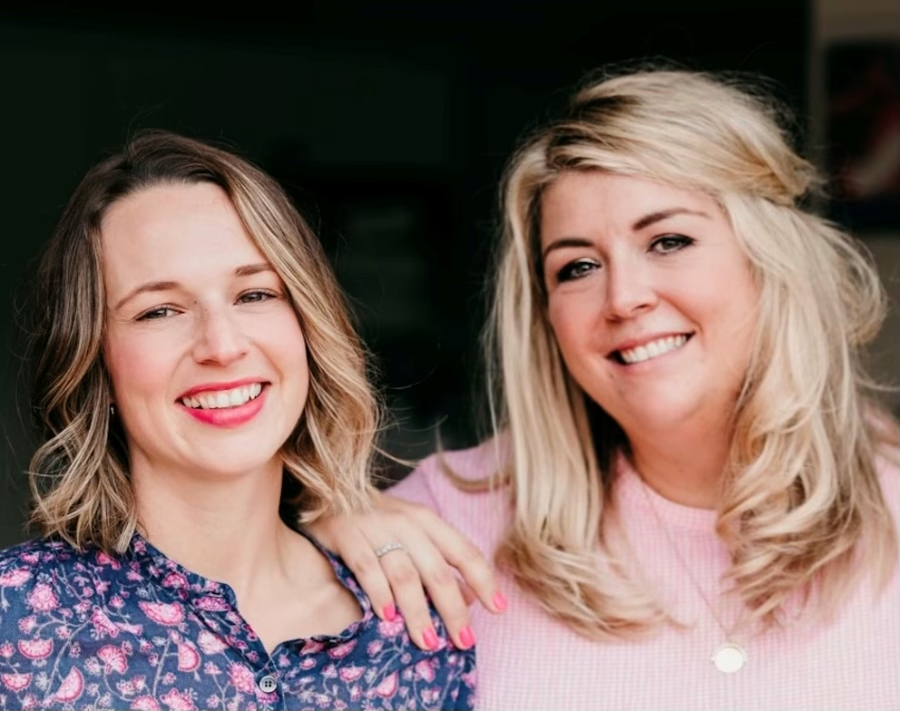
Maudie, Olivia — can you start by introducing yourselves and sharing how your personal journeys in travel first began?
Olivia — I’m Olivia, one of the co-founders of The Conscious Travel Foundation. Travel has been part of my life for as long as I can remember. My mother was cabin crew with British Airways for nearly 40 years, and my father works in shipping and lived all over the world, so movement, curiosity, and an international outlook were part of the fabric of our family life.
After university, I travelled extensively, and then began my career in the travel industry with luxury tour operator Scott Dunn. That’s where I met Maudie, and it was a formative introduction to what “exceptional” can look like in luxury travel. Later, after having my children and stepping away from tour operating, I began working with small, owner operated travel companies on marketing and communications and, through that work, I met my fellow co-founders. Those relationships, and those conversations, became the beginning of something much bigger.
Maudie — And I’m Maudie, another co-founder of The Conscious Travel Foundation. My journey in travel began in 2011 after two years of travelling and volunteering across Central and South America. I had studied anthropology and briefly worked in PR, but it was during that time that I realised I wanted travel to be part of my life and work.
Having met Olivia through a mutual friend, I then joined Scott Dunn (when it was still a small but ambitious company) moving from sales into product and eventually becoming Head of Product. I helped shape inbound travel for North America and supported the growth of Latin America as the business expanded internationally. After a short stint working in ultra–high-net-worth travel, the pandemic reshaped our industry and created the conditions for The Conscious Travel Foundation to emerge.
I’ve always been a solutionist at heart, and working with the Foundation feels like a natural convergence of my industry experience and my philanthropic instincts. It allows me to channel curiosity, problem-solving, and purpose into the sector I love.
How did the idea for the Conscious Travel Foundation first take shape?
Olivia — In March 2020, at the beginning of the pandemic, I was in constant conversation with clients and friends across the industry. A question kept surfacing: if travel was paused, what would happen to the grassroots projects on the ground that were often supported through the revenues hotels, lodges and DMCs around the world?
Initially, we thought we might raise some funds to bridge a short gap, a few months at most. But as the months rolled on, it became clear this wasn’t a brief interruption. At the same time, something powerful was happening: we were speaking with an incredible constellation of travel businesses around the world who shared the same concerns and hopes.
They wanted to collaborate. They wanted to support communities and projects for the longer term. And they also wanted to become better businesses: to evolve their practices, challenge old assumptions, learn from one another, and build something more resilient and more equitable. We saw a real opportunity to create a community that could hold all of that, and The Conscious Travel Foundation was born as a non profit in 2020.
What do you remember about the early stages of building the Foundation — the energy, the challenges, the turning points?
Olivia — It was absolutely a cauldron of emotions. On one hand, people were frightened, personally and professionally. No one knew what travel would look like on the other side, or if their businesses would survive.
But simultaneously, the energy was extraordinary. That forced pause gave so many people permission to really examine how they were operating, and whether their work matched their personal values and their outlook on life. It created a special kind of honesty. We were able to have conversations that went deeper than the usual industry exchanges, and connect in a way that felt rare, and genuinely human.
There was also a real turning point, a “do or die” moment, where Maudie and I said: we’re going to give everything else up and put our full energy into growing this organisation, this community. And once we gave it our full attention, it became transformational.
The term “conscious travel” can mean many things. How do you define it in your own words?
Olivia — When we started, we explored a lot of language, a lot of names, trying to find the right way to describe both the movement and the community. We kept coming back to “conscious” because it’s about a moment of pause.
A pause before you press a button: before you reply to an email, before you book a holiday, before you make a key decision. It’s a moment of reflection, checking that what you’re choosing is right not only for your business, but for all the stakeholders involved: communities on the ground, wildlife, biodiversity, habitats, culture, and future generations.
For us, conscious travel is also about shifting the mindset so many of us have been conditioned into, that “more, more, more” ideology, and moving towards decisions that are more thoughtful and more selfless. It goes beyond a narrow definition of sustainability and asks for a holistic approach: considering everybody, and making sure what we build is equitable for everyone and everything.
How do you help businesses, destinations, and travellers bridge the gap between good intentions and meaningful action?
Maudie — Across our industry, the word sustainability is often overused—and frequently misunderstood. Many organisations want to do better, but don’t know where to start. Others are making meaningful progress but are paralysed by the fear of greenwashing. The Conscious Travel Foundation exists to guide both groups.
We act as a handrail for travel businesses seeking practical pathways to responsible practice. In the absence of an in-house sustainability lead, we offer resources, learning, and collaborative tools—from a climate fund that enables members to co-invest in global climate projects, to a pooled philanthropy model that fuels our Community Impact Fund. This grantmaking supports locally led initiatives that drive positive change within tourism destinations.
Our network spans the entire travel supply chain—hoteliers, DMCs, travel designers sales and marketing businesses, media and guides — who in turn, influence travellers. By helping these businesses understand their influence, strengthen their supply chains, support community-rooted projects, and participate in climate solutions, we ensure that travel itself becomes more intentional, more equitable, and more meaningful.
One of the Foundation’s core strengths is its community of global members. How do you foster genuine collaboration between operators, hotels, and changemakers who might otherwise be competitors?
Olivia — I think it comes down to removing sales from the centre of the equation. Of course business happens organically within our community, but when people come together around shared values and a shared world view rather than purely the bottom line, it creates a different kind of connection. There’s warmth. There’s trust. There’s genuine generosity.
We’re constantly connecting members in different ways: introductions, peer support, sharing lived experience, linking someone with an idea to someone who’s tried it already in a different region or context. The magnanimity of how our members show up for each other is honestly what gets Maudie and me out of bed in the morning. We feel incredibly lucky to be at the helm of such a kind, open community, and that ongoing connection is what allows collaboration to flourish.
How do you maintain authenticity and trust as the network expands internationally?
Maudie — The Conscious Travel Foundation has grown from 30 founding members to around 130 members across the world in just five years. Yet authenticity remains at the heart of who we are because the Foundation is not a sales platform; it is a community.
Growth for us is not about scale, but about alignment. The people and businesses who are drawn to this network are generous with their knowledge, open in their collaboration, and deeply committed to shaping a more responsible future for travel. Our “open arms” approach means we welcome organisations at every stage of their journey: from those taking their very first steps, to those with decades of expertise in responsible tourism.
This mix creates a powerful exchange of ideas. As the network becomes more global, we see innovations born in one destination inspiring solutions in another. Authenticity is preserved—not by limiting growth, but by nurturing a culture of shared purpose, humility, and genuine care for impact.
Can you share a project or partnership that you feel best captures the Foundation’s impact?
Maudie — One project that encapsulates our impact is led by one of our long-standing mentors, Ang Tshering. Ang runs a property called The Happy House in the village of Phaplu, in the foothills of the Himalayas. During the pandemic, he used that moment of pause to develop something extraordinary: a youth pump track just outside his lodge. From that seed grew a fully fledged downhill mountain biking park—now attracting international riders to a region where mountain biking had never existed before.
The goal behind the project is to address youth migration by bringing pride, opportunity, and economic possibility back to Phaplu. Traditionally, young people from the area might become sherpas or mountain guides, but paths into the tourism economy were limited. Now, through the Phaplu Mountain Biking Club, young people are training as professional downhill riders, guides, and bike mechanics. Ang’s long-term ambition is bold and inspiring—to see a future Olympian from Phaplu.
What makes the project so impactful is how holistically it strengthens the local tourism ecosystem. International riders visiting Phaplu stay in local homestays. Income flows back into the community through trail maintenance within community forests. Large mountain biking events bring surges of economic opportunity, while day-to-day the pump track has become a vibrant community hub. After school, children gather to ride, play, and soon they’ll have an indoor space too, especially valuable during the monsoon season.
Importantly, Ang isn’t just a grant recipient, he is an integral part of our network. All funded projects are invited into the Foundation’s community, and Ang has been a mentor, a guide, and a source of shared philosophy from the very beginning. That sense of reciprocity is essential to who we are: philanthropy not as a top-down gesture, but as an equitable partnership in which ideas, innovations, and learnings flow both ways.
How do you measure success when your goals are cultural, emotional, and systemic rather than purely financial?
Maudie — It’s an important question, because while we are not driven by profit—in fact, we operate as a Community Interest Company—financial resources still play a crucial role in enabling the impact we strive for. Our focus is on ensuring we can fund Community Impact Fund projects that create meaningful change around the world, and that remains our guiding compass.
We measure success first and foremost by the projects we are able to support through both Member Directed Giving and our Foundation’s grantmaking. By the end of this year, we will have funded six Community Impact Fund projects, each one representing locally led, culturally rooted impact within a tourism destination.
Looking ahead, we are committed to growing our membership in an intentional way. Our long-term goal is to support at least ten Community Impact Fund projects by 2030. For us, success is not about volume or scale, but about deepening our ability to resource transformative, community-driven solutions around the world.
As co-founders and partners, how do you balance your strengths and differences?
Olivia — We’re very different, and that’s a huge strength. One of us is more left brain, and one is more right brain. Maudie is strategy, planning, execution, operations. I’m more blue sky: ideas, creativity, connecting dots, imagining what could be.
But we both have a bit of the other in us too, which helps us understand where the other is coming from and bring ideas to life together. We communicate well, and that makes us agile, whether we’re planning, executing, or adapting quickly when something changes. In that sense, we feel very lucky.
How do you stay aligned when managing growth, community expectations, and personal wellbeing?
Olivia — Growth comes with challenges, but the secret to our success is strong communication. We can be honest with each other, challenge each other, and constructively critique each other, without losing trust or warmth.
We also share a similar outlook on life, which helps enormously. We can switch into work mode when we need to, but we also genuinely enjoy each other’s company. We still go on holiday together, hang out together and still have a wonderful time, which I think says a lot.
How does the Conscious Travel Foundation ensure that inclusivity and equity sit alongside sustainability in its mission?
Olivia — This is very close to my heart. As a mother to a neurodivergent child, it has profoundly shaped how I think about travel, and how I move through the world. Inclusion is never far from my mind, and it’s been central to what I’ve wanted to weave through both our learning programme and the projects we support through our philanthropy.
We’re also fortunate to work with an incredible array of mentors who help shape our programming and how we operate. Learning from them has been truly transformative, particularly Sophie Morgan (who was introduced to us by Richard Thompson), who has been so generous with her lived experience and her guidance. Being able to pass that on to our members, and support them on their own inclusion journeys, has been incredibly meaningful.
Ultimately, we recognise that impact is intersectional. Unless everyone has a seat at the table, we’re not going to make the progress that we need to.
How do you both stay inspired when progress feels slow or the challenges feel overwhelming?
Olivia — This answer is easy: we look to our projects, and to the people on the ground doing the work. People who are changing lives in authentic ways, often with limited resources, and enormous commitment.
Our philanthropy programme is something we’re incredibly proud of, and we love staying close to our grantees: communicating with them, learning from them, sharing what they’re doing, and amplifying their work whenever we can. When things feel tough or busy, remembering why we do what we do is the thing that propels us forward.
What’s next for the Conscious Travel Foundation — new programmes, partnerships, or directions you’re excited about?
Maudie — We’re now deep in planning for 2026, and as always, our direction is shaped by what’s happening across the industry and by what our members tell us they need. Whether insights come through our 200-strong WhatsApp community or during regular catch-ups, our programming is always member-led. That means a mix of provocation and practicality: thought-leadership sessions that challenge perspectives, alongside workshops that help shift intent into meaningful action.
In the year ahead, we’ll continue to run collaborative roundtables, webinars, and workshops, while also operating Carbon Literacy certified courses in partnership with ecollective. We’ll be refining our shared climate fund after a successful pilot, ensuring we can collectively support climate projects with strong community impact. We’ll also be funding six philanthropy projects next year, and as more destination-based members join the network, we’re excited to grow the scope of our member-directed giving.
As for new programmes, it’s a little early to reveal everything, but watch this space!
Which book, film, or conversation has recently shifted your thinking about travel or sustainability?
Olivia — Recently, we spent a week at Riad Botanica in Marrakech during Pure Life Experiences with some of our members and mentors. And honestly, it was the conversations, at the breakfast table, and in the quieter moments wandering through the medina between meetings, that shifted something.
Bringing together a motley selection of people from across the industry, from different parts of the world, with different business models and lived experience created this unbelievable alchemy of kindness, knowledge, warmth, and generosity. Those conversations helped expand how we’re thinking, and even the direction we want to take the foundation in. They solidified partnerships and left us feeling genuinely excited for what’s ahead.
Quick Fire:
- Destination that best represents “conscious travel”: Nepal
- A sustainability practice every hotel should adopt: Meaningful partnership with grassroots philanthropic projects in the places they operate.
- The one word that defines your partnership: Lucky
- A quote or principle you live by: If you can be anything, be kind
- A change you hope to see in the next generation of travellers: The conscious pause, thinking before they purchase and reflecting on who benefits from their travel. As Ang Tshering at The Happy House says, “travel should benefit the visitor and the visited.”
What would you each tell your younger selves about courage, collaboration, and building with purpose?
Olivia — Be brave. It might feel scary, but stepping into the unknown brings amazing rewards. It might be hard, and growth can feel uncomfortable, but that’s okay.
And collaboration is the heart of where good things happen. The more collaborative you can be, the more magic can happen, and the more good you can spread. So double down on collaboration.
Maudie – and I would add don’t wait to create something that really aligns with your personal values. Because when your job is rooted in purpose, most days, it doesn’t feel like work at all.