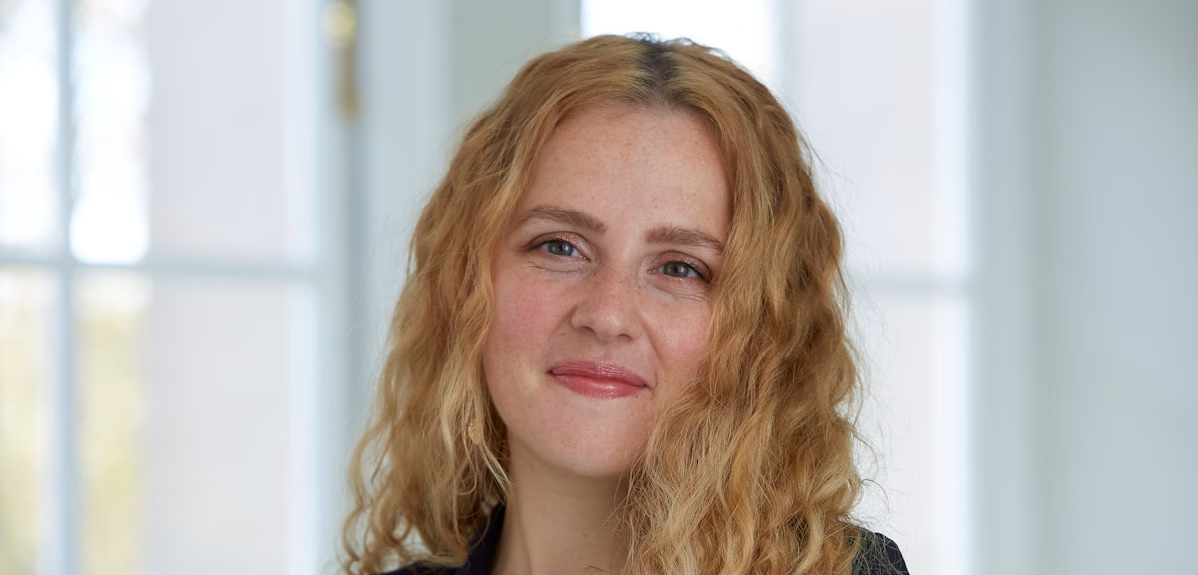
Léa Jacquot-Benson: Connecting empathy with strategy
From London’s hidden walking tours to Saudi Arabia’s luxury resorts and Mongolia’s community-led tourism, Léa Jacquot-Benson has built a tourism career connecting empathy with strategy. Her work bridges sustainability, inclusion,...
◦ 22 min readFrom London’s hidden walking tours to Saudi Arabia’s luxury resorts and Mongolia’s community-led tourism, Léa Jacquot-Benson has built a tourism career connecting empathy with strategy. Her work bridges sustainability, inclusion, and cultural understanding – proving that conscious travel isn’t a niche, but the natural evolution of tourism itself.
Background & Identity
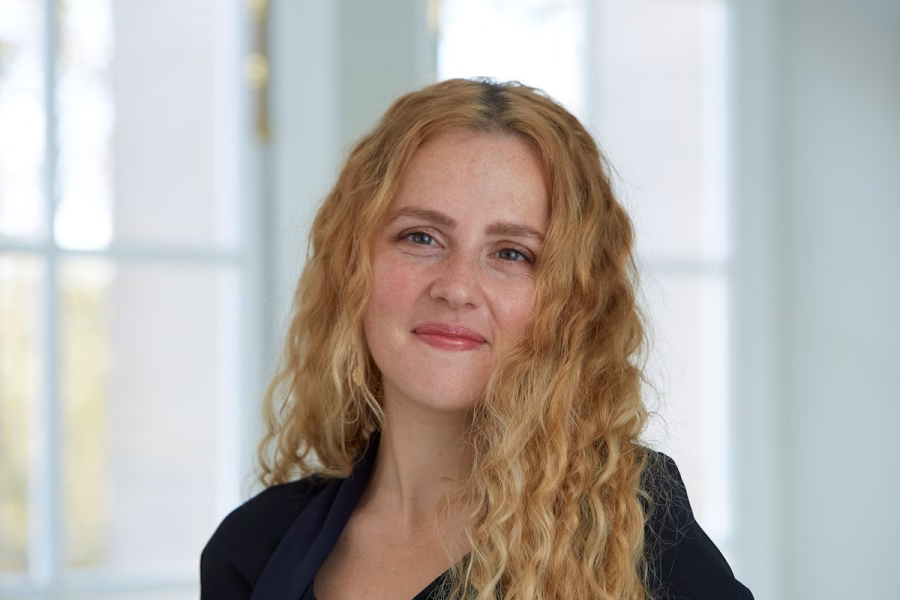
Léa, can you introduce yourself and share how you describe the work you do today at Considerate Group?
Of course! I am Léa Jacquot-Benson, a responsible tourism and hospitality specialist.
I conduct most of my work in this field through my role as a Sustainability Manager at Considerate Group, where I support hotel teams, operators and owners integrate Environmental, Social and Governance (ESG) principles into their operations. This goes from reducing waste and emissions to embedding equity, diversity, and inclusion at leadership level. I have been at Considerate for over 4 years now, and I’ve had the privilege of working with all kinds of clients across the world which has been (and continues to be) an incredibly rich experience.
You were born in France, have built your career in the UK, and recently became a British citizen. How has that blend of cultures shaped your outlook on global sustainability?
For me, sustainability really begins with a willingness to learn. I was born and raised in France and moved to the UK at nineteen, and London quickly became home in a way that felt very natural. I’ve always felt energised by its openness, diversity, and the mix of perspectives you encounter every day.
Growing up, I was exposed to very different ways of living – within my own family, across the places I moved to, and through the people I met. That experience shaped how I see the world and encouraged me to look beyond my own reference points. It also made me realise how much we can learn from each other, which is ultimately what pulled me towards sustainability.
That curiosity has only grown over the years. I’ve always been drawn to places that challenge assumptions, and in recent years my work has taken me to Saudi Arabia and Mongolia. Both are often misunderstood from the outside, yet my time there has shown me a warmth, depth, and generosity that you can only appreciate firsthand.
Cultural exchange isn’t an add-on in my career; it’s at the heart of why I chose this field. It continually reminds me that sustainability isn’t a universal template but a dialogue shaped by people, place, and perspective.
What first drew you to sustainability and responsible tourism as a career path?
As cliché as it sounds, I’ve always been drawn to travel, but only ever in a way that felt meaningful. I loved understanding how people lived, the rhythms of daily life, the human side of a place. I just never realised that this instinct could become a career until I started researching and came across an MSc in Responsible Tourism Management. I signed up immediately – and it’s the best decision I’ve ever made!
Alongside my work at Considerate Group, I support organisations like Unseen Tours in London and Eternal Landscapes in Mongolia, both of which place community, dignity, and inclusion at the heart of tourism. I also teach Responsible Tourism to Master’s students, which allows me to pass on these values to the next generation of tourism professionals.
Path to Purpose
Before joining Considerate Group, what experiences or turning points guided you towards the sustainability space?
As a teenager, I had absolutely no idea what I wanted to do but, looking back, all the ideas I explored had one thing in common: purpose. At various points I wanted to become a human rights lawyer, a therapist for children, even work with people in the prison system.
I applied to a few specialist higher-education pathways after finishing school, but I ultimately chose to study Languages instead which, in hindsight, was the perfect decision. It gave me the opportunity to move to London and then Northern Ireland, to try teaching, and to take the time I needed to understand what I genuinely cared about. That period of exploring and researching eventually led me to studying an MSc in Responsible Tourism Management.
How did your time working with a range of hospitality brands in different regions expand your understanding of the industry’s environmental and social challenges?
Having worked with clients across Europe, the Middle East, and Asia, I’ve seen first-hand how differently cultures interpret inclusion and sustainability, and how much we can learn from one another.
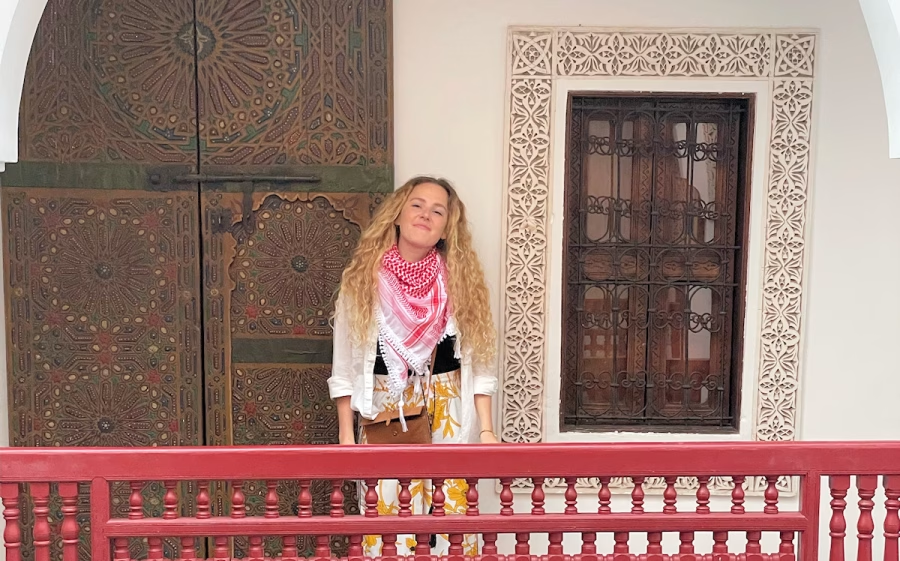
In Morocco and Mongolia, for example, I’ve come across incredible community cooperatives where local sourcing, collaboration, and mutual support happen completely naturally. I’ve worked with businesses where every employee had been there for over fifteen years and lived within a ten-kilometre radius. In these cases, local recruitment wasn’t a policy, it was simply common sense.
In the Gulf, I found that accessibility is deeply woven into daily life. Caring for the elderly or the more vulnerable isn’t treated as an initiative but as a form of respect. In countries like Saudi Arabia or the UAE, accessibility and sustainability go hand in hand because supporting others is embedded in the culture itself.
By contrast, in Western contexts we tend to rely more on frameworks, policies, and infrastructure such as bans on single-use plastics, Employee Resource Groups, inclusive parental policies, whistleblowing procedures, and so on. These systems matter enormously and create the conditions for progress, but they’re a different approach.
Each model has value. There’s good everywhere, and we don’t need to reinvent the wheel: we just need to look further, stay curious, and communicate better.
Who and what have shaped your philosophy of sustainability – how have people, moments, and influences guided your approach?
I always say that my number one privilege in life is the exposure I’ve had to so many different people and ways of living. That foundation shaped how I see the world and, later on, how I came to understand sustainability as something fundamentally human.
I’ve also been incredibly lucky to grow up surrounded by strong, independent women, which meant I never saw myself as any different from my male colleagues or leaders. That sense of equality has been reinforced by mentors who supported me with care, honesty, and high expectations, which is the best combination.
Interestingly, the biggest challenge hasn’t always been gender, but age. In a field where experience is often equated with years, being young can sometimes make people hesitate before taking your advice. But I found my path very early on and my personal life reflects my professional goals, which has allowed me to gain significant experience in a number of areas. I have also found that curiosity, commitment, and compassion go a very long way, and I’ve learned to trust that.
All of this has shaped my philosophy of sustainability: it’s about people, perspectives, and the responsibility we have to lift others as we grow. Being an ally or mentor has become a natural extension of that belief. While there’s still progress to be made, I know I’m part of that change and that gives me hope.
Inside Considerate Group
What does your role as Sustainability Manager involve day-to-day?
I lead ESG strategy development for hotel groups, owners, and operators, helping them set priorities, navigate evolving legislation, and understand where they can have the greatest impact. A key part of my work involves translating those strategies into clear, actionable steps that drive behavioural change at property level.
I rely heavily on data to inform decisions and to show teams the tangible effects of their actions, but I also focus on creating the right conditions for people to engage with sustainability in a way that feels practical and empowering. Beyond client work, I stay connected to the wider hospitality and sustainability community through industry events, panels, and peer learning which keeps my perspective grounded, current, and enriched by what others are doing across the sector.
How do you balance high-level ESG strategy for asset owners and destinations with hands-on guidance for hotel teams on the ground?
The two are deeply connected. At the ownership and destination level, I focus on long-term vision, measurable targets, and alignment with regulatory frameworks. But strategy only matters if it works in the real world, so I spend a lot of time with hotel teams to understand operational realities: how decisions affect workloads, guest expectations, budgets, and daily routines.
This dual perspective allows me to bridge ambition and practicality. A solution that looks perfect on paper needs to make sense in a housekeeping briefing or a kitchen workflow. My role is to ensure both levels speak to each other so sustainability becomes part of how the business operates, not a separate layer added on top.
What are some of the most exciting or impactful projects you’ve worked on recently?
2025 has been a particularly exciting year ! I visited Intrepid Travel’s first-ever accommodation in Marrakesh, a stunning riad in the Medina. It was great to see how well-embedded sustainability is in an organisation as big as Intrepid, and how they constantly aim for improvement.
I am also working with Eternal Landscapes Mongolia on Chandmana Erdene, a tourism training centre for women in the ger districts of Ulaanbaatar. Supporting a project that blends skills development, community empowerment, and responsible tourism has been one of the most meaningful parts of my year. It’s a powerful reminder that sustainability happens at every level, from global strategy to local opportunity.
Strategy & Systems Change
What do you see as the most urgent sustainability priorities for the hospitality sector in 2025?
The awareness around sustainability has grown dramatically in the past few years, which is incredibly encouraging. But now that the foundations are in place, the priority is to look beyond the four walls of the hotel and understand the wider system we operate in.
Waste and supply chain remain two of the biggest opportunities for impact. With waste, the first step is often simply understanding it: monitoring what is produced, where it comes from, and where it ends up. From there, reduction and responsible disposal become much more realistic.
Supply chain is just as critical. We need a much deeper understanding of the people and processes behind the products we use: what do our suppliers’ labour practices look like? How can we collaborate rather than just procure? What are their carbon emissions, their hiring practices, their approach to local employment and inclusion? These questions are no longer optional; they’re essential to building a meaningful sustainability strategy.
And then there is social impact: a pillar that is still too often overlooked simply because it’s harder to measure. Unlike carbon or energy use, you can’t reduce human rights, employment quality, or inclusion to a neat dashboard. But tourism is a people-driven industry, and we need to do much better on the human side of sustainability: fair work, dignity, safety, representation, and genuine inclusion.
Environmental progress is important, but if we ignore the social foundation, we miss a huge opportunity to understand and increase our impact.
How do you define meaningful systems change in hospitality, and what is often overlooked in that process?
People often only see the visible results: the certifications, the ESG reports, the awards. Those are important, but they’re only the surface. The real work happens long before that, shaped by legislation, budgets, supply chains, guest expectations, leadership priorities, and the motivation of the teams on the ground. All of these moving parts influence the pace and depth of progress.
Transformation is rarely linear. It demands endurance, collaboration, and the humility to keep adapting. Behind every achievement sits persistence: hours of advocacy, negotiation, and patient education. What people often overlook is how much of this work depends on individual commitment. A single champion who cares, who asks questions, and who pushes for consistency can influence an entire organisation. Champions turn abstract values into daily habits; they keep momentum alive when the process feels slow.
Sustainability is a long game, shaped by countless small actions rather than one big gesture. That’s the part most people never see, but it’s also where the real transformation happens.
How can data, behavioural insights, and storytelling help shift hospitality from compliance to culture?
I see sustainability as both a mindset and a mirror. It reflects who we are as people: how we treat others, how we design experiences, and how we build systems that last. Data helps us understand where we stand; behavioural science helps us shift habits and mindsets; and storytelling brings meaning, emotion, and aspiration into the process.
A recurring mistake I have seen is treating ESG as a checklist. This really misses a big opportunity for change – Compliance might tick a box, but culture is what changes an organisation. To me, sustainability is a language of respect, a way to make sure that every person feels understood, safe, and valued. When data and storytelling work together, sustainability becomes not just a responsibility, but a source of pride.
People, Equity & Inclusion
You’ve worked extensively on equity, diversity, and inclusion within sustainability frameworks. What does inclusive luxury really mean, and why is it essential to a sustainable hospitality experience?
Inclusion is the purest expression of what true luxury should be. The industry has spent years trying to “redefine luxury,” but all that really means is rediscovering care. Today’s travellers want meaning, not excess. Having a butler or water flown in from across the world isn’t impressive anymore; luxury now lies in attention, authenticity, and the feeling of being understood.
That’s why inclusion sits at the heart of sustainability. If we want to design experiences that are truly thoughtful, they must work for everyone. One of my favourite examples is the Kimpton Fitzroy London: its retractable marble staircase discreetly transforms into an accessible platform lift, allowing wheelchair users seamless access without altering the heritage aesthetic. It’s practical, beautiful, and deeply considerate – exactly what inclusive luxury should be.
Whether I’m designing a strategy for a luxury resort or supporting a walking tour led by someone with lived experience of homelessness, the question is always the same: how do we make people feel seen, safe, and valued?
How can hotels and destinations create sustainability programmes that genuinely include local voices and underrepresented communities?
Inclusion is most powerful when it grows from within. Some of the strongest sustainability models I’ve seen come from teams and communities who were already doing the work instinctively: recruiting locally, designing for dignity, and caring for the people around them long before it was framed as “ESG.”
The key is understanding that hotels and destinations don’t need to reinvent the wheel. The solutions often already exist; what’s needed is more intentional listening and genuine engagement with the right people.
A great example is Unseen Tours, which centres its entire model on the expertise of people who have experienced homelessness. The guides shape the tours, the narratives, and the impact, and their lived experience becomes the foundation of a truly meaningful product. I’ve had countless conversations with hotels in cities like London about community engagement, and partnerships with social enterprises like Unseen Tours offer an authentic, thoughtful way to connect guests with the local community.
When sustainability programmes are built with people rather than for them, they become rooted in place, relevant, and far more resilient.
What’s one change every leadership team could make tomorrow to build more inclusive workplaces?
Representation. When hotels reflect diversity in their imagery, staff, and storytelling, everyone feels welcome – and that’s what belonging truly looks like.
But this also means creating spaces where people feel safe to speak, question, and share. Leaders shouldn’t be afraid of conversations about equity or identity; they should welcome them. A workplace becomes inclusive when people know their voices matter and their experiences will be met with respect, not hesitation.
Guest & Employee Engagement
Many sustainability goals fail without human engagement. How do you inspire staff and guests to care and participate?
For me, it’s about connecting empathy with structure. Sustainability only works when it speaks to both sides of the brain, the logical and the emotional. If people understand why something matters and how they can make a difference, participation comes far more naturally. It’s never about pressure; it’s about purpose.
What tools or resources have proven most effective in bridging the knowledge gap between sustainability policy and daily operations?
In my experience, the most effective tool isn’t a platform or a checklist but the engagement and consistency of the people driving sustainability. Behind every certification or successful initiative are hours of advocacy, negotiation, reminders, and patient education. These consistent efforts build momentum over time. Sustainability never really ends, and that’s part of what makes it meaningful: it grows with the people and the place.
How can storytelling; visual, emotional, or educational, turn sustainability from obligation into pride?
Storytelling gives sustainability a human texture. Data tells us what is happening, but stories tell us why it matters. When people can see themselves in the narrative – whether it’s a chef reducing food waste, a housekeeper improving recycling systems, or a guest recognising their impact – sustainability shifts from obligation to pride. It becomes something shared, something people feel connected to, rather than something they feel responsible for alone.
Culture, Faith & Values
You’ve spoken about the role of personal values in your work. How have your own beliefs influenced your sense of responsibility and compassion in leadership?
At the heart of my work lies one consistent principle: care. I see sustainability not as a technical checklist, but as a language of respect. I’m always asking, How do we make it work for everyone? I think of sustainability as a way of thinking and relating — it shows how we value people, how we design experiences, and how we build systems that last. It reflects who we are, how we treat others, and the systems we choose to build.
How do you maintain balance and clarity amid the complexity of global sustainability challenges?
For me, balance comes from perspective. Sustainability can feel overwhelming if you see it as a single, immovable challenge, but it becomes more manageable when you break it down into people, relationships, and moments of progress. I remind myself that I can’t solve everything, but I can make a meaningful difference in the spaces I touch, whether that’s a hotel team, a student cohort, or a community initiative.
Grounding practices also help: stepping away from my screen, reconnecting with nature, praying, or spending time with friends and family. These moments bring clarity and remind me why the work matters in the first place.
What keeps you optimistic about progress?
I stay optimistic because I’ve seen how collaboration can turn an idea into real change. When people come together across departments, cultures, sectors, or even continents, things move. I genuinely believe empathy and excellence can, and should, coexist. Every time I witness a team shift their mindset, improve a process, or rethink a decision, it reinforces my belief that progress is not only possible, but already happening.
Future of Responsible Travel
How do you see the relationship between sustainability and luxury evolving?
The future of luxury lies in its ability to combine empathy with excellence, and consciousness with creativity. Sustainability isn’t just about protecting the planet; it’s about protecting our shared humanity. If we can connect attentiveness with quality, and strategy with soul, we’ll have already redefined what luxury really means.
And truly, inclusive luxury is not as complex as people make it out to be. Real luxury has always been about feeling understood. The industry talks a lot about “redefining luxury,” but what that really reflects is a growing realisation that guests want meaning, connection, and experiences tailored to who they are. You simply can’t do bespoke without doing inclusive.
Representation matters just as much. When diversity is reflected in branding, imagery, and staffing (both front and back of house), it signals that everyone is welcome. That’s what inclusive luxury looks like.
Which destinations or innovators are inspiring you right now?
Saudi Arabia, Mongolia, and Morocco continue to inspire me each in their own way, showing how culture, community, and innovation can coexist beautifully. Their approaches remind me that sustainability isn’t a template; it’s a reflection of context, values, and lived experience.
Oman is also very high on my list. I’m fascinated by how such an understated destination has managed to remain so deeply true to itself: authentic, welcoming, and quietly confident.
I’m also constantly inspired by the hotels I encounter through my work. Some of the most thoughtful initiatives I’ve seen are the ones that never make headlines: a Paris hotel piloting an app that helps visually impaired guests navigate independently; a Milan property offering regular, fully funded health check-ups for employees; or a hotel in Monaco joining local reuse schemes, drastically reducing packaging waste. What I find especially striking is that all these examples come from large international hotel groups, in places where you wouldn’t necessarily expect such grassroots innovation.
These quieter efforts remind me that meaningful change often happens where thoughtfulness meets creativity, long before it becomes a trend.
What does the “next generation” of responsible hospitality look like to you?
It looks like sustainability and inclusion made effortless. Systems that respect people and the planet as naturally as they deliver comfort and beauty. Responsible hospitality should feel intuitive, not performative.
Human Details
What’s something people would be surprised to learn about you?
People are often surprised by how much music shapes my everyday life: according to my Spotify Wrapped, I listen to the equivalent of two full months of music each year! It’s my way of staying grounded, energised, and connected. I also absolutely love dancing; it’s the one space where I stop thinking and simply feel.
Describe a recent travel moment that reminded you why sustainable tourism matters.
Travelling through the Hisma desert in Saudi Arabia was one of those moments. It’s a region I am certain will become a major tourism hotspot in the coming years, yet for now it remains largely untouched. Standing there, with nothing but sandstone cliffs and silence stretching in every direction, I felt the privilege of witnessing a place before most of the world discovers it. It reminded me why sustainability matters: so that destinations as beautiful and fragile as this can welcome travellers in ways that protect their essence, their communities, and their future.
Quick-Fire
- Favourite sustainable hotel or destination: I cannot NOT mention Eternal Landscapes Mongolia because I’ve never seen anything quite like it… Everything is intentional: community partnerships, inclusive recruitment, and a deeply thoughtful environmental approach in a country with very limited infrastructure to support it. More unexpectedly, I recently stayed at The Standard in Ibiza, which was an excellent blend of sense of place, community engagement (I had never been to a bingo night quite like this one!) and environmental efforts. Finally, from a luxury perspective AlUla was was absolutely breathtaking and a beautiful and ambitious example of cultural heritage revival.
- Most underrated ESG win: Consistency. The small, continuous actions that never make headlines but change behaviours, build culture, and move the needle more than people realise.
- A ritual that keeps you grounded: Music and dancing. Always. It resets my energy, clears my head, and brings me back to myself in a way nothing else does.
- Your definition of “quiet luxury”: Feeling genuinely valued, not through excess, but through care, intention, and being seen as a person rather than a transaction.
- Sustainability buzzword you’d retire forever: “Eco-friendly.” It’s vague, overused, and meaningless. Tell me what you’re doing, not just that you’re “eco” anything.
- Quote or principle you live by: Be so completely yourself that everyone feels safe to be themselves too.
Closing
What’s one question you wish people asked about sustainability in hospitality.. but rarely do?
“How do we make sustainability work for everyone?” Not just for the environment, or the business, or the guest, but for the people who clean the rooms, grow the food, run the tours, manage the operations, and welcome us into their communities. When that question becomes central, innovation, inclusion, and impact naturally follow.
What would you tell your younger self about courage, clarity, and building impact one conversation at a time?
I would tell her that courage rarely looks dramatic. It’s simply showing up with honesty and openness. Studying my masters fully online removed so many barriers; reaching out became easier, and I realised how much a single conversation can change your path.
I’d remind her that no one truly knows what they’re doing, and it’s completely fine to figure it out as you go: it’s your first time being you! And I’d reassure her that empathy is a strength, not something to tone down.
Impact is built quietly, one exchange at a time. Trust those small steps; they shape everything.