Jezza Williams: Pioneering Inclusive Adventurist
Background & Identity Can you introduce yourself and share how you describe the work you do today through MakingTrax? Kia ora, my name’s Jezza Williams — a Kiwi on a...
◦ 33 min readBackground & Identity
Can you introduce yourself and share how you describe the work you do today through MakingTrax?
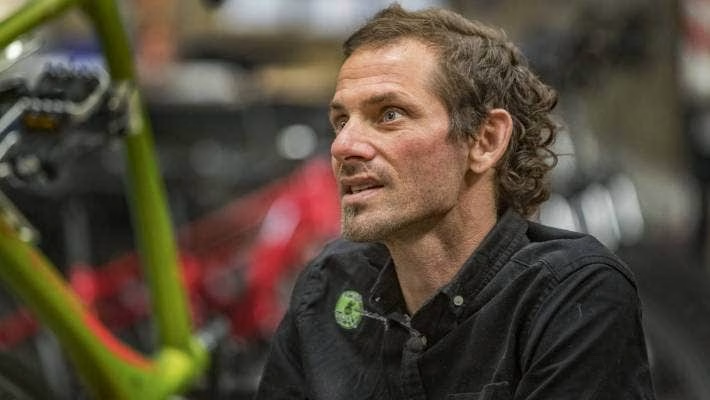
Kia ora, my name’s Jezza Williams — a Kiwi on a mission to make Aotearoa the accessible adventure capital of the world, and help the rest of the world follow suit.
Back in 2012, I founded what’s now the Makingtrax Foundation — a charitable trust dedicated to revolutionising adaptive adventure travel. We work alongside tourism operators, giving them the knowledge and tools to open their experiences to people with disabilities and access requirements. I work as an adaptive adventure tourism advisor both here in Aotearoa and internationally.
Where did you grow up, and what early experiences shaped your love for the outdoors and adventure?
I was lucky to grow up in the wild beauty of the South Island — on a farm tucked away in the middle of nowhere, surrounded by rivers, lakes, and mountains. It didn’t take long before the outdoors came calling.
From a young age, I was hooked. In winter I was a skier, competing for my school. In summer, I was on the river, guided by my maths teacher — a kayak guru who I definitely got on better with outside the classroom.
Our school, Mackenzie College, became New Zealand’s first outdoor education school, so I was in my element right from the start. Skiing and kayaking were my true passions, but I dabbled in anything that pushed my limits — climbing, mountaineering, mountain biking, even sailing.
After school came three years of higher education — a degree in Outdoor Education, a diploma in Ski Patrol, and a year studying Adventure Guiding and Leadership. That set me loose on the world.
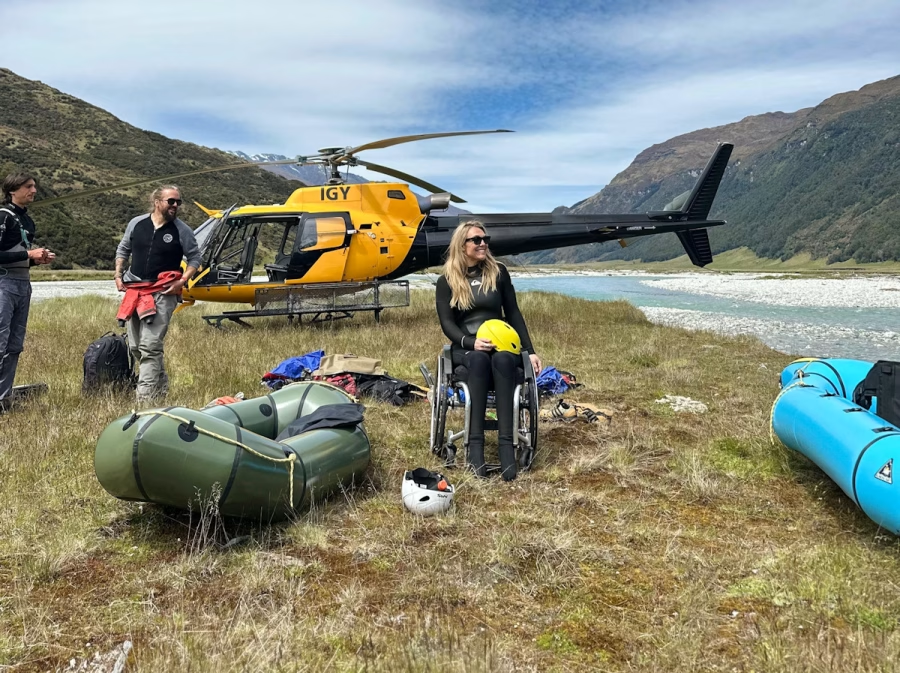
The next 15 years were spent chasing seasons and wild places — guiding expeditions, skiing big mountains, and exploring corners of the earth only a few get to see. From the jungles of Central America to the mighty Zambezi in Africa, the Atlas Mountains of Morocco to North America’s big white water, the Northern Territory to Australia’s tablelands. I’d still return home every few years to run rivers so remote they could only be reached by helicopter.
Which parts of your identity – guide, adaptive athlete, educator, advocate, feel most central to your story today?
At my core, I’m a guide — always have been, always will be. My passion is bringing people into environments they never imagined possible.
I consider myself extremely lucky to have gained skills through experience to adapt to any environment, and that’s shaped who I am today. With knowledge comes responsibility, and that’s where the educator side of me has grown. Sharing what I’ve learned doesn’t just open opportunities — it shows others what’s truly possible.
A Life-Changing Turning Point
You were already deeply rooted in adventure guiding before your accident. What do you feel comfortable sharing about that moment and its aftermath?
Everyone loves the gory details — they always seem to be the highlight of the story. As a kid, I used to sit in my gran’s hallway reading the Drama in Real Life section of her Reader’s Digest collection. I loved those stories of limits and survival. So yeah, I’ll share mine.
It was 2010, and I was working in Interlaken, Switzerland — a five-month summer contract. I was 35, at the top of my game, chasing endless summers: rafting the Zambezi, running trips in Morocco, then straight into the Swiss season. Switzerland was a dream gig — rafting and canyoning right in the heart of the Alps.
Canyoning is where you start high in a narrow rock canyon filled with waterfalls and deep blue pools, all carved smooth by centuries of flowing water. As guides, we lead people through it — swimming, sliding, leaping, abseiling. Anchors set in the rock, ropes our only way down. It’s technical, physical, and demands complete respect for the environment.
That morning was a standard tour — me, my good mate Steve, and five clients. We’d just finished the last abseil and I was catching up to the crew below. One jump — that’s all it took.
In my rush, I took a different line than the clients, one I’d done many times before. But that time, it didn’t go to plan. A small slip on take-off, the rotation went wrong, and my helmet struck rock. I landed in the waterfall pool below — face-down, body out of my control.
As my arms drifted across my eyes in the bubbling water, I knew instantly it wasn’t good. Steve reacted like the absolute pro he is — jumped in, rolled me over, and the look on his face said it all. Later, he told me my body wasn’t connected to my head.
The rescue was straight out of a movie — a 250-metre longline from a Rega helicopter. It took forty minutes for the paramedic to reach me, and that was the most efficient team on earth. Strapped in a stretcher, we swung through the canyon walls and into the unknown — the start of the hardest journey of my life.
Multiple surgeries to rebuild my neck. A near-drowning. Continuous collapsing lungs. Five weeks in a coma. I woke unable to breathe or move. That was the beginning of the rest of my life — eleven months in Nottwil Spinal Rehabilitation, then back to Aotearoa, defying every specialist’s opinion.
Diagnosis: Axial A C5 tetraplegic
How did that experience change your relationship with risk, freedom, and the natural world?
It didn’t really change my view — it just made access to it a whole lot more challenging. If anything, it gave me a new drive to rewire what “risk” and “freedom” meant to the new me.
At first, it was a complete unknown. My body had changed drastically, and everything needed to be relearned. To get back out there, I had to take risks far greater than anything before — but all relative to my new reality.
I already had a lifetime of testing limits and learning from experience, so I had the knowledge. But the landscape had shifted, and I had to start again. That became the most demanding — and ultimately the most rewarding — journey of my life.
What helped you rebuild confidence, identity, and community after such a profound shift?
Coming home to Aotearoa after rehab, everything slowed down. It was winter. I’d bought a house I’d never even seen, and suddenly I was still — after years of living fast and hard. My mates were out there living the dream, while I was learning how to live again. It was a low point, no doubt.
But I’ve always loved a challenge. I held onto that — and the belief that tough experiences make us grow. Even the smallest tasks became challenges, and I embraced that process.
I was already a confident person, but this journey gave me a deeper awareness of myself and others. I chose life. I chose to focus on the positive and the possible.
Soon enough, I was back on the river — back travelling the world. Different, yes — now completely reliant on others and my own unique systems — but the fire was still there.
Personal Journey
What did returning to adventure look like for you as a wheelchair user?
Adventure was all I’d ever known, so getting back out there wasn’t a question — it was a drive. I was lucky to have good mates in the adventure industry who trusted my imagination and were willing to put in the hard yards with me. Funny enough, I went straight for the activities that were probably the hardest, but because I knew them so well, they felt like the easiest path back.
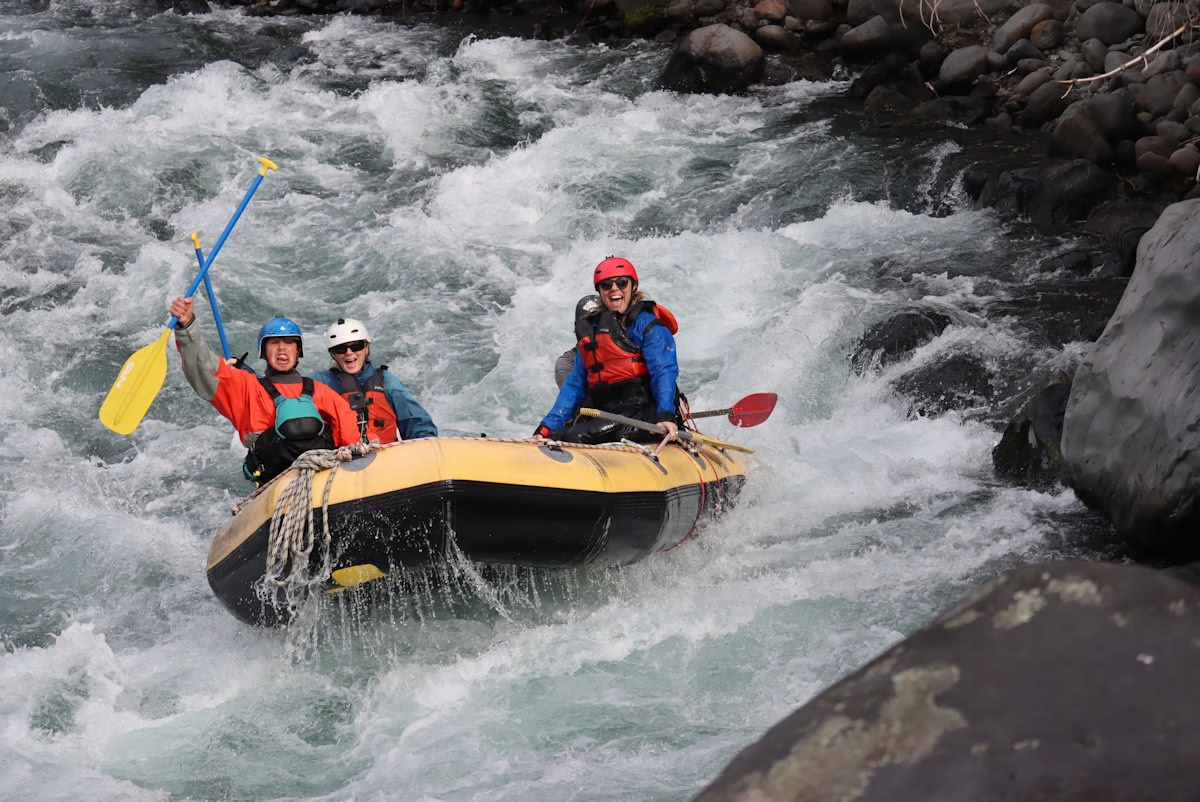
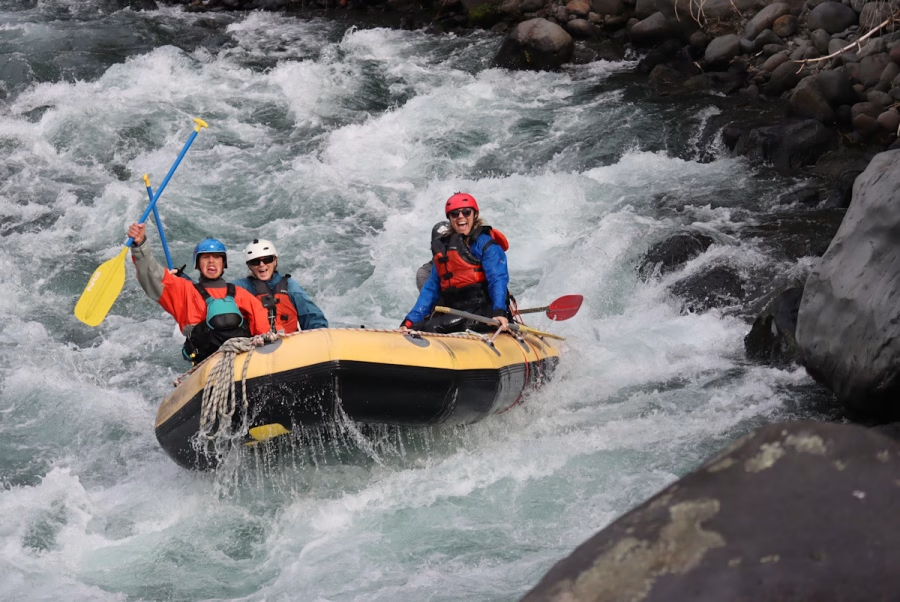
Take rafting. People may imagine just sitting in the bottom of a boat, but I needed to be part of the team — not guiding anymore, but contributing. That meant figuring out everything: keeping my body temperature regulated, managing abrasion on skin that’s now compromised, learning how to sit upright on the pontoon with a harness system I could escape from if something went wrong. And then the big one — what happens when you’re in the river and can’t actively swim? Those risks were real, and at the start, mostly unknown.

It took years of trial, error, and stubbornness to get the systems right. I used my body as the test rig. I froze. I tore up my tailbone. I went past my comfort zone more than once, into territory I’d call stupid in hindsight. But through all of that, I rediscovered myself and the wilderness. I ran rivers in Aotearoa — six-day missions deep in wilderness — and in Nepal. I even went back to Switzerland and ran the Lütschine, a glacial class-4 river that leaves no room for error. These were my choices. I knew the risks. I trusted my team. And I trusted myself.
Pushing my limits has always been how I understand my reality. One turning point came five years after my injury when I needed to test what I could actually endure. Four mates and I travelled 36,000 km from Wales to Mongolia through Euro-Asia and back through Russia in a tiny Toyota Yaris. Two months on the road, camping, showing up at strangers’ doors, passing through places where someone with my body simply didn’t exist. That trip taught me the power of adaptation and reminded me how generous humanity can be. It also reinforced that the biggest limits we face are usually in our attitudes — even when living with a C5 spinal cord injury.
In the same spirit, I learned to paraglide from scratch. I built my own buggy, earned a licence, collected a couple of crashes along the way — all part of understanding myself.
Everything that followed from those early years rewired the way I see life, risk, and adventure.
How did it feel to move from participant to pioneer; designing experiences that didn’t yet exist?
I’ve never really thought of myself as a pioneer. It wasn’t a moment of realisation — more a natural progression. I often say I’m one of the luckiest unlucky people out there. I ended up in a situation where I had deep experience in adventure tourism and suddenly a whole new lived experience to match it. So when a barrier popped up, I didn’t see a problem — I saw a challenge to solve.
Because I understand how adventure operations work — the systems, the risk management, the culture — adapting experiences felt straightforward. I’m also a perfectionist. I hold high standards because if we’re working with operators, industry experts, and regulators, we need solutions that are practical, safe, and credible. To create change, you need to earn trust. You need to speak the same language — or better yet, bring knowledge that complements theirs.
I’m now over 30 years deep in adventure tourism, with more than a decade dedicated to inclusive adventure. I turned 50 this year, and I’m still learning. That matters to me, because the changes we make must be safe, dignified, and simple. This work deserves respect. If it’s done poorly or based on assumptions, it can set the whole industry back. So I keep showing up to ensure we get it right.
Who or what kept you focused on inclusion rather than limitation?
For me, limitation is just admitting you haven’t found the answer yet. It burns energy you could be using to figure out what’s actually possible.
Every situation has its reality — that’s where you start. From there, you shape the best solution to expand the potential of that reality. The more knowledge and experience you bring, the simpler those solutions become.
And sometimes the solution is as simple as rolling away, changing your angle, or shifting your focus. It’s not avoiding the challenge — it’s approaching it from a place where possibility feels bigger than the barrier.
Founding Making Trax
What sparked the creation of Making Trax, and what problem were you determined to solve?
Makingtrax started by accident — my accident. The spark landed during rehab in Switzerland in 2010. I was suddenly faced with the reality of a future I hadn’t planned for, and a lot of time lying in a hospital bed learning how to breathe, eat, and live again. In that space, the next journey began to form. I knew I needed to stay connected to the industry that had shaped me.
The name came easily, and from there things evolved bit by bit. I gave myself a year to settle back into life and take a hard look at the adventure tourism industry through the lens of my new reality. What I found for someone with my ability was, frankly, pretty bleak. So I decided to change it.
Through a mix of stubbornness and passion, I knew my body could still do these activities — so why shouldn’t others? Being recognised in the adventure tourism capital of Aotearoa New Zealand helped. Slowly, we gained traction and began creating real change.
We started small. And just like my personal journey, Makingtrax evolved as my knowledge and experience grew. What began as a personal mission became a what it is today.
How does the organisation empower both travellers and operators to redefine what’s possible?
It starts with understanding how an operator actually functions — their procedures, regulations, and the real-world challenges of running an adventure business. Then it’s about understanding the customer: their ability, their needs, and how they engage with risk. It sounds simple, and it is when you’ve lived a lifetime in both worlds.
The biggest challenge on both sides is assumptions. In the outdoors we have a saying: assumptions are the first cause of every fcuk-up. There’s no room for them in adventure. My job is to redefine how an experience can be made safe, efficient, simple, dignified, and enjoyable for everyone involved.
Adaptation, lateral thinking, and simple solutions all play a role — but simplicity is key. Adaptive equipment must add real value, not complexity.
Makingtrax also designs systems, rigging, and adaptive support seating for activities like rafting, climbing, and kayaking. These are used commercially by operators across the country.
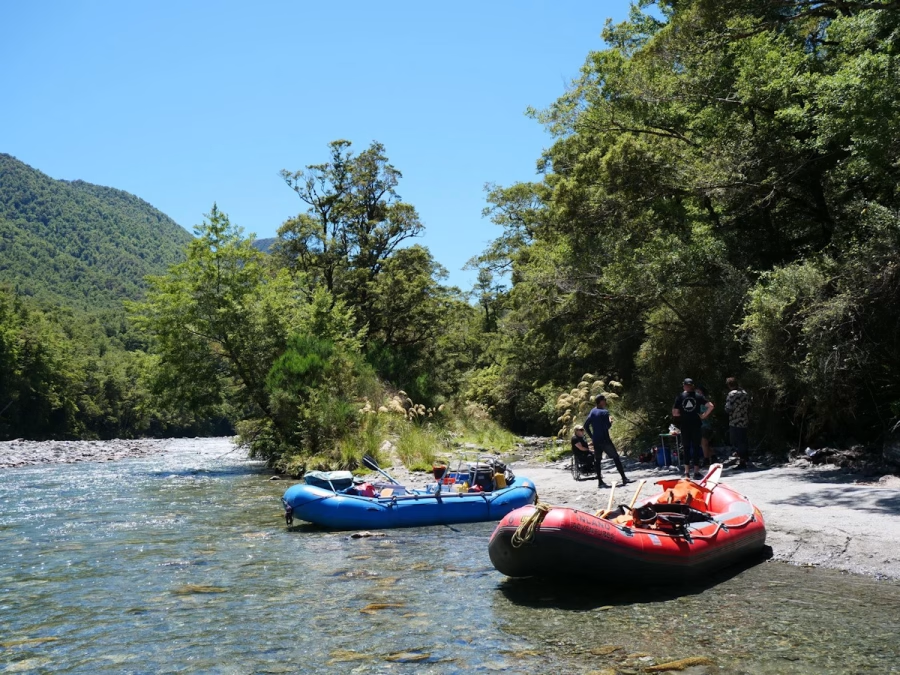
And it’s crucial to recognise that not every ability suits every experience. The skill lies in finding the potential of each experience relative to the customer — not forcing participation, but enabling it where appropriate. Every experience is different, and so is every person. Participation isn’t one-size-fits-all, and within the framework of safety operations, people are not a policy.
At its core, Makingtrax is an adaptive advisory service — supporting both travellers and operators to explore what’s truly possible.
What have been the biggest lessons in bridging the gap between safety, inclusion, and adventure?
The biggest misunderstanding about adventure is that it’s inherently dangerous. Sure, I’ve personally pushed the envelope plenty of times, but when we talk about commercial adventure operations, the picture is completely different. In Aotearoa New Zealand, operators follow strict safety operational procedures audited by regulators like AdventureMark. These standards exist for one reason: to keep people safe.
When adaptive adventure comes into play, the key lesson is that safety procedures must never be compromised. Any adaptive equipment — hardware, harnesses, seating — must support the existing safety system, not replace it.
Every country has different regulations, but the safest approach is to understand the most rigorous standards and treat those as the benchmark. And when you’re adapting adventure experiences, go above and beyond that line.
Inclusion doesn’t mean everyone can or should do every activity. Safety remains paramount. Eligibility criteria — whether based on weight limits, motor skills, or the need to use specific safety gear — aren’t personal. They’re part of how the activity runs. Respecting that is what keeps inclusion authentic, not risky.
Adaptive Adventure & Systemic Barriers
What are the most persistent myths about accessibility and adventure travel?
Adventure looks different to everyone — it’s always relative to the individual. One of the biggest myths is that travellers with disabilities don’t do much. The truth is most are active, curious, and adventurous; they just navigate the world differently.
Another misconception is that accessibility is only about built environments. Adventure lives well beyond ramps and railings. It’s about adapting, problem-solving, valuing people, and learning from each other. Good customer service can create incredible experiences even in the most challenging environments.
That’s the power of inclusive tourism. In some ways, Nepal is more inclusive than New Zealand simply because people are more willing to help. Some travellers want assistance; others want to stay independent — both are valid. The real myth is assuming everyone fits into one box.
Which barriers – logistical, attitudinal, design-based, still limit disabled adventurers?
The biggest barrier is always attitudinal. Most of the time, it’s unconscious — a kind of implicit social bias built from years of separation in sport, education, and community. It creates a “them and us” mentality. It still exists because there’s a lack of genuine connection.
Connection is where everything shifts. Once people actually meet, talk, work, or adventure together, the landscape changes. We all have different abilities — physical, intellectual, social, emotional. Inclusion is about valuing those differences, not hiding them or being awkward around them.
When attitudes improve, everything else becomes simpler. Attitudinal barriers breed assumptions, and assumptions without knowledge create all the other barriers.
Design-based issues and poor information are still common too. Small, innocent mistakes — usually from a lack of understanding — can create major access barriers, even when operators are trying to do the right thing.
But it always starts with attitude. Remove that barrier, and the rest can be solved.
How do you convince operators that inclusion isn’t a liability, but an opportunity?
I don’t convince them — I educate them and let them decide what kind of business they want to be. When operators take a moment to actually understand the access market and the simplicity of adapting, it becomes a no-brainer.
Authenticity matters. If a business isn’t doing it for the right reasons, it shows. That’s why these days I mostly work with those who come to me — the ones genuinely ready to evolve.
Recently I launched Adapting Aotearoa, a platform designed to show businesses the reality of what it takes to operate inclusively. It includes more than 20 training modules to lift industry knowledge and confidence.
To put it another way: imagine if accessibility were transportation. If no one valued the research, technology, or innovation, we’d still all be driving cars from the 70s. A few people might have newer models, but no one would know how to operate or maintain them, and most businesses would ignore the experts because they didn’t see the value. They’d just stick with what they know — even if it holds them back.
The access market is no different.
Purpose, Impact & Advocacy
What kind of change are you most focused on creating in the global adventure tourism industry?
I believe real change has to come from within the adventure tourism industry itself. Inclusive tourism is no longer a niche — we’ve got the research to prove it, even if some numbers get stretched. What matters is that it creates meaningful cultural and community impact.
My focus is on educating the global industry by setting a clear standard and giving operators the knowledge and tools to take ownership. Nothing changes unless they truly understand the market and believe it’s worth the investment.
We need to value research, knowledge, accountability, and quality. Once a business genuinely commits to inclusion and sees the value, they invest — and when they invest wisely, that’s when authentic, safe, high-quality adventure becomes possible.
How do you educate guides and companies to move beyond compliance toward cultural inclusion?
In adventure tourism — in any visitor experience — you need to understand how things actually work. You’re entering an industry with rules, regulations, and operators and guides who’ve poured their lives into building their skills and products. You’re not there to tell them how to do their job; you’re there to help them unlock a whole new market and improve the experience for everyone.
Most issues come down to misunderstanding, assumptions, and lack of connection. My approach is to work with the systems and procedures they already have, then integrate enhancements through services, solutions, and lateral thinking — always keeping things simple and adaptable.
The business grows over time, and when it does, I’m there to guide best practice. Inclusive tourism isn’t a destination — it’s a journey, and the industry evolves step by step.
What conversations still need to happen around leadership, training, and representation?
Because the access market is growing so quickly, inconsistencies in how experiences are designed and delivered are inevitable. Tourism agencies and operators need to adopt a more inclusive culture, and when they do, they need to invest in high-quality advisory — not shortcuts.
Too often we see in-house strategies created “for” disabled people without involving them. And we see the opposite: advocacy-led approaches that expect a lot without fully understanding the realities of the tourism sector.
What’s needed is experience-based representation and genuine collaboration between industry experts. Less policy, more practical awareness. More education, better information, more transparency, and a commitment to best practice.
Outdoor Culture & Identity
What does “belonging” look like in outdoor spaces historically built for the able-bodied?
Belonging really depends on how you look at disability. These days, the line between “disabled” and “able-bodied” is pretty grey. We’ve got technical equipment, systems, and knowledge that can massively increase participation — but it also depends on the individual and what the outdoors means to them.
My own sense of belonging is different to most. My background, my experiences, my attitude — they’ve shaped me. My peers are outdoor gurus and I feel no different. If I want to go on a mission, I go. Simple as that.
But belonging isn’t just about people like me. It’s about those who don’t have the confidence, the knowledge, or the support to engage with outdoor spaces. That’s where the outdoor scene still needs to evolve. We keep forgetting that the outdoors is about adventure and connection — not gatekeeping.
In Aotearoa New Zealand, we’re still learning how to build a shared outdoor culture. Attitudinal barriers remain the biggest obstacle, and they show up in simple but harmful ways: access barriers on tracks, students left behind on school trips, or adaptive programmes that separate disabled people from their peers. These decisions create multigenerational patterns of segregation and perceived limitation.
Integration is where the magic is. When everyone shares the same space and experience, something shifts — for all involved. It’s the power of connection I mentioned earlier.
A practical example: this year, working with Recreation Aotearoa, we developed national industry guidelines to support more inclusive trail design. We’ve laid the groundwork, but adoption still sits with councils and DOC — and that’s where historic attitudes linger. The work continues.
How do you personally navigate accessibility, independence, and interdependence in wilderness settings?
For me personally? It’s a whole different ball game. I’ve been out in the wilderness nearly half a century. If I want to head off-trail, I’ve got tricks of the trade refined over decades — and the biggest one is preparation.
I think of it like a river. When I was younger, we’d fly into steep West Coast rivers and kayak out in a single day. No walking out, no shortcuts, and only the gear we could carry.
We had the experience to be there. We did our research. We talked to others who knew the river. We understood the weather, the flow, the dynamics. We trusted our team. We carried spares. We kept things simple and adaptable.
Flying up the valley, I wasn’t looking at every rapid — that would be impossible and overwhelming. I was scanning for the big hazards: slips, trees, the major features. Then the chopper would leave, and it was just us. No backing out. So it had to be a great adventure.

We ran the river one move at a time. We scouted horizon lines, made decisions together, set safety when needed. If someone had a near miss or a scary swim, we learned from it and kept going. Adapt, adjust, carry on. Like chess — one piece at a time.
Adaptive adventure is exactly the same. It’s about trusted people, outside knowledge, research, preparation, adaptability, and simplicity. You accept the challenge, break it down, stay flexible, and understand that the target keeps shifting. A mishap isn’t a failure — it’s part of the learning curve.
What role does fear – yours or others’, play in the evolution of inclusive design?
Fear shouldn’t play any role in inclusive design, especially commercially. Adventure comes with inherent risk, so good design — whether it’s equipment or procedure — sits firmly within safe operating parameters.
What people call “fear” is usually perceived risk. And risk comes in three layers:
Perceived Risk — your subjective take on danger. Low experience often means high fear or, on the flip side, dangerous complacency. With more experience, your perception sharpens.
Absolute Risk — the raw maximum danger with no safety measures in place.
Real Risk — absolute risk after all safety systems are applied. This is where inclusive design operates.
With adaptive adventure, real risk is higher than in standard operations, so everything must be designed around that reality. Good adaptive advisory is worth its weight in gold because it ensures risks are understood, controlled, and integrated — not feared.
Things will go wrong sometimes, but the difference lies in the extent, impact, and how we learn and adapt moving forward.
Global Advocacy & Collaboration
How has Making Trax influenced adventure operators internationally?
Honestly, this question is best answered by the operators we’ve guided over the years. I could list the agencies, organisations, and tourism bodies we’ve worked with — but the real influence shows up in how the approach is spreading.
The idea of Inclusive Tourism as a solutions-based, experience-focused practice is becoming more widely adopted overseas. We see it in rising sales of adaptive harnesses. Inbound agencies now request advisory services. Outdoor safety authorities are reaching out to understand how we do things here in Aotearoa.
The market is growing faster than the industry — and Covid accelerated that shift. When global tourism rebooted, operators had a chance to reassess priorities. Demographics have changed: younger generations are increasingly neurodiverse, and older generations are more active-minded but less physically able. That reality is reshaping what inclusion needs to look like. Not a special add-on — but a fully integrated product.
Meaningful Tourism, according to the International Adventure Tourism Research Association, is the next major driver for the industry. And comprehensive information — the key enabler — is now recognised as essential.
I hope the work we’re doing continues to influence that global shift.
What partnerships or countries are leading in adaptive adventure right now?
If I had to name a leading destination, I’d say Aotearoa New Zealand — and yes, I’m a bit biased.
But we’re not alone. There are incredible pockets of leadership around the world. Impact Adventures in Nepal — led by our mate Pankaj — is doing outstanding work. Travel writers like Sophie Morgan are opening doors and perspectives. There are brilliant people everywhere carving out pathways in adaptive adventure.
But what we really need is destination-level change: governments, regional tourism bodies, and DMOs recognising the importance of the access market and committing to strategy, investment, and proper advisory. Like any tourism sector, it needs to be understood before it can be valued — and not as a special service, but as standard practice.
Research tells us that 50% of people with access needs would travel more if tourism felt more accessible and inclusive. That’s a huge opportunity waiting to be met.
What’s next for the movement – certification, networks, mindset shifts?
The next big shift is education. It’s a mindset change within the industry itself. Once operators truly understand the access market — who their customers are, what inclusion actually means, and what people expect — they’ll see how beneficial it is.
It comes down to where they get their information. That’s why reaching out to the experts is the simplest, smartest first step.
Check out Adapting Aotearoa.
Emotional & Philosophical Dimensions
What has adventure taught you about vulnerability and courage?
I’ve always lived by the philosophy behind Adventure Based Learning — challenge creates a fuller life. I understood that as a schoolboy, but it really sharpened into meaning when I had my accident. Instead of staring at the impossible all at once, I dealt with the challenges as they showed up. My definition of adventure has never changed: you undertake something without knowing how it ends.
We tend to talk about vulnerability as weakness. But the truth is, every time you step into the unknown — wilderness, high-risk environments, or life-changing moments — you are choosing vulnerability on purpose. The more you’re exposed to that, the more self-awareness and capability you build. Experience is everything.
I’ve felt vulnerable in so many settings: hacking through the Darién jungle in Panamá, living rough in Honduras, paddling wild rivers, rafting with hippos, skiing massive mountain lines. But none of it compared to breaking my neck in a remote canyon on the other side of the world. That was vulnerability at its absolute limit.
What I didn’t realise then was that my life of chasing challenge — sometimes intentionally, sometimes blissfully unaware — was building a superpower. It taught me to spot other people’s fears, read their struggle, understand when to push and when to adapt, and rewrite my own story from the ground up.
Courage is born out of vulnerability, not strength.
I’m only the person I am today because I’ve lived a lifetime on that edge — and even more so afterwards.
Adventure gave me resilience in my blood, instinctive problem-solving, and a deep awareness of others.
Challenge didn’t break me — it built me.
How do you handle the emotional weight of constant advocacy?
I appreciate the question, because yes — it’s heavy. When you’re carving a new path, everyone nods along at first. But when change starts demanding real action, only a handful stay the course. That’s the emotional weight: trying to shift attitudes that have been cemented since day one.
It takes a generation to shift social thinking, so I hold tight to the people and operators who genuinely see the value. I focus on the small wins, the moments where someone has a life-changing experience because a business chose to do better.
Like everything else in my life, I deal with it by focusing on the possibilities. I know the industry can integrate inclusion — I’ve seen the results with my own eyes. My role is to help the authentic ones grow, not force anyone into something they don’t believe in.
You can’t force change.
But when a business truly owns their adaptive experience — when it’s genuine — it shines.
What moments remind you that inclusion isn’t charity; it’s humanity?
The more time you spend in adaptive adventure, the more you understand people — not “disability,” but humanity in all its diversity.
When you value people as they are, without assumptions, you see that diversity is the foundation of humanity. If our environments — social, physical, attitudinal — reflected who we actually are as a society, everyone would thrive.
We’re all somewhere on a spectrum of:
- Social and attitudinal experience
- Communication and information needs
- Physical and sensory environment
Understanding that reality is what pushes me forward. Inclusion isn’t charity — it’s just an honest reflection of who we already are.
Future Vision
What would a fully inclusive adventure industry look like?
In the ideal world, the entire visitor journey is controlled by the traveller — and it starts at the destination level.
Operators would work with adaptive advisors to maximise the potential of their experiences, delivering safe, high-quality inclusive adventures. Those operators would collaborate with transport providers to ensure their policies are aligned and solution-based.
Every operator would have a proper Access Guide — the real engine of an inclusive experience — integrated into their website, with accurate, practical, visual details. Travellers could choose how they participate, organise the support they need, or make an informed decision to go elsewhere.
Accommodation, hospitality, culture, arts, transport — everyone in the destination ecosystem would have Access Guides. Destination management agencies would use them to build inclusive itineraries and market opportunities.
And just like any other part of tourism, every business would have development goals, annual appraisals, and access to advisory support for future projects. Inclusion wouldn’t be an add-on — it would be the standard.
If you could rewrite one global travel norm overnight, what would it be?
Easy: every tourism business would publish an Access Guide.
Good access starts with good design, but the real game-changer is how you communicate that access. An Access Guide gives travellers the clarity they need — honest, visual, factual information so they can make their own decisions.
It builds trust. It removes uncertainty. It shows commitment.
“Accessible” as a label is meaningless. Transparency is what matters.
An Access Guide isn’t a judgement — it’s a tool. You’re not telling people what they can or can’t do; you’re giving them the information to decide for themselves. That’s empowerment, and that’s the future of inclusion.
When you imagine your legacy, what do you hope people feel, not just see, because of your work?
Truthfully I’m not too bothered about legacy. If anything, I’d hope people reflect on their own decisions. If my work nudges someone to understand others with more value and less judgement, then I’ve done something worthwhile.
At the end of the day, I just want people to feel free — free to explore, free to have fun, free to find their own adventure.
Human Details
What’s something people would be surprised to learn about you?
I’m a total softy. Put on a inspiring film, a good piece of music, or a story about someone’s journey and I’m gone. Not sad tears — the opposite. I get hit with pure joy, and it doesn’t take much.
Which cultural moment – film, book, exhibition, or conversation, is inspiring you right now?
I’ve always had a dream of designing and building my dream home, last year my partner Jane, her 13-year-old boy Charley and I moved into our new paradise. Ever since I have been improving our paradise we have a hectare of land to develop, along with the gardens, I’ve so many ideas like an insulated swimming pool. I’m inspired by designing.
Whenever I do get spare time to pick up a book, its mine. I’ll probably never get it finished.. one of those passion projects that you never have time for.
I did go to the ballet not long ago and was quite surprised how much I enjoyed it, that’s pretty cultured for me.
Mostly I listen to controversial podcasts based around true crime or survival stories
Sometimes Netflix but honestly it’s not that inspiring, it has to be a true story.
Describe a recent adventure or connection that reignited your sense of purpose.
Most weekends I’m out on the local trails on my adaptive mountain bike. Living in the Abel Tasman region near Motueka means I’ve got the Great Taste Trail, Kahurangi National Park, and endless back-country tracks right on my doorstep.
I recently built a drop-deck trailer — self-designed, of course — so Jane can load and unload the bike easily, plus a lifting system so loading me is just as simple. I upgraded the battery system too, so now the bike can go further than my body ever could.
It’s absolutely epic.
Quick-Fire
- Favourite adaptive adventure: Right now it’s mountain biking. I built an adaptive beast that suits my body perfectly — a bit of a hybrid, a bit of a monster. Nothing on the market worked for me, so I did what I do best: designed my own.
- A tool or piece of gear you can’t live without: My custom rigging system for fast, clean transfers. It’s made from a compact rescue kit and a repurposed climbing harness — I only use the leg loops, running them around my wrists and under my arms. Simple, genius, and it’s a gamechanger – Charley says it his Mum, I totally agree but she’s greater than any piece of equipment.
- Most accessible destination you’ve visited: Infrastructure-wise, Singapore — it’s just easy. Most inclusive, but nowhere near “accessible” in the traditional sense? Nepal. People genuinely want to help, adaptability is a way of life, the true form of adaptive adventure travel
- Ultimate “quiet luxury” in the wild: My big, fat, beautiful Exped down sleeping bag and down-filled bedroll — Swiss engineering at its finest. Honestly more comfortable than my bed at home.
- A hospitality detail you obsess over: Coffee. It has to have good coffee! Non-negotiable
- One small change with outsized impact: That one’s simple: Access Guides.
Closing
What’s one question you wish people asked about inclusive adventure travel… but rarely do?
Is it really that easy? – Answer Yes (let me show you).
What would you tell your younger self about courage, community, and redefining limits?
Hold on buddy – it’s going to be one hell of a ride!
Seriously though…
Courage – comes with time. Time being true to yourself and your values, not just taking the easiest path, sometimes it will feel uncomfortable, but it will feel right.
Community – surround yourself with people who inspire you to do better and hold the same high values. Take your time to learn all landscapes of humanity without judgement. If you feel awkward in a situation ask yourself why and don’t ignore it, learn from it.
Redefining limits – you’re only as able as the boundaries you set on yourself. If you truly want to explore what you’re capable of, don’t let your perception of reality hold you back. Everything will work. Why you ask? – because once you’re out there doing it; it has to!!