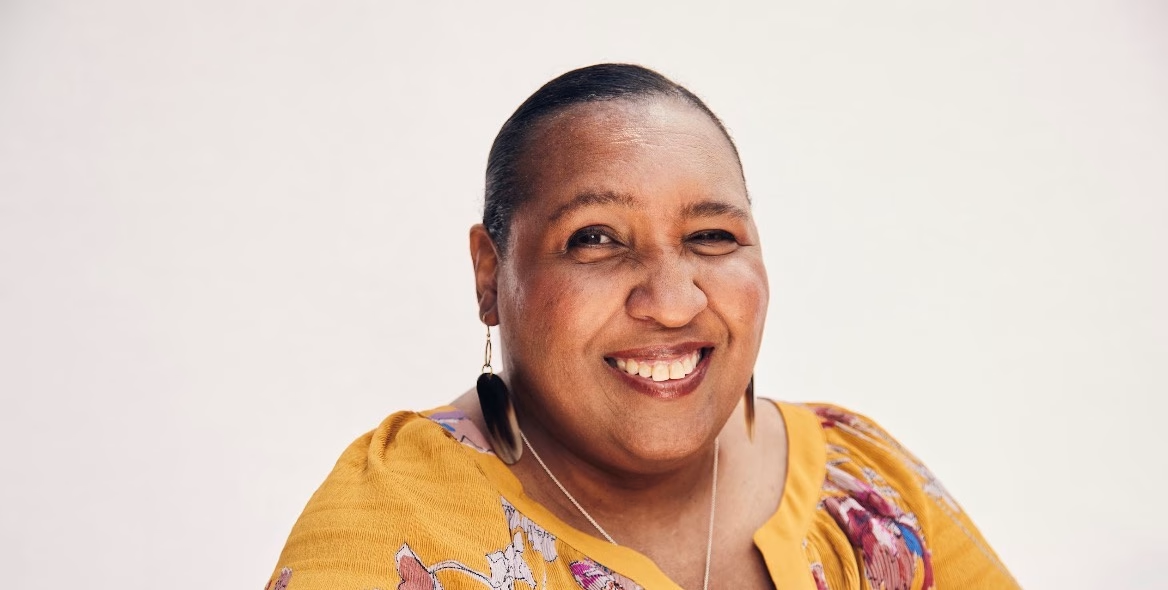
Elaine Hughes: Founder, The Inclusive Wedding Company
The Inclusive Wedding Company positions accessibility not as compromise, but as innovation.
◦ 9 min readRebuilding an Industry
You’ve said you’re not here to participate in the wedding industry but to rebuild it. What did you see that made rebuilding—not reform—the only honest response?
I saw an industry capable of performing inclusion selectively while maintaining systems that quietly exclude, even at the highest end of the market. There has been visible progress around race, sexuality, and gender in weddings and luxury travel, and that progress matters.
But disability, neurodivergence, and intersectionality have remained largely theoretical, particularly within HNW and ultra-luxury spaces where tradition, image, and perceived perfection carry significant weight. They’re acknowledged in values statements, yet postponed when they challenge aesthetics, pace, or established profit models.
This creates a hierarchy of inclusion, where some identities are welcomed and others are structurally alienated. Rebuilding became the only honest response because partial inclusion still leaves too many people, including high-value clients, designed out of the experience.
The Inclusive Wedding Company positions accessibility not as compromise, but as innovation.
Why do you believe the wedding industry has been so slow to understand this?
Because the industry has confused tradition with quality. In ultra-luxury environments, deviation is often mistaken for dilution.
Accessibility is framed as limitation rather than intelligence. Yet true luxury, particularly for HNW clients, is about anticipation, ease, and discretion. Accessibility demands deeper thinking about human experience. That level of intention challenges templated packages and surface-level aesthetics. Not everyone is prepared to do that work.
Weddings are often framed as “once-in-a-lifetime perfection.” How does that narrative both harm disabled and neurodivergent couples, and hold the industry itself back?
I’m well placed to challenge that narrative because I represent everything the wedding industry has historically pushed to the margins.
I’m a plus-sized, physically disabled Black woman. When I look at wedding marketing, ultra-luxury supplier imagery, or even who is spoken to with ease and confidence, I rarely see bodies, identities, or lives that look like mine. That absence is not accidental. It’s a signal.
When perfection is narrowly defined, it quietly communicates who belongs and who doesn’t, not just visually but economically. It tells certain couples that their love, their bodies, and their money are welcome, while others are treated as complications rather than clients.
For disabled and neurodivergent people, this creates alienation before a conversation has even begun. For the industry, it limits creativity, growth, and long-term relevance.
When you dismantle the myth of perfection, you don’t lower standards. You expand them.
When people don’t see themselves represented, they don’t just feel unwelcome. They take their money elsewhere.
The Inclusive Wedding Company at its Core
What was the personal or professional moment that made The Inclusive Wedding Company inevitable rather than optional?
It wasn’t a single moment, but an accumulation. Years of watching couples apologise for their needs. Years of seeing wedding planners, venues, and suppliers panic when disability entered high-value conversations. Years of hearing, “We’ve never had anyone like that before.”
Accessibility wasn’t being considered strategically. It was being treated as an afterthought.
Eventually, it became clear that my lived experience, professional skill, and strategic thinking weren’t optional extras. They were the missing infrastructure. The Inclusive Wedding Company was inevitable because the gap was structural, not personal.
Your work spans strategy, design, training, and systems change. Why was it important to build an ecosystem rather than a single service offering?
Because exclusion doesn’t live in one place. It lives in contracts, language, lighting, timelines, staff training, booking systems, and assumptions, even within ultra-luxury operations.
A single service treats accessibility as a moment. An ecosystem treats it as a journey.
That ecosystem includes training, industry standards, live events, and The Inclusive Knot, a digital platform supporting disabled and neurodivergent couples and the professionals who serve them.
My role is to work across wedding and event planners, interior designers, long-term architects, and hospitality operators, aligning those disciplines so accessibility is embedded consistently rather than treated as a last-minute add-on.
How does your F’AIRE™ framework move accessibility from a checklist exercise into a commercial, cultural, and creative advantage?
F’AIRE™ reframes accessibility as value creation. It connects fairness, accessibility, inclusion, representation, and excellence to outcomes HNW and ultra-luxury businesses already care about: reputation, longevity, trust, and generational loyalty.
Instead of asking, “Are we compliant?”, it asks, “Who are we excluding, and what is that costing us financially and culturally?” That shift moves accessibility out of compliance theatre and into intelligent design strategy.
What does “barrier-free luxury” actually look like in practice—and where do venues and planners most often misunderstand it?
Barrier-free luxury is seamless. Thoughtful lighting that reduces sensory overload. Clear, discreet communication that removes anxiety. Timelines that respect energy, not just spectacle.
The most common misunderstanding, particularly in ultra-luxury spaces, is believing accessibility is an aesthetic exercise.
In reality, barrier-free luxury is operational and human. It includes staff confidence, training, and support. Too often, teams are expected to deliver inclusive experiences without the tools, language, or permission to do so.
We also overlook that many staff members may be disabled, neurodivergent, or caring for disabled or neurodivergent loved ones. When those realities are unsupported, inclusion fails quietly.
When staff are confident and equipped, inclusion becomes seamless for everyone. In HNW environments, staff confidence directly affects client trust.
True luxury is invisible labour done well by people who feel supported rather than exposed.
Power, Profit & the Purple Pound
You speak openly about accessibility as a route to profitability and relevance. Why is this still such an uncomfortable conversation in luxury spaces?
Because it exposes where inclusion has been conditional.
Accessibility has long carried negative connotations that have diluted into bias. Mention disability or neurodivergence and many organisations bristle, apologise, or claim it isn’t their market. That gap between perception and reality is where my work sits.
Once intersectionality is acknowledged, it becomes impossible to frame this as niche. Disabled and neurodivergent people exist across every income bracket, including some of the most commercially valuable clients in the market. Ignoring that reality isn’t cautious. It’s commercially short-sighted.
How do you respond to organisations that see inclusion as reputational risk rather than market opportunity?
I remind them that silence is also a reputational choice, particularly in ultra-luxury spaces where perception travels quickly and privately.
Inclusion done poorly is risky. Inclusion done properly builds trust, discretion, and long-term loyalty.
My approach is holistic and pragmatic. Accessibility should feel positive, achievable, and commercially intelligent, not overwhelming or performative.
What would change if the wedding industry truly acknowledged the economic power of disabled and neurodivergent couples, guests, and families?
We’d see different venue designs, longer stays, multigenerational travel, and deeper brand relationships.
We’d also see more creativity, as designers find ways to be inclusive without losing edge. Weddings would be recognised not as isolated events, but as gateways into hospitality, travel, property, and cultural influence, particularly within HNW ecosystems.
Lived Experience & Leadership
You bring lived experience into boardrooms that often treat accessibility as theoretical. How has that shaped your leadership style?
It’s made me direct, strategic, and measured. I lead with clarity rather than permission-seeking.
Lived experience cuts through abstraction. In ultra-luxury environments, where decisions are often insulated from consequence, that perspective brings urgency and precision.
I work holistically, meeting people where they are and weaving accessibility through every aspect of the business.
Has there been a moment where your lived experience directly challenged an industry assumption, and changed the outcome?
Yes. A venue insisted they were fully accessible because they met minimum standards. Walking the journey exposed barriers no audit had captured.
The shift wasn’t just physical. It revealed staff who were anxious, under-trained, and afraid of “getting it wrong”. They had been left unsupported.
Addressing accessibility alongside staff confidence transformed the experience for everyone. The venue didn’t just improve access for guests. It strengthened its team, service culture, and position within the HNW market. That change only happened because inclusion was treated as a holistic system, not an aesthetic upgrade.
What emotional labour do disabled founders still disproportionately carry when driving systemic change?
Disabled founders are still expected to educate, reassure, and soften truth for others’ comfort, often without pay.
When disability intersects with race, gender, or class, that burden compounds, particularly in elite spaces. I’m clear that my expertise has value. The work I do builds systems that create long-term revenue, resilience, and relevance for organisations.
Culture, Legacy & What Comes Next
The Inclusive Wedding Fair will be the UK’s first of its kind. What does its existence signal about where the industry must go next?
It signals that accessibility belongs at the centre of excellence, not the margins, including within HNW and ultra-luxury markets.
The Fair isn’t about novelty. It’s about normalising barrier-free luxury as a benchmark, while amplifying disabled-owned businesses that are often overlooked yet growing rapidly.
If accessibility were designed into weddings from the start, what ripple effects would that have on other sectors?
Weddings are a microcosm. Get them right and you influence hospitality, travel, retail, and cultural spaces.
Designing for access raises standards everywhere and creates reputational security that benefits entire industries.
Looking ahead 10 years, what would success look like for The Inclusive Wedding Company if the industry truly listened?
Success would mean accessibility thinking is embedded across ultra-luxury and mainstream systems alike.
Disabled and neurodivergent people would be welcomed with ease rather than questioned. If the industry truly listens, it will be because someone was willing to build the framework first.
The legacy is systems that outlive me.
Closing Question
If you could rewrite one unspoken rule of the wedding industry, what would it be—and who does that change most liberate?
The rule that inclusion can be phased.
True inclusion isn’t sequential. It’s intersectional by design. When you build for those most often excluded, everyone benefits, including the most powerful players in the room.
Quickfire
- A word you’re reclaiming: Luxury
- A rule you’d happily break: That accessibility has to be explained quietly
- Your comfort ritual: Low lighting, good tea, no urgency, and a good book
- A place that surprised you (in a good way): Spaces that listened before speaking and showed genuine commitment to learning
- The most underrated leadership skill: Restraint
- One thing you want more of in the world: Ease of conversation