Vision Meets Grit: The Evolution of Chris Fair
Your Story & Identity For those discovering you for the first time, how would you describe who you are today – as an athlete, a coach, and a visually impaired...
◦ 12 min readYour Story & Identity
For those discovering you for the first time, how would you describe who you are today – as an athlete, a coach, and a visually impaired leader in sport?
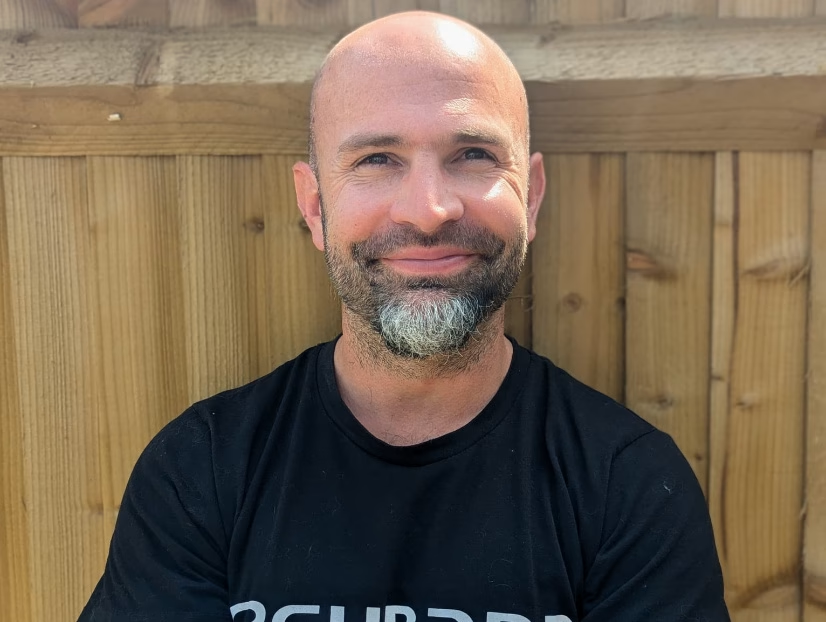
I would describe myself as a young Dwayne The Rock Johnson, wait will there be a photo included? As that may contradict that… As an athlete I am dedicated and love the journey. I will try and do what is needed to achieve the goal, especially if that requires having to eat a whole lasagna to help recovery. As a coach my main aim is to treat everyone as an individual, looking past any challenges so we can focus on their individual goals and adapt training to what they can do. As a leader in sport I just wish I started earlier and realised the positive influence sport would have on my life sooner.
What was your journey into sport before your visual impairment, and how did your relationship with athleticism evolve afterwards?
As it happens, my athletic journey didn’t actually start until after becoming visually impaired. Although I always enjoyed being active I had never actually been someone who went to the gym very often or did any sports. I worked in hospitality which took me travelling, I really enjoyed snowboarding so at 19 I spent a year in Whistler, Canada and then I did four ski seasons managing luxury ski chalets in Val d’Isere, France. It was at the end of working these ski seasons that my eyesight was deteriorating and I was struggling with both working in the chalets and snowboarding safely on the mountain. My real fitness journey began as I changed careers to become a coach.
Can you share the moment you realised that sport would not just be part of your rehabilitation or lifestyle, but part of your identity and purpose?
During the four years working in France, I had no control over my own diet, a lifestyle that revolved heavily around socialising and was exposed to both sun and reflected sun off of the snow every day. I did not recognise how much of an impact this could have. This was the most rapid deterioration I have experienced, I went from being able to drive to having almost no central vision in the space of four years.
Since changing careers where I focus on understanding and looking after my health as a priority, that deterioration has slowed down dramatically. This has made me realise how important it is to find that balance of enjoying yourself and putting your health first. I discovered that the sport became a part of my identity after my first international competition, the way that everyone described me had changed. The people I coached seemed to hold me in such high regard and recognised my strength over my disability, which was a lovely feeling.
What misconceptions about visual impairment in sport do you still find yourself challenging today?
Probably that we are less able. I was competing at an international event in Texas, they had scaled the event for our division back so much in skill level that we thought they had made a mistake. I imagine this is the same with many disabilities – people not realising that when you have to make life adaptations daily you become more resilient, not weaker.
How has your impairment shaped your mindset as both an athlete and a coach? Does it give you a different lens on motivation, discipline, or performance?
Absolutely, as an athlete I would say it makes you more determined, you want to prove that you are just as good and also inspire others who may be lost and need someone to look to. As a coach it 100% has made me more adaptable, I like to take everyone and see them as an individual person not as their disability. You could have 100 people with the same condition, yet how I would program for them would all be different as it’s not their disability or illness that defines them.
Sport, Coaching & Human Potential
You’ve coached both disabled and non-disabled athletes – what do you think disabled coaches bring to the high-performance environment that the industry often overlooks?
The people I coach online are just wanting to improve their health and wellbeing, training for everyday life. The thing that is missing from most coaches repertoire is the ability to adapt. Most find it hard to see past disability to see the potential a person might have. The average PT qualification doesn’t teach you to coach anybody but the average person and it’s down to the individual coach to seek out further support to learn anything more.
What personal principles guide your coaching philosophy?
My philosophy is to treat everyone as individuals, focusing on what they can do, rather than what they cannot do. If there are barriers, I like to try to find a way to remove or work through them.
Athletes talk a lot about resilience but resilience for disabled athletes often looks different. What does resilience mean to you?
Resilience, to me, is working to improve your life when you could use disability as an excuse not to. I enjoy having a chance to show what is possible when you adapt rather than give up. I see it in the people I coach every day. Showing up for yourself is sometimes the biggest practice of resilience, especially when your day might be full of obstacles to overcome already.
What’s one moment or milestone in your athletic career or coaching career that felt especially defining?
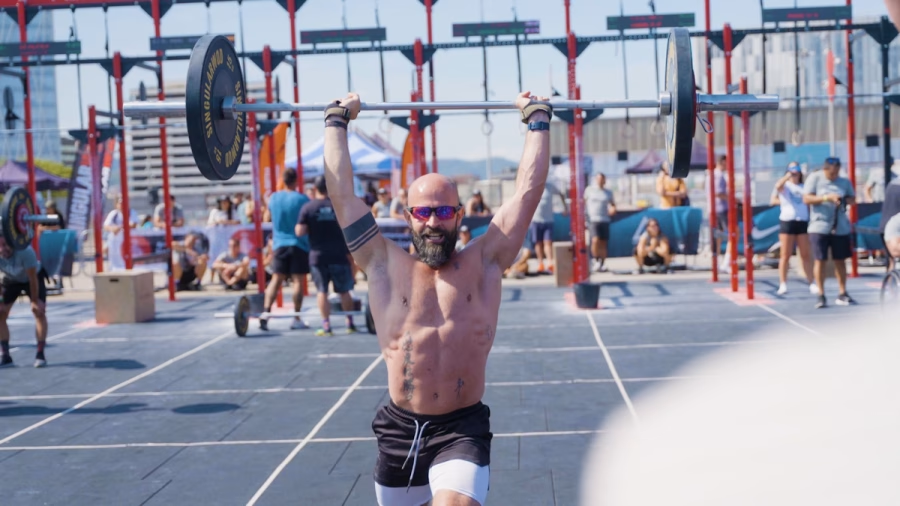
I got entered into the Crossfit Games by a friend, two weeks before it started. I came second. I didn’t realise that everything I had been working towards in the gym, had somewhere I could apply it competitively. It got me excited to see where my potential was and was the start of this journey. The following competitions I did, saw my first wins at both Wodcelona and the Crossfit Games.
Is there a coach, mentor, or figure from your own life who influenced how you show up for others today?
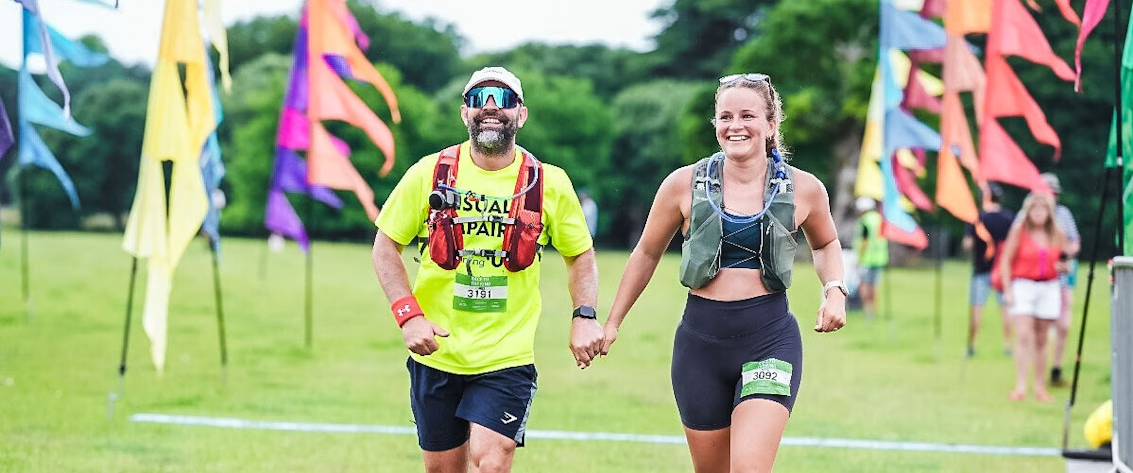
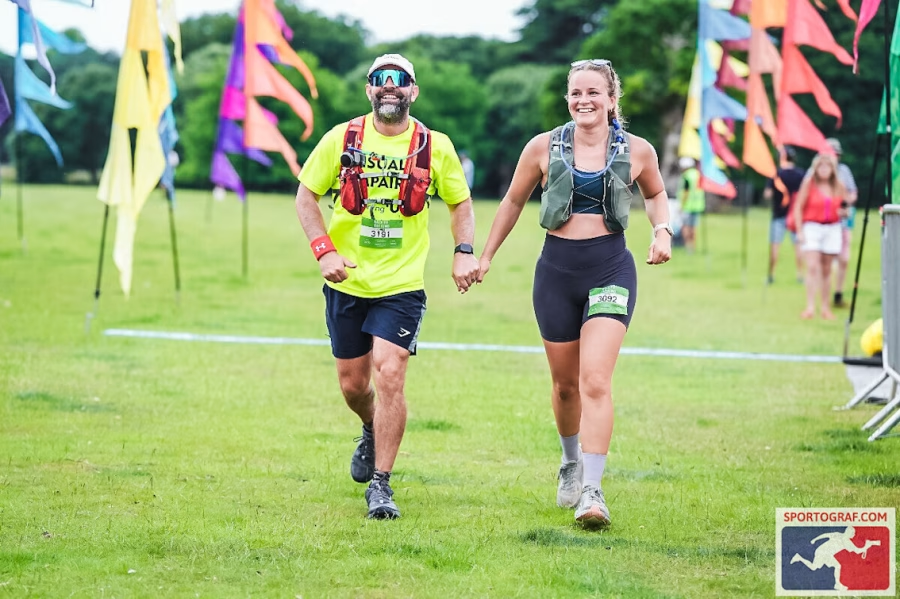
My incredible wife is my biggest supporter, she is always challenging me to try new things and experience the world of fitness outside of the gym. She was my guide this year when we completed an ultramarathon and there are talks of us doing an Ironman 70.3 next year, where she will have to pilot a tandem bike and guide me through both a swim and a run.
Travel, Access & Lived Experience
As a visually impaired traveller and athlete, what destinations, venues, or sporting events have impressed you most with their accessibility and human understanding?
We climbed Mt Kilimanjaro for our honeymoon this year, the guides and company that supported us couldn’t do enough to assist me to ensure I summitted. Although no specific accessibility adaptations could be made, the attitude and support given by the guides was amazing.
Conversely, what barriers do you still face when travelling or competing internationally, and which of those feel the most unnecessary?
Transport, direction and knowing where I am and where I need to go. Getting lost is a big fear of mine so I only ever travel with someone. Filling in physical forms, visa applications and even researching places to go takes me a long time.
Has travel helped shape your sense of independence or identity as a visually impaired person?
I used to travel a lot more alone. I still enjoy going to new places but require more support.
What do inclusive environments look like to you – not just physically, but culturally and attitudinally?
It’s all down to the people, there are many environments that aren’t purpose built for people with visual impairments, but a person introducing themselves by name and asking how they can help, makes all the difference. My perfect environment is well-lit, without background sounds with voice controlled features on everything. Probably the opposite of most people’s preferred dining experience.
If you could redesign the travel experience for visually impaired travellers from the ground up, what three changes would you make first?
I’d start by cutting out paperwork, make flight boards able to respond to voice so they can tell where I’m going and there’d be a button in airports that tells you which gates each exit leads you towards. I’d also put a zoom function on the aeroplane TV’s so that I can use them independently along with any other screens.
Disability Culture & Representation
How do you feel disability and disabled athletes are represented in mainstream media, and what narratives do you think are still missing?
The full spectrum of disability is not always shown, often obvious disabilities are well represented whereas invisible or less visible disabilities seem to be shown less. Although this does appear to be slowly changing. The narrative shown is mostly about the help people might need rather than the adaptations that can be made to enable people to showcase their talents. However, bigger events like the Paralympics seem to be becoming more widely televised and watched. There are still many adaptive sporting events that most people wouldn’t know are happening, because they are not shown by the media.
Do you see positive shifts happening in how sporting bodies, clubs, or federations engage with disabled athletes and coaches?
Our local swim club now has a para-swim session. Although when we asked the pool to pay to hire a lane so that I didn’t crash into people at another time, this was denied. So I think yes and no, there is still room for improvements. I think it mostly comes from people not knowing how to help or support people that might require adaptations.
What part of the visually impaired community’s experience do you wish more people understood beyond the clichés about bravery or inspiration?
I think how frustrating a small task can be and how much longer things can take when there isn’t an accessible option. Technology is great but you lose a lot of privacy when your phone has to read you everything or zoom in very closely to a screen. Also, that I am just a average person doing the same things everyone else does. Just having a disability doesn’t make you a hero.
What role does community; both within disability and outside of it, play in your life and athletic journey?
I have a really strong community of other visually impaired athletes whom I have competed with. We support each other as well as have a place where we can joke about silly things we have done due to being visually impaired. A strong community is great for everyone, so I strive to surround myself with people who positively influence my life.
If you could speak directly to young visually impaired athletes who feel unsure about their future, what would you tell them?
I would tell them to follow their passion and to keep going, regardless of their impairment. To not be discouraged and adapt wherever possible. You can only try and you might surprise yourself.
The World, Leadership & What’s Next
What does leadership mean to you at this stage of your life – on and off the field?
To always be encouraging and supportive to others. In competition I like to be on the floor supporting others until the end of the workout. In life outside of competition I enjoy coaching to help others reach their potential.
What’s the most valuable lesson sport has taught you that continues to shape your life today?
You get out what you put in.
You’ve worn many hats: athlete, coach, mentor, advocate. Which of these roles feels most energising right now?
I’m really excited about coaching, now I’ve started my own business – Strong without Sight, I am so excited to help those who need the support of someone who understands adaptation. I find it very fulfilling when someone achieves something they had previously written off.
What’s next for you in sport, coaching, or personal mission?
Sport: TBD.. Coaching: I’m excited to help as many people as possible. Personal mission: To redefine the way people view people with disability.
And finally: what impact do you hope to leave on the next generation of visually impaired athletes?
When I started, I didn’t know about the possible avenues I could explore. I’d love to encourage them to find a way to do the thing they love.
Quick-Fire Round
Short, personality-revealing, lively — very TILT!
- Morning person or night owl? Morning person
- Your go-to piece of adaptive tech? Screen readers
- Greatest athlete of all time? Mat Fraser
- The soundtrack to your training sessions? Miley Cyrus Wrecking Ball (it works on so many levels
- Dream sporting event to attend or compete in? The Paralympics – to watch wheelchair basketball especially
- One food you must have when travelling? Chocolate
- A country still on your bucket list? Nepal (Everest Base Camp)
- A disability stereotype you wish would disappear forever? That disabled people can’t do anything for themselves