Bianca Tavella: CEO, Founder and Social Entrepreneur
Background & Identity Can you introduce yourself and share how you describe the work you do today? My name is Bianca Tavella and I am the Founder & CEO of...
◦ 13 min readBackground & Identity
Can you introduce yourself and share how you describe the work you do today?
My name is Bianca Tavella and I am the Founder & CEO of Fair Shot. Today, I lead the charity that I founded with vision, strategy and overall operations to make sure that we are always moving forward towards our vision, where if a person with a learning disability wants to work they can.
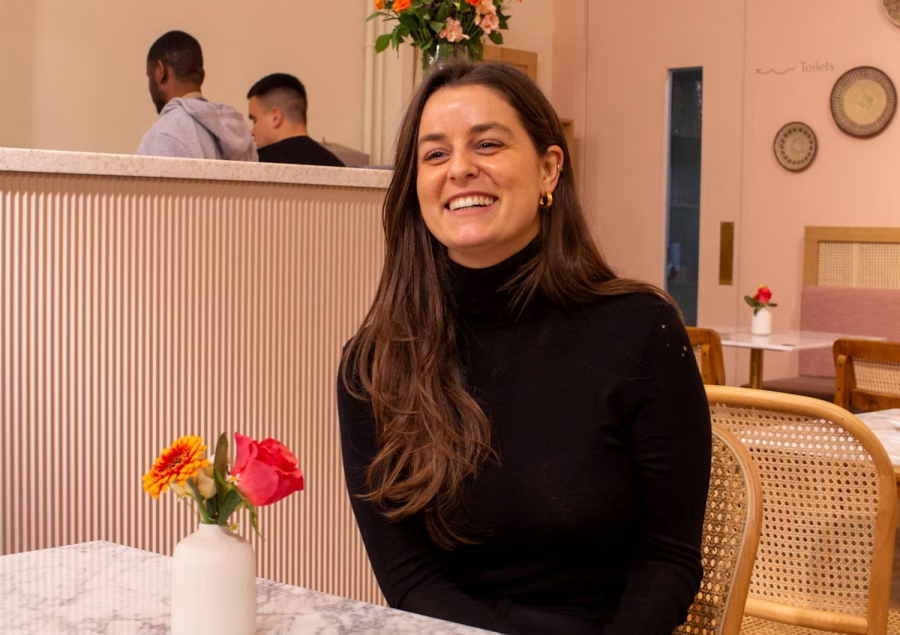
Where did you grow up, and how did your early environment shape your views on fairness, community, or opportunity?
I grew up in London, to Italian parents very closely to our church community that came from all over the world and all walks of life. Most importantly, I grew up watching my mum, in complete awe, forming relationships, speaking with strangers and going out of her way to help others – no matter who they are or where they came from – with such pure kindness and grace. Her genuine compassion and consideration formed the basis of what I think it means to be human and how to use your life in service to each other.
Which parts of your identity or lived experience feel most present in your work at Fair Shot Café?
The way that we all speak to each other and the way that we show up for our learners and just all care so much. This is present is every interaction and every single day.
Personal Journey
What personal experiences or turning points led you toward advocating for disability inclusion and supported employment?
Becoming close friends with a guy who was a year older than me and Autistic. Growing up very closely and going through life experiences at the same time but having very very different expectations and opportunities led me to experience this unfairness first hand and force me to the point of action.
Were there moments when you first became aware of the systemic barriers people with learning disabilities face?
Going out with my friends with learning disabilities and seeing how people looked at them, would not answer questions asked by them, would reply to me instead and not take them seriously. It really is scaring and the last of understanding and education is just deeply upsetting.
Who or what influenced your values around empathy, leadership, and equity?
Same answer as –
Where did you grow up, and how did your early environment shape your views on fairness, community, or opportunity…
Professional Evolution
How did your career begin, and what moments revealed gaps in hiring, training, or access within hospitality?
I started working in NGO’s in developing countries but Fair Shot has been my dream since I was a teenager. The gaps in training or access in hospitality were found when I started researching into how to create Fair Shot a possibility which then helped me understand how to shape Fair Shots model.
When did you realise that traditional models weren’t working and needed reimagining?
I knew that there were either great programmes but behind closed doors (ie in colleges or churches) and then paid programmes of work but not much of an in between the two. Young adults with learning disability needed a real life but safe working environment where they can gain real hospitality experience but also feel like they can make mistakes.
What gave you the courage to build something new rather than adapt what already existed?
I had just seen from first had that nothing was really working and actually getting them into jobs. It was mainly just activities for the week or one of work experience programmes which just felt fake and not actually helping them get anywhere apart from filling up their time. I felt like I wanted to at least try and see whether I can make something different and if it didn’t work it was not the end of the world. You need to believe you can do it 100% (which I believe in my ability to make this a reality) but at the same feel at peace with it very likely failing.
Founding Fair Shot Café
What sparked the idea for Fair Shot Café, and what problem were you determined to solve?
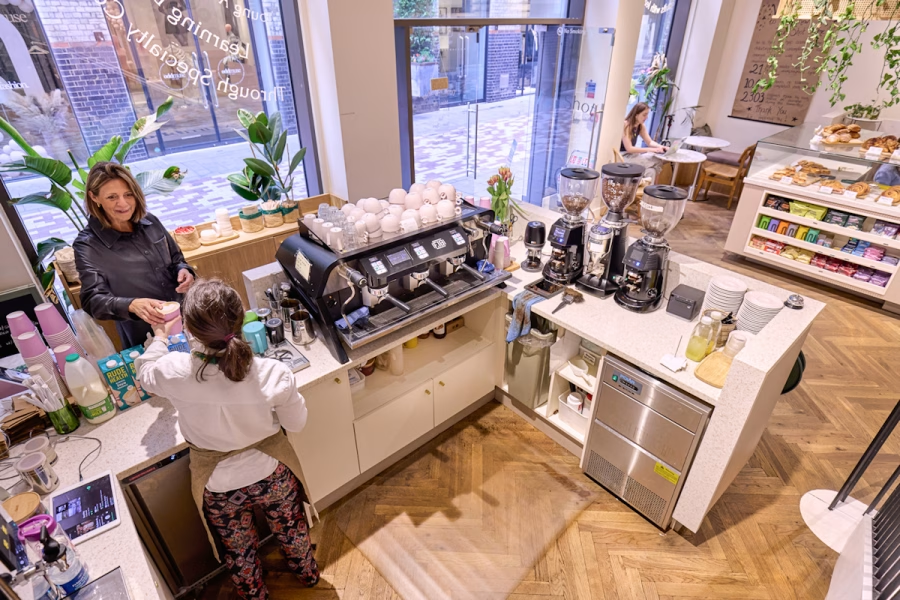
Growing up part of a church that did sign language to all of their songs, I grew very close to a lot of other children similar to my age with learning disabilities. Growing up so close to these families helped me see their perspective and how testing life can truly be – once you feel someone’s pain you can’t unfeel it. It became my absolute goal to create a tangible realistic solution to the fact that people with learning disabilities are not fully welcomed into our society. At 21 I eventually quit my job in NGOs and started my Fair Shot journey. This began with 1.5 years in hospitality openings, another 1.5 years working in a cafe whilst working on my business plan in spare time and another 2.5 years fundraising the initial £350k needed to open. In December 2021 we finally opened the doors to our very first cafe in Mayfair.
Why hospitality—what makes cafés uniquely powerful as environments for training, visibility, and confidence-building?
From a learners perspective, hospitality is practical and versatile. It is easy to carve different roles to an individual strengths. It is easy to start without any previous experience and keep growing and building from there at your own pace. This in itself is extremely empowering. From a customers perspective, we have access to hundreds of customers a day and the change to change their mind. Change starts small – but the most powerful change starts with positivity. We are giving people positive interactions and exposure to people with learning disability and showing them that people with learning disability can and should work. Once people see it with their own eyes, they believe it and start being that change without even realising.
Inclusive Employment & Training
What does meaningful training look like for young adults with learning disabilities?
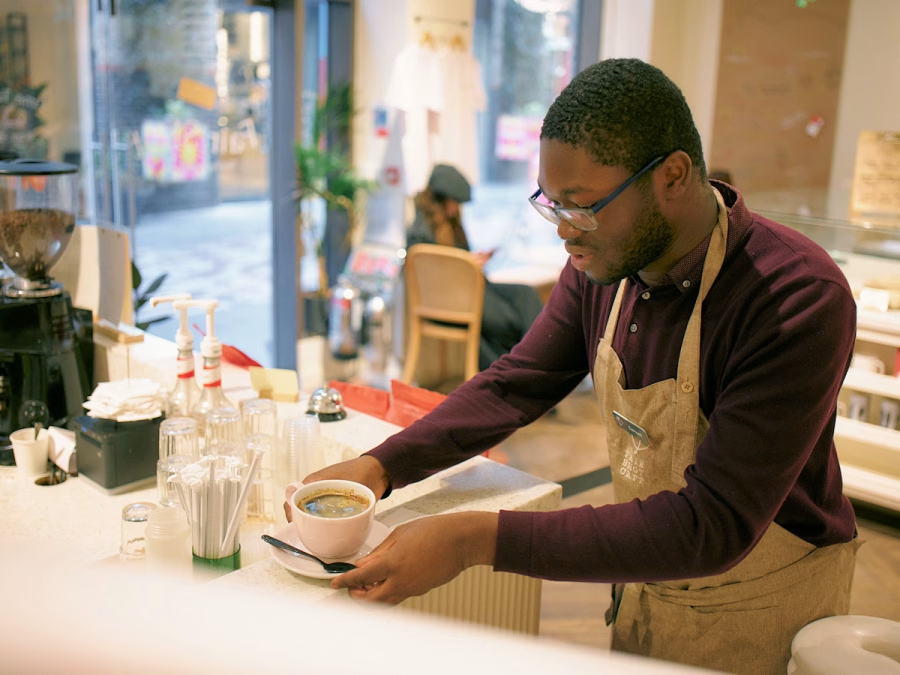
Meaningful training means having the chance to practice for an important amount of time (not just a couple of weeks or months) in a real life work environment, with real colleagues, real challenges, real customers and footfall. It also means being trained in a supportive and structured training ecosystem that allows for you to keep being pushed and growing each day whilst still allowing you to move at your own pace. It means focusing on the individual and their confidence, their empowerment and themselves just as much as the skills behind because leaving the programme and knowing that you can push yourself and you believe in yourself is the biggest lesson learnt.
How do you ensure your trainees develop confidence, independence, and real career pathways?
By giving them the space to be able to make mistakes and be their true selves. This is the biggest way that someone can then progress through our curriculum, stations and targets. Only by creating a safe, fun and structured environment can our learners develop confidence and independence to then transition into sustainable employment.
What does the industry still misunderstand about inclusive employment?
That the most important part is understanding the individual.
Cultural Impact
How has Fair Shot changed public perception simply by existing in a busy London neighbourhood?
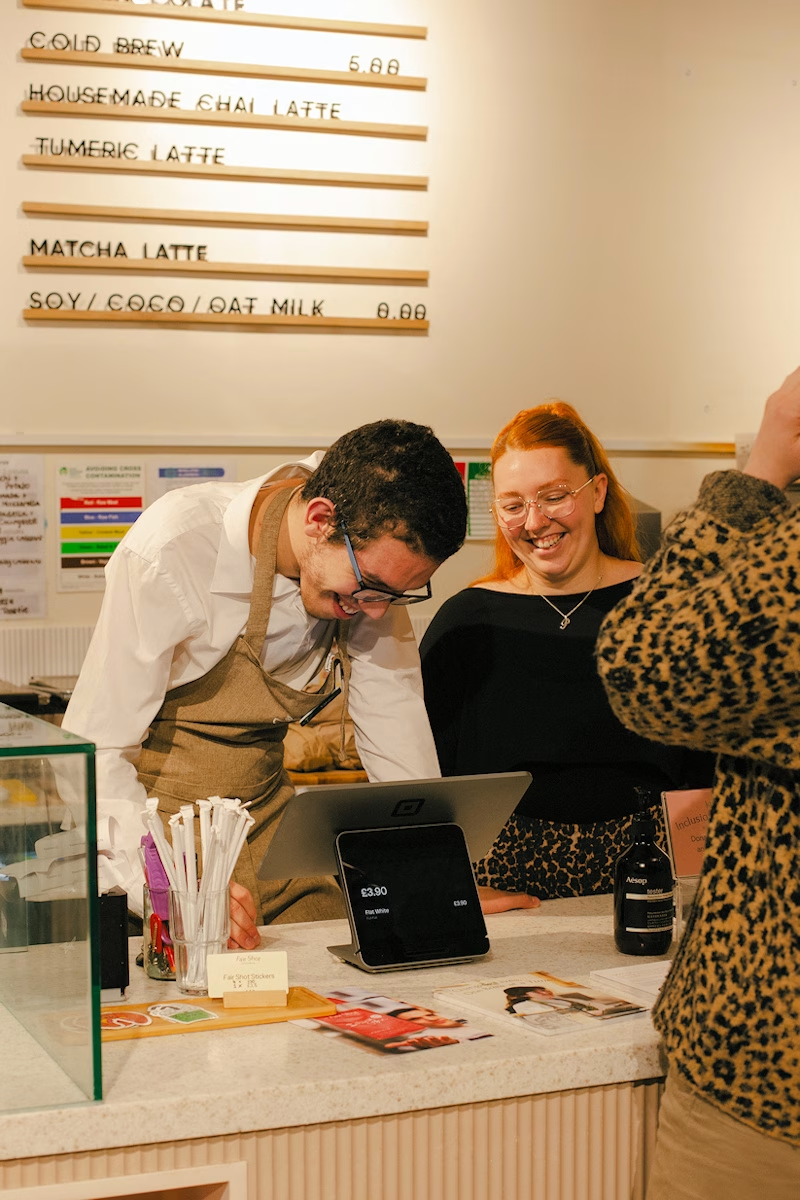
We have access to hundreds of customers a day and the change to change their mind. Change starts small – but the most powerful change starts with positivity. We are giving people positive interactions and exposure to people with learning disability and showing them that people with learning disabilities can and should work. Once people see it with their own eyes, they believe it and start being that change without even realising.
What have customers learned through daily interaction that no campaign could teach?
Exactly that—daily interactions teach what a campaign never could. No poster or tagline can replace the impact of a genuine conversation, a great cup of coffee, or a friendly exchange with someone they might previously have underestimated. Customers learn that ability is diverse, that inclusion strengthens a community, and that talent exists everywhere when people are given the chance to shine.
These interactions make inclusion feel normal, natural, and necessary.
How does representation shift when disabled people are visible, valued, and paid fairly?
Representation becomes reality. When disabled people are seen working, contributing, and being recognised for their value, the entire narrative around disability shifts. Visibility challenges stereotypes, fair pay reinforces dignity, and meaningful roles demonstrate capability.
Instead of being viewed through a lens of limitation, disabled people are seen as colleagues, team members, and professionals. It sets a new standard—one where inclusion isn’t exceptional, but expected. And once society sees that expectation in action, it becomes far easier for others to follow.
Challenges & Change-Making
What systemic barriers are still hardest to confront – funding, policy, stereotypes, hiring bias?
How much funding is needed to tackle the 95% unemployment rate. Inclusive employment, is not a numbers game. The reality is is that it is an extremely costly problem to have, more than getting any other vulnerable group into employment as it is such a layered and structural problem. We’re dealing with a 95% unemployment rate among people with learning disabilities. That alone shows how layered and structural the problem is. Inclusive employment isn’t a quick fix or a numbers game it requires specialist support, training, and a huge cultural shift. Yes, it’s costly, more costly than supporting most other vulnerable groups into work, but that shouldn’t put people off. It should push us to take it seriously.
How do you navigate fatigue when your work is both operational and advocacy?
You just have to keep going and not get deflated by challenges and by how hard it all feels to get right. There is a reason why until recently impact and business were always separate so it is impossible for it to be ‘easy’ now that you are trying to tackle the two together, every, single, day.
What conversations need to happen at leadership level across hospitality brands?
We need honest conversations about what it actually takes to become an inclusive employer. Hospitality brands need to come together and build real networks of employers who are genuinely willing to support vulnerable adults through their organisations. And alongside that, we need expert charities involved, people who know how to guide those businesses through the transition and make it work in practice.
No single organisation can do this alone. It has to be partnership, shared learning, and everyone bringing their expertise to the table. That’s the only way we’ll create real, long-lasting change.
The Industry Lens
How is hospitality evolving, and where is it still stuck?
Hospitality is evolving, brands are finally talking about wellbeing, culture, and the importance of people. But where it’s still stuck is in who it sees as “talent.” There’s still a very narrow idea of who fits the mould, and that keeps thousands of capable people locked out of the industry before they even get a chance to try. Until we rethink what skill, value, and potential actually look like, we’ll keep repeating the same hiring patterns and calling it progress.
What would you love to see hotels, restaurants, and cafés rethink about talent pipelines?
I’d love to see hospitality stop waiting for the “perfect” candidate and start building pathways for people who’ve never been given the opportunity. Talent isn’t something you always find ready-made it’s something you develop. And there’s a huge, overlooked pool of people with learning disabilities who, with the right support, can thrive in these environments. We need to rethink pipelines as long-term investments, not quick fixes.
Which organisations or collaborators are driving meaningful progress?
The organisations making the biggest difference are the ones willing to partner, listen, and learn the ones who understand they can’t do inclusion alone. Charities specialising in disability employment, inclusive employers who open their doors to trainees, and hospitality brands willing to challenge old norms are the ones truly pushing things forward. The real progress is happening wherever businesses and experts come together with a shared goal of making the industry accessible, supportive, and genuinely inclusive.
Entrepreneurial Lessons
What was a moment of doubt—and how did you get through it?
Knowing that everything happens for a reason and there is no perfect anything.
What’s a risk you took that turned out to be pivotal?
Moving to a premises twice the size in central London.
What skills have you gained as a founder that you never expected to need?
The important of communication, positivity, energy and emotional intelligence (I knew I needed this but never thought how pivotal they would be).
Social Enterprise & Purpose
How do you balance commercial viability with social impact?
By looking at each individual micro opportunity and challenge that comes up. Looking at it on too much of a macro scale means you miss out on the essence and logistical challenge of each.
How do you measure success beyond profit?
Via our Theory of Change outputs.
What values guide every strategic decision you make?
Whether the decision with help us scale our impact, support our team or help us move closer towards self sustainability. Every decision has to benefit the long term of our charity and our impact.
Future Vision
What’s next for Fair Shot? Growth, programs, new spaces, partnerships?
We are refining how to get better, not bigger, for now. How to create a safe and strong hub before expanding any bigger. We are looking forward to creating our own framework of inclusive employment to help others do the same and expanding our coffee wholesale offer to support our expansion on the way.
What would it take to scale this model across the UK.. or globally?
Other individuals and organisations to replicate our model.
When you imagine your long-term legacy, what would you hope people say changed because of your work?
That we gave others a tangible and realistic solution to the unemployment rate.
Human Details
What’s something people might be surprised to learn about you?
I am not a perfectionist.
What cultural moment—film, exhibition, book, conversation is energising you right now?
Queen Victoria – the series!
Describe a recent moment of joy, connection, or perspective that stayed with you.
Watching one of our graduates perform a solo of ‘we are the world’ at our halloween social.
Quick-Fire
Go-to coffee order: I do not drink coffee – Normally an english breakfast tea with soya milk.
Café detail you obsess over: Customer service.
The most underrated hospitality skill: Emotional intelligence.
A “quiet luxury” everyone deserves: Hot drink.
A ritual that keeps you grounded: Telling myself I am grateful 5 times a day at different times of the day.
Closing
What’s one question you wish people asked more often about disability-inclusive employment?
What do we need to change in our organisation to actually make this work.
What would you tell your younger self about courage, advocacy, and patience?
You will learn the right lessons at the right time.