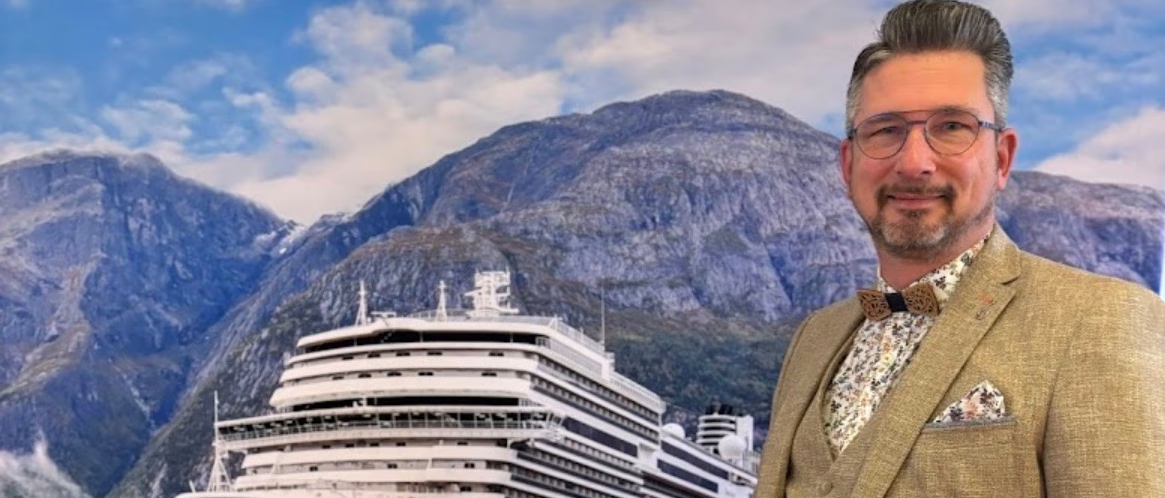
Walter Colijn: Luxury Travel Specialist, Wooden Bow Tie Guy
People travel in their own rhythm - their natural pace, their sensory thresholds, their ways of processing a day. That is the real blueprint. Once you understand that, you stop trying to squeeze someone into a structure that doesn’t fit.
◦ 16 min readOrigins
Do you remember the first moment when travel truly captured your imagination?
I was age fifteen, and my parents took me on a winter Caribbean cruise on Holland America Line’s MS Westerdam. They ran a busy dance school and rarely allowed themselves time off – closing even briefly carried the fear that clients wouldn’t return. That winter, for the first time, it felt safe enough.
I still lived at home, so taking me along was easier (and cheaper) than leaving me behind. I slept on the sofabed in the cabin – nothing glamorous, nothing curated. Just the three of us, out of routine, in warm winter light between sea days and island ports. Somewhere in that simplicity, something opened quietly. I didn’t have words for it then, but I do now: it was the first time I felt what travel can do rather than what it can show.
When did you begin to realise this could become not just a passion, but a profession?
In the mid‑90s, “tourism” wasn’t a defined study path. Career counsellors didn’t really know what to do with someone who wanted to work in travel, so I had to piece my own route together. I chose practical, service‑oriented programmes – nothing glamorous, nothing strategic – just enough hospitality to move forward. It wasn’t the names or diplomas that mattered; it was the direction they offered.
Those early choices taught me something I’ve carried ever since: no perfect route exists. You build your own, step by step, with what’s available – and often the most ordinary steps become the most defining.
Finding your way in travel
Looking back, which experiences shaped the way you approach travel today?
The years between 1997 and 2012 shaped me more than anything else. Different companies, different systems, different expectations, different leadership styles. Some years energised me; others drained me. All of them taught me how travellers behave in real life – the unspoken habits, the rhythms, the patterns of decision‑making, the things people don’t say but reveal in how they move through a day.
Those years taught me that travel is rarely about the destination alone. It’s about the fit. The pacing. The transitions. And, perhaps most of all, it taught me that people often look for clarity even when they ask for choice.
Was there a moment that changed the direction of your career entirely?
Yes.
In 2011, the cruise department I had built with care and pride was placed “in the shop window” – prepared for a sale or a slow dismantling. I was asked whether I wanted to stay involved in that process or choose a different direction. The clarity came quickly, but softly: it was time for something else. Staying would’ve meant watching something I had built be taken apart.
I spent the following months back in the department where I had started in 2001 – a dignified closing of the loop. A steady place to land before stepping into a new chapter. It wasn’t dramatic, it wasn’t emotional. It was simply the right thing to do.
When did travel become personal rather than a product?
Somewhere in those years, I realised people weren’t buying trips. They were looking for rhythm, space, alignment. Something that helped them feel more like themselves, rather than a postcard version of themselves.
Once you see that, you can’t go back to selling brochures. You start designing real days for real people – days that breathe, days that move in a way that fits someone’s energy. That’s when I understood: I’m not the right fit for travellers who want something quick from the shelf. That’s a transaction. I can be the ribbon on top, but only if I’ve shaped the gift underneath.
Designing a journey
What does “designed around the traveller” mean in practice?
It means starting with the person, not the product. People travel in their own rhythm – their natural pace, their sensory thresholds, their ways of processing a day. That is the real blueprint. Once you understand that, you stop trying to squeeze someone into a structure that doesn’t fit.
Nothing I offer is off‑the‑shelf. A journey has to grow from the traveller, not the other way around.
Designing around someone’s rhythm isn’t a big gesture. It’s usually subtle:
- one extra night to make the pacing humane
- a different cabin location to reduce noise
- a calmer embarkation window
- the right transitions between days
- clarity over quantity
- and always: removing friction before someone feels it.
What do you listen for first when someone approaches you?
Tone. Always tone.
People think they need to give me a wish list, but their tone tells me far more – how they talk about time, their mornings, their energy, what unsettles them, what gives them ease. A wish list is often about what they want. Tone tells me why they want it.
Most travellers unknowingly reveal their true rhythm in the first ten minutes.
My job is to listen between the lines.
How do you turn ideas or uncertainties into a journey that feels like theirs?
By translating – quietly, carefully, deliberately.
I translate personality into pacing.
Preferences into structure.
Sensitivities into comfort.
Uncertainties into clarity.
It’s not about “improving their ideas.” It’s about understanding their underlying needs and aligning everything – ship, route, hotel, cabin location, timing, transitions – so it all moves in the same rhythm they do.
A well‑designed journey doesn’t feel dramatic.
It feels exactly right.
Budget, Value & Reality
How do you talk about budget in a world where prices constantly shift?
Budget comes up often, and understandably so. But travel isn’t priced in isolation. It moves with the world: fuel, wages, availability, global events – the same factors that make the petrol station more expensive one month than the next.
People accept those fluctuations without question, yet when travel reflects the same reality, it’s quickly labelled “expensive.”
A journey costs what it’s worth within today’s conditions. My role is to bring clarity – to explain why prices sit where they sit, how the value fits the traveller, and what matters or doesn’t matter inside that budget.
My work carries value too: removing avoidable noise, guiding choices, reading pacing and fit, and making sure a journey doesn’t fall apart on things that could have been prevented.
When the world moves, prices move.
When advice adds insight, the journey gains value.
And if they return with a quiet wish the trip had lasted a little longer, the balance between cost, value and experience was exactly right.
The pull of the sea
What keeps drawing you back to being at sea?
The sea gives back time.
Distance softens people.
Movement creates clarity.
The horizon removes noise.
At sea, days unfold differently – not rushed, not stretched, but naturally paced. And when the right cruise line and ship align with the traveller, hospitality becomes almost invisible: effortless, warm, well‑timed.
For travellers who’ve never considered a cruise, what might surprise them?
That cruise isn’t one thing. People imagine a binary – either calm or busy – but it’s always about the match. A ship can feel intimate and boutique, or full of energy and colour. Both can be right, depending on the traveller.
Even with autism, I feel at ease on a line like Virgin Voyages. I know there’s performance, movement, sound – and sometimes I genuinely enjoy that:
– Scarlet Night
– the sailaway party
– bingo with The Diva
– live music at On the Rocks (the actual live‑music venue, not The Roundabout)
It’s lively yet predictable, hosted with intention, grounded in genuine hospitality.
A moment I won’t forget is hearing Slam Allen perform I Can See Clearly Now. Someone walked past him mid‑song; he paused with humour and a knowing smile – not breaking the moment but folding it into the performance. On many lines that would have been “off‑script.” Here it was welcomed, warm, human, playful, still respectful.
People often expect to be overwhelmed.
But what surprises them is how much cruising can match who they are.
Quiet mornings, lively nights – or both – depending on the ship, the rhythm and the hosting.
Style, Detail & Identity
You’ve become known for your wooden bow tie. How did that become part of your identity?
It began as a personal twist – a way to bring a bit of myself into formal moments without turning it into theatre. I never set out to create a “signature.” It simply became one because people remembered it. Combined with the clothes I naturally gravitate toward – nowadays by default from A Fish Named Fred – it made me recognisable in a way that felt authentic rather than loud.
Most people say, “You’re the one with the wooden bow tie.” And I’m fine with that.
I do want to stand out, and this tells me: people sense intention. They see that I take my work seriously – and that I show up with care.
Does style matter in the way you work?
Yes – but not in the usual sense.
Style isn’t fashion; it’s behaviour.
It’s tone. Timing. Detail. Clarity.
It’s how you enter a room, how you speak, how you listen, how you handle friction, how you signal that someone is important enough to receive your full attention.
Style is everything you communicate before you say a word.
Over the years, that small wooden bow tie did something unexpected: it attracted the right travellers, and it helped me get noticed by suppliers who take me seriously – and whom I take seriously. The ones who value nuance, quiet care, and attention to detail. It also built trust with partners and suppliers – not because of the object itself, but because it aligned with the way I consistently show up.
It wasn’t designed as branding, but it functions as a quiet signal.
Consistency often speaks louder than design.
You’ve spoken about how you choose which cruise lines and suppliers to align with. How do you decide that?
By experience first – always.
Many companies say: “Deliver sales, and then we might introduce you to our product.”
But that flips the logic of service.
Form follows function – not the other way around.
If a supplier believes I fit their brand and wants my attention – and the clients who belong there – then show me the function first. Let me see it, feel it, test it, understand it.
I am very hesitant to sell something I haven’t experienced, because then I’m not advising – I’m guessing. That benefits no one: not the client, not the supplier, not me.
That’s why I have such a strong connection with service oriented suppliers. They understand the value of “experience first.” They know that when I’ve truly seen how they operate – the rhythm, the crew, the tone, the hosting – the right travellers will follow naturally.
Trust is not built through pressure.
It’s built through alignment.
Seeing the world differently
Has being autistic shaped the way you design journeys?
Yes, profoundly. Autism didn’t limit me; it sharpened me.
Patterns, sensory load, transitions… I pick them up fast. Faster than most people realise.
I notice micro‑signals.
How a hotel maintains its bathrooms – the tiles, the grout, the upkeep.
How a ship handles boarding.
How noise travels across a deck.
How a restaurant manages flow in busy hours.
These details tell me everything about the real standard of care. Often long before other people feel it.
Neurodivergence gives you a lens.
Not louder or softer – just different.
And that different view allows me to design trips that remove friction before it exists.
Is the industry improving in how it approaches neurodiversity?
Slowly.
In 2024, Travel Counsellors Netherlands joined Hidden Disabilities Sunflower at my request – still the only independent service organisation in the Netherlands to have taken that step.
In 2025, neurodiversity appeared within our international DEI programme (Diversity, Equity & Inclusion – recognising differences, creating fair access, and making people feel welcome) for the first time.
It’s progress – small, quiet progress – but real.
People often talk about inclusivity in big statements.
But real change happens in the details: fewer assumptions, more listening, clearer hosting, willingness to adjust without labelling someone as “difficult.”
Hospitality becomes powerful when it becomes predictable without becoming rigid.
Travel & Empathy
Has caregiving changed your view on time, travel and what matters?
Completely. My wife lives with post‑COVID complications.
She isn’t a patient; she’s my wife.
Some days are easy, some are heavy, most fall somewhere in between. Caring for her reorganised my priorities in a way nothing else could.
It taught me the difference between being available and being present.
Those are not the same thing.
Presence became more important than performance.
And that understanding flows directly into the way I design journeys:
- clarity over complication
- pace over pressure
- fit over fantasy
- days that breathe instead of days that impress
Clients matter deeply.
But she comes first.
And somehow, that makes me better at what I do – calmer, clearer, more intentional, and more human.
The meaning of travel
What are people really searching for when they decide to travel?
Most people want to step out of their routine for a while – not to escape life, but to return to it with clearer eyes. Time for a holiday. Time for each other. Time to discover something new. And often: time to celebrate something, whether alone, as a couple, with children or with the whole family.
People talk about “getting away,” but that’s rarely what they truly seek.
They want breathing room. A calmer rhythm. A few days where nothing demands their attention except the moment they’re in.
Sometimes travel is simply a reset: “we’re out for a bit.”
A chance to notice each other again. To laugh again. To mark something – a milestone, a recovery, a reunion, a quiet victory. Not everything needs fireworks; sometimes the meaning sits in the stillness.
What do you hope they feel when they return?
That it felt right for them. Not perfect, just right.
Perfect is brittle. Right is human.
If people come home with a sense of, “This was exactly what we needed,” then the journey has done its job. And if there’s that quiet wish the trip had lasted a little longer – that soft afterglow you only get when something aligned – then the balance between cost, value and experience was exactly right.
Destinations
Is there a place in the world that continues to inspire you, no matter how many times you visit?
Cambodia – and I’ve only been once. It was my first time in Asia, and the history hit harder than I expected. Phnom Penh, S‑21, the dignity of the people, the calm underneath the noise… it stayed with me.
I travelled with colleagues, and on that trip I met someone who became a lifelong friend – my “work‑husband.” Since that journey I know one thing for sure: if I travel for work, I either share a room with him, or I take my own. If that isn’t possible, I don’t go on the fam trip. That boundary came straight from Cambodia – understanding what feels right and what doesn’t.
Is there still a destination you dream of experiencing one day?
There isn’t one single dream – more a constellation.
Different places call for different reasons:
French Polynesia – for warmth and Pacific clarity.
Micronesia – for the remoteness.
The Panama Canal – because movement fascinates me.
The Kimberleys – for scale and perspective.
Japan by sea – for rhythm and culture.
The Magdalena, the Douro, the Mekong – because rivers shape a journey rather than just guide it.
The polar regions – for silence.
What I dream of shifts with life. Some places suit curiosity. Others suit reflection. Others are best shared with the people I love.
It’s not a list to complete it. It’s a horizon that moves with me.
Quickfire
Wooden bow tie or captain’s hat?
The wooden bow tie – always.
Ocean liner or river boat?
Ocean – with a soft spot for river ships, if executed well. They let me experience first, before expecting anything in return. That matters.
Early morning harbour arrival or late‑night sailaway?
Early morning – when the world feels reset.
Suitcase perfectly packed or organised chaos?
Deliberately packed – by my wife. My physical limitation makes packing tricky. On the return trip, I do it myself. And if there’s butler service, I happily hand the suitcase over. It always comes back tighter than it left home.
A place you instantly felt at home.
Our home in France – and in travel: Scandinavia.
A cruise moment you still smile about.
That first cruise on the Westerdam – on the sofabed. Not glamorous but defining.
The best seat on a ship?
Aft – watching the wake.
Coffee on deck or champagne at sunset?
Coffee on deck.
A small luxury that makes a journey special.
Space – in the room, on deck, and in the day.
A destination that surprised you.
Berlin, London, New York and Phnom Penh in a very different way.
If travel had a soundtrack…
Something with rhythm and clarity – anything from 50s rock ’n roll to soul, 70’s Disco 80s pop or 90s Eurodance. But I do appreciate classical more and more too nowadays.
A place you could happily get lost for a day.
Anywhere – I get lost in my thoughts more than in destinations.
Something travellers worry about too much.
Perfection. While I remove avoidable noise, a journey only needs to fit. If they return wishing it had lasted a little longer, it worked.
Something travellers forget to notice.
The simple things: how people host, how a day flows, how well something is cared for.
If you could step onto a ship tomorrow…
It depends on the version of tomorrow:
Warmth → French Polynesia
Movement → Panama Canal
Perspective → Kimberleys
Rhythm → Japan
Rivers → Magdalena, Mekong, Douro
Silence → Arctic or Antarctica
Image by Meg von Haartman on Unsplash