Ariane Sanders: Founder, Sonda Studio
Through understanding how strongly environments can support or drain how I feel, I wanted to make sure the spaces I design were truly supporting the people using them.
◦ 11 min readSpace, perception & people
You’ve said that everyone experiences space differently. When did that truth
first become clear to you in your work?
I’ve always know that people have different preferences; most people know what they like visually. We use mood imagery to help shape the style a client liked, creating spaces that reflect their aesthetic preference. But it was a few years ago, through my own experiences, I realised it is so much more than what it looks like.
There was a period in my life when I felt depleted and overwhelmed. I noticed I was instinctively seeking out nature. During that time I was questioning myself, why does this make me feel better? What is it about our environments that affect us?
That’s when I started reflecting on my work. Through understanding how strongly environments can support or drain how I feel, I wanted to make sure the spaces I design were truly supporting the people using them.
It became clear both through observing others and through my own sensitivity to environments. I noticed how strongly space could either support or break my own focus and regulation and I saw the same variability in the people I was designing for. One person could feel energised and focused, while another felt overwhelmed, distracted, or uncomfortable in that exact environment.
That made it obvious that people don’t experience space in the same way.
So my work shifted toward understanding those differences and designing with them, rather than assuming one solution works for everyone.
What do you think designers most often assume about how people move, feel and behave in space – and where do those assumptions break down?
There’s often an underlying belief that if a space is well-designed aesthetically and functionally, it will work well for everyone.
Where that breaks down is in the reality that people don’t experience environments in the same way. We all have different brains, bodies, sensory thresholds, attention patterns, emotional states, and needs for stimulation or calm. So the same level of light, sound, openness or activity can feel energising for one person and overwhelming for another.
When spaces are designed around a narrow idea of productivity or behaviour, they can unintentionally overwhelm, exclude, or exhaust people. That’s where those assumptions fall apart, and where design needs to shift from designing for an average, to designing for range and choice.
How has your understanding of “good design” evolved as you’ve worked with more diverse teams, clients and environments?
It has evolved into designing through the senses. It’s about understanding how people see, hear, move, and feel in a space, and how those sensory inputs affect their comfort, focus, and wellbeing. I’ve learned that you can’t assume how a space will be experienced, you have to ask questions, explore ideas, and test them with clients and users. When you design with empathy and sensory awareness together, the space is far more likely to genuinely support the people using it.
Sonder, empathy & design thinking
The idea of sonder sits at the heart of Sonda Studio. How does that concept practically shape the way you approach a brief?
To sonder is to have an awareness that every person’s life is as rich and complex as your own. That idea sits at the heart of how I approach every brief. It reminds me that everyone entering a space carries their own inner world, experiences, sensitivities, and pressures, most of which are invisible. So rather than starting with assumptions or a fixed vision, I approach a brief with curiosity.
In practice, I take the brief and then unpick it into layers. The felt meaning, the practical needs, the efficiencies, and what might be sitting underneath all of that.
From there, I dig further asking and listening. Focusing on really understanding the people who will use the space. How do they feel in it now? What works? What doesn’t? What frustrations or complaints are coming up? I try to ask these questions across the whole organisation where possible, or if that isn’t realistic, through a diverse range of voices. New starters and long-standing team members.
Gen Z through to boomers. The quietest voices as well as the loudest. That range is important, because it helps move away from assumptions and towards a more honest understanding of how a space is actually experienced.
That’s how sonder becomes practical. It shapes a process that designs with people, not for an imagined average, and allows the space to reflect the real complexity of the lives within it.
How do you translate something as intangible as empathy into physical decisions – light, layout, acoustics, flow?
Empathy shows up in design through the choices we make about how a space feels and supports people. It shapes decisions based on what helps people feel comfortable, safe, focused or connected.
If people are saying they get headaches, this could be glare from the lighting, so we look at how the light is affecting the people using the space and adjust it. If people are saying they can’t concentrate, this could be the acoustics. Noise is often the biggest invisible stressor in the workplace, creating constant cognitive load and mental fatigue. Designing in acoustic solutions is always part of my work,
but if there is a real issue we develop this further, looking at zoning and giving people choice over the acoustic conditions they work in.
So we listen to what people are telling us about their experience, explore what might be causing it in the environment, and translate that into spatial changes.
Do you think the design industry genuinely values emotional and sensory experience yet or is it still catching up?
Yes there are pockets of real progress, people thinking about wellbeing, user experience, neurodiversity, and how space feels, not just how it looks. But too often, those ideas get treated as add-ons or buzzwords, rather than fundamentals that shape the whole design process.
A lot of design still prioritises efficiency, aesthetics, or trends over how a space actually feels in someone’s body or nervous system. There’s often a disconnect between how spaces are designed and how humans actually move, feel, and function within them.
I think more education is needed to help people understand that as human beings, we are at our best and most efficient when our nervous systems are regulated.
That regulation is the baseline for focus, creativity, and resilience, not a luxury or an add-on. At the moment, emotional and sensory experience is still often overlooked, misunderstood, or dismissed as something “soft,” when in reality it’s biology. People are an organisation’s greatest asset. Creating environments that support them to feel and function at their best is therefore fundamental to
organisational success.
Workplaces, inclusion & lived experience
Where do modern workplaces still quietly exclude people; even when inclusion is part of the brief?
It usually shows up when assumptions are made about the space and where there is a lack of choice. When everyone is expected to work, meet, rest, and socialise in the same way, people who need calm, privacy, lower stimulation, or time to regulate are left adapting rather than being supported. Meeting rooms that favour fast talkers, social areas that reward extroversion, or lighting and acoustics that can’t be adjusted all quietly push certain people to the edges.
What small design choices have you seen make a disproportionately big difference to how people feel at work?
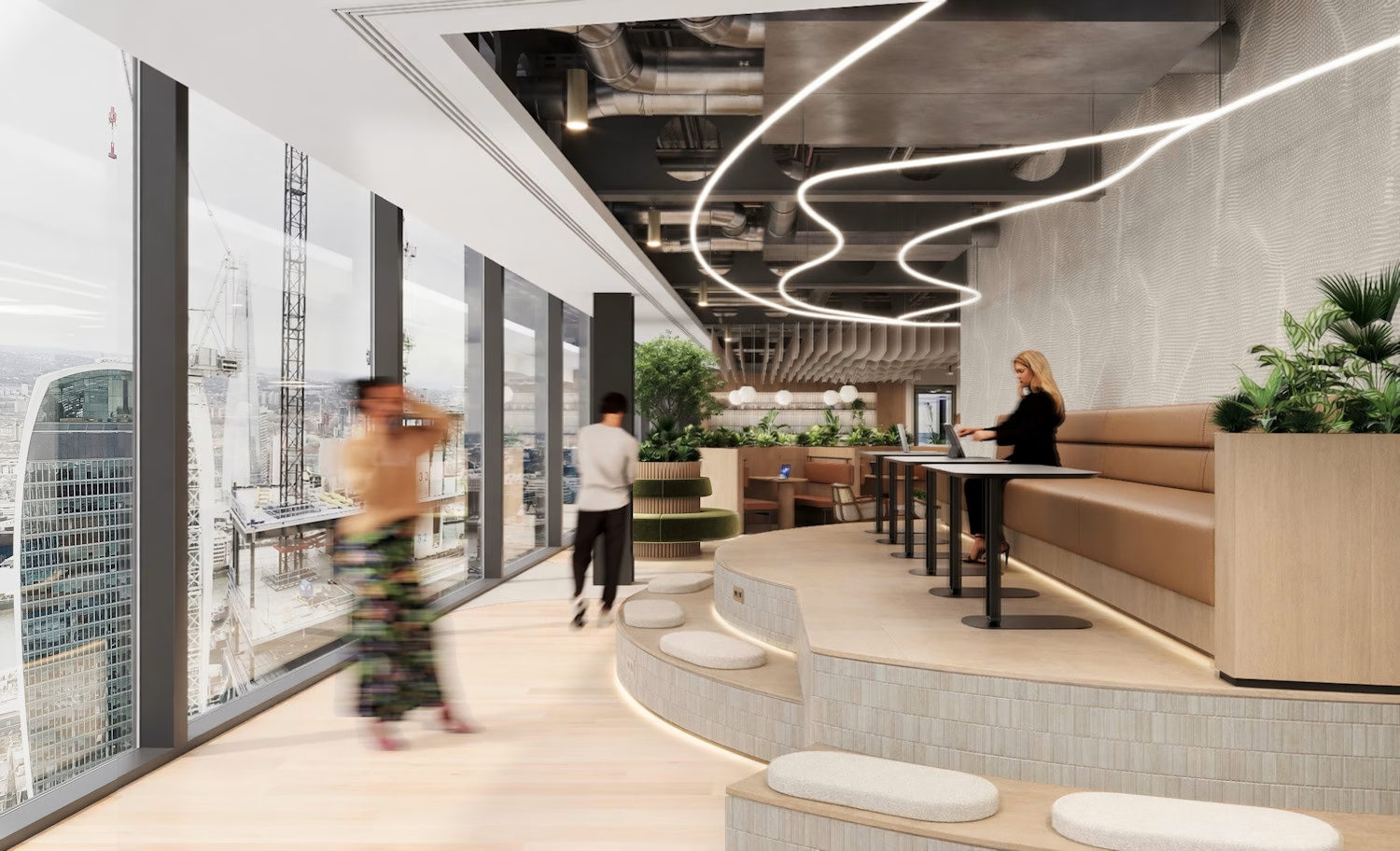
Designing within a Sensescape- creating layered sensory conditions within a space. This means we design through sensory layers: light, sound, movement, touch, visual input and temperature. Together, these layers shape sensory load and influence how regulated or overwhelmed people feel in a place.
Starting with lighting; maximising natural daylight wherever possible, then giving people control over lighting so it’s not too harsh or too dim. Reducing glare can immediately change how comfortable a space feels.
Acoustics are a major factor. Sound conditions need to feel balanced and consistent – providing privacy where it’s needed, a gentle background hum so spaces don’t feel unnervingly quiet, and moments of buzz where energy and connection are encouraged.
Introducing biophilic elements, simple connections to nature like planting, natural materials, patterns and views out can help people regulate and settle.
These aren’t headline design moves, but together they shape whether a space feels supportive or draining.
Influence beyond aesthetics
How much responsibility do designers carry for shaping behaviour, wellbeing and belonging – even unintentionally?
We carry a lot of responsibility, because people spend a large proportion of their lives within built environments at home, at work, and across the everyday spaces in between. If you think about time spent across these settings, a large proportion of life is experienced in environments that have been intentionally designed.
If we create spaces that help people feel and be their best versions of themselves, we are contributing to their overall wellbeing, behaviour and happiness.
Environments continuously influence how safe, comfortable, stimulated or overwhelmed people feel and that in turn shapes how they act, relate and function.
Within workplace it there is additional responsibility as people often don’t have as much control, they are told on average they need to be in the office 3 days a week, that’s that equates to roughly 45% of the year. It is people who make an organisation successful therefore, we must ensure they are in environments that support them for both their own and the organisation’s success.
Personal perspective
What environments make you feel most at ease and why?
When I am in nature, it always has both a calming and exhilarating effect.
Therefore, bringing natural elements into an interior makes it feel good to me.
I like spaces that reduce my cognitive load – they aren’t too busy, and the layout is intuitive and easy to read. They feel open, with sightlines throughout the space, so I feel connected to the outdoors and can also read the space easily.
When a project really works, what does that success feel like to you personally?
Seeing people in the space and watching how they experience and interact with it.
Then hearing about how the space makes them feel. When you hear that what you designed is helping people and adding to their lives, that’s the real measure of success to me.
What’s one belief about space or design that you’ve had to unlearn?
That it is about what it looks like, so many visually amazing environments are acoustically harsh, glaring or overwhelming. Aesthetic success doesn’t guarantee human comfort.
Quick fire with Ariane
First thing you notice when you enter a room?
For me it’s Light! Do you know a quick way of understanding what effects you most in a space.. If you fall asleep with no alarm, notice what tends to wake you first. Is it noise, light, temperature, or movement? That’s often the sense your brain is most sensitive to. When we’re asleep, our filters are down, so whatever pulls us out of rest is usually what our nervous system is monitoring most closely. It’s a quick way of understanding what affects you most in a space.
- Light, texture or sound – which do you instinctively tune into first? Light, especially fractures – the natural patterns formed by shadows and light.
- Most underrated design detail? Sightlines, creating visual connection through space, they help people feel oriented to where they are and are going. Help people feel connected, even when they are on their own. They create intrigue, curiosity, a sense of safety and openness.
- Open plan: misunderstood or overdue a rethink? Misunderstood, I think it’s the lack of choice around it. Open plan when designed correctly is a great place to work, you can connect, see your colleagues, learn from each other, you have visibility so you feel safer.
- Desk you prefer: perfectly styled or happily chaotic? I think I am in the middle, maybe call it natural flow?
- Space that made you exhale recently? Walking in Windsor great park
- Creative thinking happens best: walking, sketching or talking it out? I’d say both walking and talking.. walking meetings are great, combines them both with the outside. Most of my creativity happens when I am in nature and then the ideas blossom when I speak about them or put pen to paper.