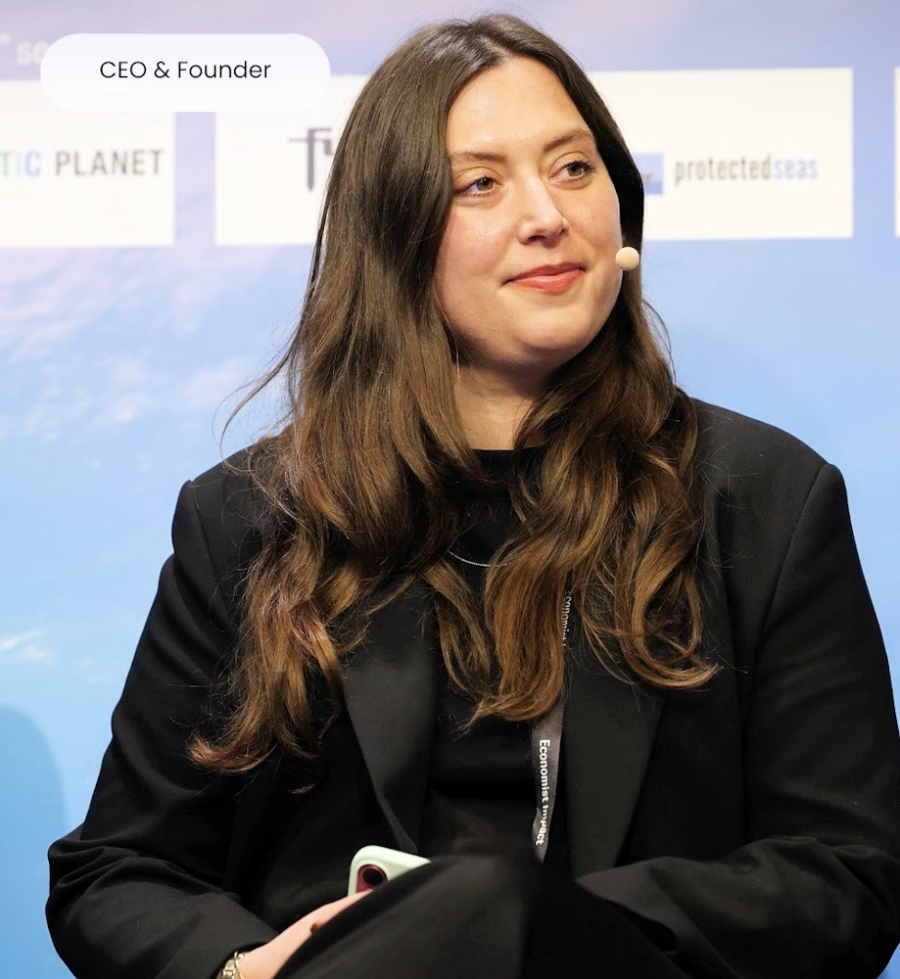
Aleksandra Dragozet: Founder, Sea Going Green
Sea Going Green was born out of a gap: destinations and (marine) tourism businesses wanted to be sustainable, but lacked clear, actionable pathways. I wanted to bridge science, policy, and industry in a way that drives implementation.
◦ 10 min readEarly Years & Formative Influences
You began your journey in science before moving into entrepreneurship. What first drew you to marine biology and environmental systems?
I was lucky to spend my summers growing up in a small coastal town in Croatia, where my Dad’s family is from, and that’s really where I first fell in love with the sea. I also saw what an emerging tourism industry does to a local community and the respective environment first hand. That early connection stayed with me and eventually led me into my studies, including a formative set of internships with the Oceanographic Environmental Research Society in Canada, where I was exposed to the practical realities of marine science, complex environmental systems, and the impact of human activity on marine life.
I later went on to study tropical conservation biology in Singapore, where I was confronted firsthand with the intersection of marine ecosystems, local communities, and overtourism. Seeing those dynamics play out so visibly is what ultimately pushed me toward working at that intersection. For me, marine biology became more than a scientific discipline, it was a way to better understand not just ecosystems, but our relationship with them.
Were there early experiences; places, mentors, or moments, that shaped your connection to oceans and travel?
Growing up near the coast and spending time in nature shaped a lot of that connection. In my dad’s hometown in Croatia we visibly started seeing water quality go down every summer, less and less marine life everytime we went snorkeling, while local communities were able to live off of tourism they also strted to realize the negative impacts as well. Later, mentors in academia helped me see how science could inform real-world decisions, especially in tourism-heavy regions.
Growing up, did you always imagine yourself working in sustainability, or did that path evolve over time?
It definitely evolved. I started in pure science, but over time I realised that research alone wasn’t enough, I wanted to influence how industries operate, particularly tourism.
How did studying and living in different countries influence your worldview and your approach to global tourism?
Living and studying in different countries exposed me to very different models of tourism, some extractive, some regenerative. It made me more aware of cultural context and the importance of locally grounded solutions. I also worked for a large tour operator in my early career and quickly realized that mass tourism was not something I wanted to work in or promote.
Career Path & Turning Points
What was the moment you realised you wanted to work at the intersection of tourism and environmental protection?
It was during my studies in Singapore, I got to travel through a lot of Southeast Asia, where I really saw mass tourism at another scale along with incredible diverse and beautiful marine life. On one hand tourism was booming in these beautiful places but the environment and local communities were suffering where it was not managed properly.
How did your academic background translate into the realities of working with destinations, governments and businesses?
Academia gave me a strong analytical foundation, but working with governments and businesses requires translation, turning theory into practical, scalable strategies. I also get to really consult in an environment , the marine environment of destinations, which I really understand from a scientific perspective which gives our work a more holistic feel.
What inspired you to found Sea Going Green, and what problem were you most determined to address at the start?
Sea Going Green was born out of a gap: destinations and (marine) tourism businesses wanted to be sustainable, but lacked clear, actionable pathways. I wanted to bridge science, policy, and industry in a way that drives implementation. Our mission is still to alleviate the negative impacts of tourism on the (marine) environment.
Transitioning from academia into entrepreneurship can be a leap; what were the steepest learning curves for you?
The biggest shift was moving from structured research environments to ambiguity, navigating business development, stakeholder management, and decision-making without a clear roadmap as the tourism industry is always evolving, especially in emerging destinations. Another learning curve was learning how to translate scientific data and findings to impact measurements, linked to KPI’s, businesses would understand and care about.
Sea Going Green & Regenerative Tourism
“Regenerative tourism” is a term used widely – how do you define it in practical, measurable terms?
Regenerative tourism goes beyond minimising harm, it actively improves ecosystems and communities. Practically, that means measurable outcomes: biodiversity restoration, local economic retention, and reduced resource dependency. We are going past “leave no footprints behind” to giving back to a destination or place you are visiting.
What differentiates Sea Going Green from more traditional sustainability consultancies?
We focus heavily on systems thinking and implementation. It’s not just strategy documents, it’s about embedding sustainability into operations, governance, and long-term planning. We also work in the (marine) tourism space which is still quite niche, with the private sector, public sector, and research institutions.
You work across both public and private sectors; how do those conversations differ in priorities and pace?
Public sector conversations tend to be longer-term and policy-driven, while private sector tends to focus on immediate ROI and operational feasibility. It keeps us on our toes though as with the private sector we can test out technologies and strategies quickly, and with the public sector we are always thinking 5-10 years down the line for a whole destination.
Can you share a project that fundamentally shifted how a destination or organisation approached sustainability?
Projects where sustainability shifted from a marketing narrative to a core business strategy stand out, especially when KPIs and accountability mechanisms were introduced. One of our clients was able to lower their carbon emissions by over 50% with our operational strategies, and the marketing manager went on to become their first sustainability manager to better manage their internal sustainability strategies.
What misconceptions about sustainable tourism do you still encounter most often?
One common misconception is that sustainable tourism is inherently more expensive or less profitable. In reality, it often improves resilience and long-term value.
Systems Thinking & Destination Impact
Much of your work operates at a systems and strategy level. What excites you about working at that scale?
Working at a systems level allows for real impact. You’re not just changing one business, you’re influencing how an entire destination functions. Our dream is to work with a destination that can be an example of best practises in action and inspiration for others.
How do you balance environmental urgency with economic and political realities when advising destinations?
It’s about aligning incentives. Environmental protection needs to be positioned as economically and socially beneficial, not just ethically necessary. Indeed though some political realities can not be avoided and they do cause significant delays in projects, but we keep pushing the needle.
What do you see as the biggest threats facing marine tourism today?
Climate change, biodiversity loss, and over-tourism are major threats, along with unregulated human activities such as dynamite fishing.
Are there destinations or organisations you feel are genuinely setting the standard; and why?
Destinations and businesses that integrate sustainability into governance, not just marketing, are setting the standard. It’s about consistency, not just ambition. Examples of these include Costa Rica and Slovenia and companies such as Boat Bike Tours and the Jetwing Hotel collection in Sri Lanka.
Leadership, Recognition & Influence
You’ve been recognised by Forbes 30 Under 30 and other global platforms. How has that visibility influenced your work?
Visibility has helped open doors and amplify impact, but it also comes with the responsibility to be thoughtful and credible in what I advocate.
What responsibility comes with being a young voice in sustainability leadership?
There’s a responsibility to represent both urgency and practicality, to push for change while staying grounded in what’s implementable.
How do you maintain credibility across science, business and policy spaces?
Credibility comes from consistency in my opinion, grounding everything in evidence, being transparent about limitations, and delivering tangible results.
Personal Motivation & Perspective
What keeps you optimistic while working in a field defined by urgent environmental challenges?
What keeps me optimistic is seeing change happen, when destinations shift direction or when interventions lead to measurable impact.
Has there been a defining moment that reaffirmed why this work matters to you personally?
Moments in the field, especially seeing degraded ecosystems, have reinforced why this work matters on a personal level. Recently we have done quite a bit of stakeholder engagement, and the feedback from local communities on what kind of tourism they want, and don’t want is really motivating for me personally as you can also see the benefits of tourism at the ground level when it is managed properly.
What role does travel play in your own life today – beyond your professional work?
Travel for me is now more intentional. It’s about learning, observing, and engaging more deeply with places rather than just passing through. Having my own family now, I am more conscious than ever on how we travel and what impact we have, but it still something I very much enjoy, and look forward to!
The Future of Sustainable Travel
What shifts do you expect to see in tourism over the next decade?
I expect a shift toward accountability, more regulation, more data, and less tolerance for superficial sustainability claims.
Where do you believe the greatest opportunity for meaningful change lies?
The greatest opportunity lies in destination-level transformation, where policy, business, and community align. But it needs to be coupled with implementation and accountability.
How can travellers engage more consciously without feeling overwhelmed?
Travellers can focus on small, consistent choices, where they stay, how long they stay, and how they engage locally. For me personally, I like to treat the place I am visiting as I would my own hometown.
If you could implement one global change in tourism tomorrow, what would it be?
Embedding true cost accounting into tourism, so environmental and social impacts are reflected in pricing and decision-making.
Advice & Legacy
What advice would you give to those hoping to build careers at the intersection of sustainability and travel?
Build a strong foundation in one discipline, but stay interdisciplinary. And be prepared to work across sectors, impact happens at the intersections.
Looking ahead, what do you hope Sea Going Green will have achieved in ten years?
I hope Sea Going Green will have helped shift multiple destinations toward regenerative models, with measurable environmental and social outcomes that could be looked at as best practises in the industry.
Ultimately, what kind of impact do you want your work to leave behind?
Ultimately, I want the work to contribute to a tourism industry that supports, rather than depletes, the systems it depends on while supporting local communities and their respective environments.
Quick-fire
- Ocean or mountains? Ocean
- A destination that changed how you see the world? Indonesia
- A marine species you feel deeply connected to? Otters and beluga whales
- Sunrise dive or sunset reflection? Sunset reflection
- A place you return to for perspective? The Mediterranean coast
- Most underrated travel experience? Slow travel in lesser-known coastal communities
- A book or documentary everyone should see? Ocean with David Attenborough (2025)
- One small habit travellers can adopt that makes a real difference? Staying longer in one place and supporting local businesses
- Best advice you’ve ever received? Don’t be afraid to ask for helpA future destination high on your personal list? Costa Rica